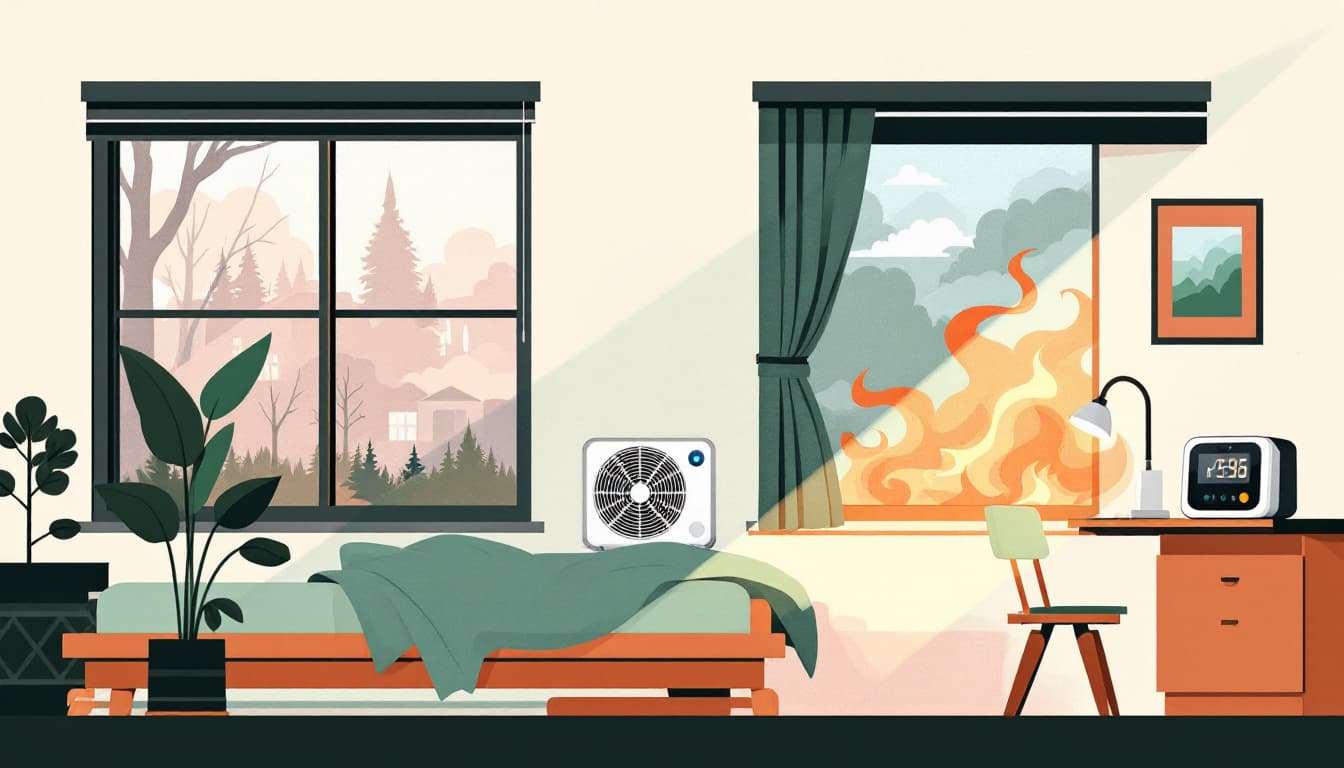
On a June morning in the Inland Empire, the San Gabriel and San Bernardino mountain ranges disappear behind a gray-orange haze you can taste. A Patch report this week documented deteriorating air quality across the region as the Shore Fire pushed smoke over communities in Riverside and San Bernardino counties. The South Coast Air Quality Management District issued elevated-pollution advisories. For residents already dealing with summer heat, the compound problem — close windows against smoke or open them against the heat — is not a theoretical one.
What's actually changing
California's fire season no longer follows the old calendar. Fires that would historically have been a September and October concern are now igniting in June, when vegetation is dry but marine layer moisture hasn't fully retreated. The Inland Empire is particularly exposed: prevailing winds during Santa Ana and Diablo patterns push combustion products directly into densely populated valleys. The IE's geography acts as a bowl, trapping particulate matter at ground level where people breathe it.
The specific hazard in wildfire smoke is fine particulate matter — particles smaller than 2.5 microns, called PM2.5 — which bypasses the nose and throat and reaches lung tissue directly. CARB, California's air resources board, maintains a real-time map at AirNow.gov that shows PM2.5 readings by ZIP code. During the Shore Fire event, multiple IE monitoring stations recorded readings in the "Unhealthy" range. Children, older adults, and anyone with asthma or cardiovascular disease face the greatest risk, but sustained exposure at those levels affects healthy adults too.
The secondary issue is duration. A single bad air day is manageable. A week of smoke — which is increasingly normal during active fire periods — requires a household infrastructure response, not just a "stay inside" instinct.
What we'd actually do
Check AirNow before you open anything in the morning. Bookmark AirNow.gov or install the EPA's AirNow app; it pulls from CARB monitoring stations and updates hourly. Before you open windows, run the dishwasher, or let kids outside, look at the current AQI for your specific ZIP code, not the regional average. The Inland Empire spans a large area with significant variation between valleys and foothill communities.
Build a clean room in your home, not a clean house. Trying to filter your entire home during a smoke event is expensive and usually ineffective. Instead, identify one room — ideally with fewer windows and doors — and concentrate your filtration there. A box fan with a MERV-13 or higher furnace filter taped to the intake side, sometimes called a Corsi-Rosenthal box, costs under $40 to build and measurably reduces PM2.5 in a single room. California households should have the materials on hand before fire season peaks, not during it.
Stock N95s specifically, not fabric masks. Surgical masks and cloth masks do not filter PM2.5. N95 respirators, when properly fitted, do. NIOSH-approved N95s are available at most hardware stores for roughly $1-2 per mask. Keep a box in your household supply. If you need to drive somewhere, run an errand, or evacuate during a smoke event, you want these available without a last-minute hardware store run during a regional emergency when shelves are empty.
Know your HVAC system's filter rating. Most home HVAC systems ship with MERV-8 filters, which are designed to protect the equipment, not your lungs. During smoke events, a MERV-13 filter in your HVAC return — if your system can handle the increased resistance — will meaningfully reduce indoor PM2.5. Check your system's documentation or call an HVAC tech. If your system can't support MERV-13, that's useful information to have now rather than in October.
Register for SoCal county emergency alerts if you haven't. Riverside County uses Alert RivCo; San Bernardino County uses Aware & Prepare. Both systems send evacuation orders, air quality emergencies, and shelter-in-place notices by text and email. Registration is free and takes three minutes. During fast-moving events like the Shore Fire, these systems are how official information reaches you before social media rumors do.
The bigger picture
The Inland Empire is one of the fastest-growing regions in California, and much of that growth has pushed residential development into the wildland-urban interface — exactly where fire and smoke exposure is highest. That's a land-use and policy question beyond the scope of a household preparedness site. What households can control is their interior environment, their information sources, and their supply margins.
The goal is not to live in fear of every smoke plume. It's to have already made the decisions — the clean room, the N95s, the alert registrations — so that when a Patch report drops on a Tuesday morning about deteriorating air quality, your family's response is calm and practiced rather than improvised.
Durability is built before the event.