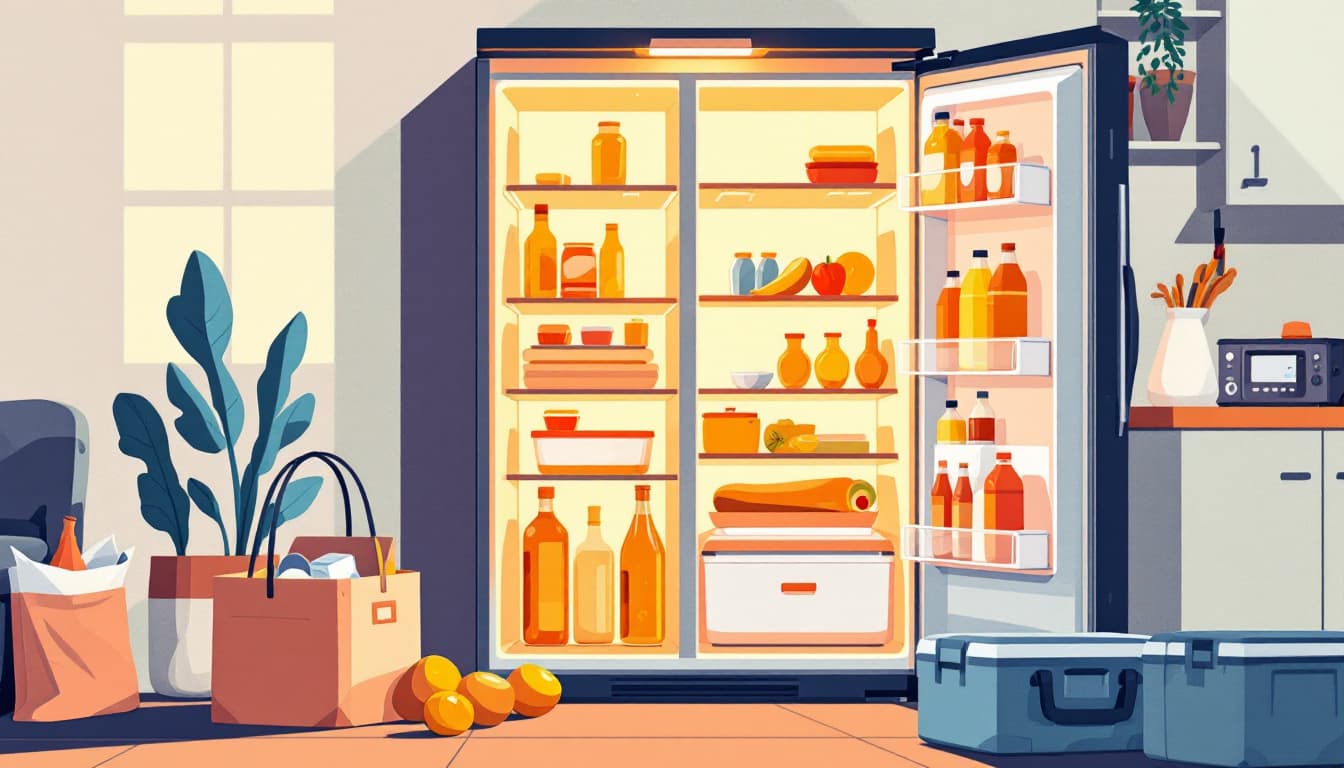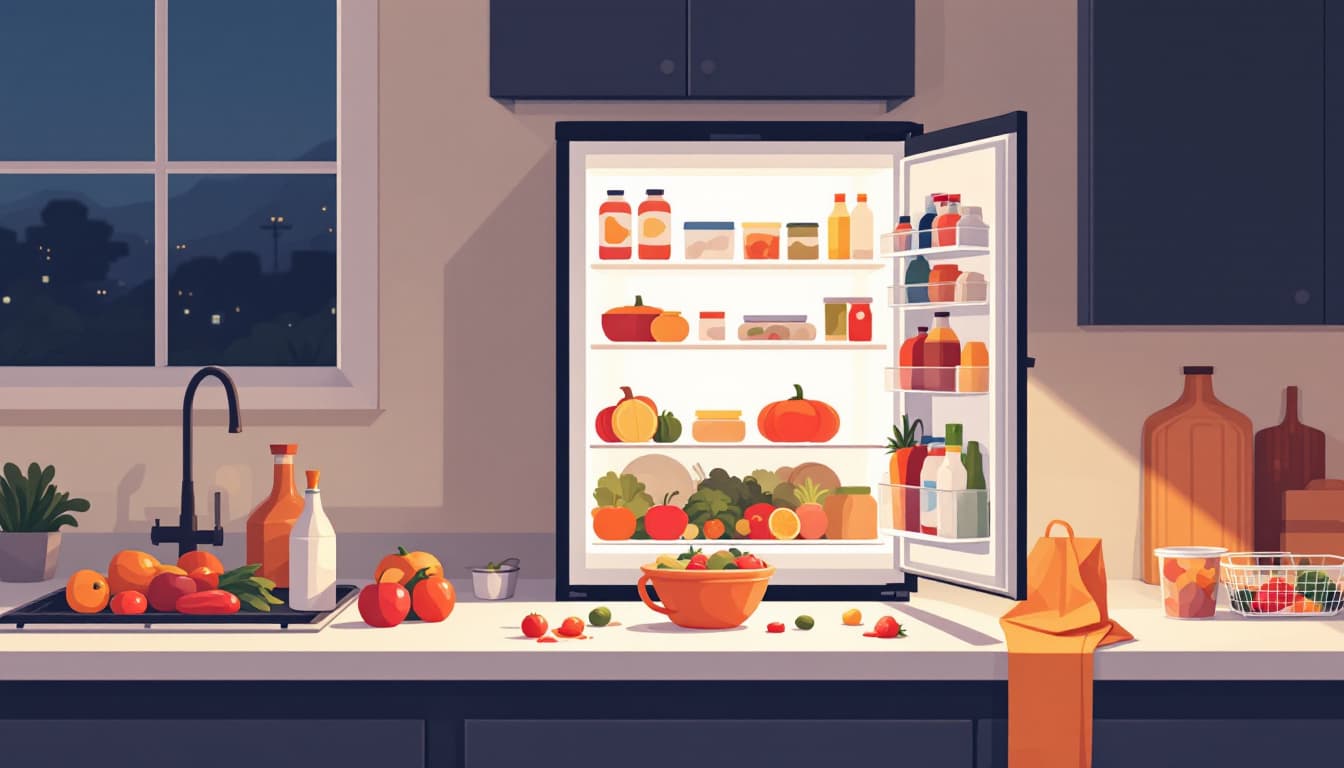
At 2 a.m. on a Tuesday, a capacitor relay on a 9-year-old refrigerator compressor quietly burns out. By 7 a.m., when someone opens the door to grab milk, the interior is already 50°F and climbing. By noon, when the appliance repair company finally picks up the phone, it is 58°F. The repair technician arrives Thursday morning.
This is not a disaster story. It happens in hundreds of thousands of American households every year. It is also, for many families, one of the most expensive single food events they will ever experience — and almost no one has thought about it in advance.
The numbers are not small
The average American household spends roughly $1,000 to $1,200 per month on groceries, according to recent BLS consumer expenditure data. A well-stocked refrigerator and freezer at any given moment typically holds two to three weeks of food in various stages of use — call it $300 to $600 in perishable inventory.
The FDA's safe temperature guidance is clear: refrigerator contents are at risk after four hours above 40°F, and most perishables — meat, dairy, cooked leftovers, opened condiments, eggs — should be discarded after that window closes if the cause of the temperature rise is unknown or prolonged. A freezer holding at 0°F can stay safe for 24 to 48 hours if kept closed, but a failed compressor often means the freezer is warming too.
Run the math on a realistic household: two pounds of ground beef, a dozen eggs, a quart of milk, leftover rotisserie chicken, deli meat, an open block of cheese, yogurt containers, a bag of frozen shrimp, half a dozen homemade freezer meals. We are easily talking $120 to $200 in food that is now a health question, not a meal plan. Add a full chest freezer in the garage — something roughly a third of American households own, according to appliance industry surveys — and a slow failure over 36 hours while the family is traveling could mean $400 or more.
Why people underweight this
Preparedness culture has a strong bias toward low-probability, high-drama events. People buy generators to survive hurricanes. They stock three weeks of shelf-stable food for grid failures. These are not irrational preparations, but they absorb planning attention that the quieter, higher-frequency risks do not get.
Appliance failures are mundane. They do not feel like "emergencies" worthy of a preparedness framework. They happen in the middle of ordinary weeks, and the response — panicked calls to the repair company, a frantic afternoon moving things to a neighbor's freezer, a garbage bag of thawed meat — feels like bad luck rather than a solvable problem.
But the frequency changes the calculus. The average compressor lifespan is roughly 10 to 15 years. In a 30-year stretch of homeownership, a household will likely cycle through two or three refrigerators, and compressor or sealed-system failures are the leading cause of complete unit death. The chance of experiencing at least one significant cold-chain failure in that window is not a tail risk. It is close to a certainty.
The structural gap
The interesting thing is that the fix is not expensive or complicated — it is just unthought. A refrigerator thermometer that logs temperature over time (available for under $20) gives you a data trail for an insurance claim and tells you exactly how long the unit was warm, which is the difference between "throw everything out" and "the freezer held and the produce is fine." Many homeowners' and renters' insurance policies cover food spoilage from a mechanical breakdown — but the coverage limit, typically $250 to $500, often requires documentation of the temperature event. Without a thermometer, you have no claim.
A secondary cold-storage plan — knowing which neighbor has freezer space, or whether your building has a communal chest freezer, or whether your camping cooler and a $10 bag of ice can hold your most expensive proteins for 24 hours — is worth thirty minutes of thinking you will never have to spend in a panic.
This is the category of risk that sits at the intersection of "happens to almost everyone" and "almost no one has a plan." It is not glamorous. It does not appear in preparedness books. It does not sell freeze-dried meals or tactical gear.
The bigger pattern
The refrigerator problem is a useful lens because it illustrates something that is broadly true about household resilience: the risks most worth planning for are not the ones that feel most dramatic. A realistic household risk inventory would weight job disruption, appliance failure, a minor medical event, and a single supply chain gap in a specific category of food you depend on far more heavily than most of the scenarios that dominate preparedness media.
Slow-leak risks are underweighted precisely because they are not frightening enough to trigger the limbic-system alarm that motivates action. The response to "your refrigerator will probably fail once in your adult life and cost you several hundred dollars" is not fear — it is a vague sense that you should do something about that sometime.
Sometime is usually never. A thermometer in the fridge costs less than one bag of groceries. If you want to run through how much of your food budget is currently sitting in perishable inventory versus shelf-stable storage, our water and food calculator can help you think through the proportions.