On a typical August morning in the western Piedmont or the mountains around Asheville, you can smell it before you see it — a low, woody haze sitting over the ridge line. It used to mean a neighbor was burning brush. Increasingly, it means smoke has traveled hundreds of miles from fires in the Southeast or even the West.
A report this week from North Carolina Health News walked through what state residents should know about smoke exposure and indoor air quality. The piece covered health basics, but it stopped short of the household-level question most families actually face: once smoke is outside, how well does your home actually block it?
The honest answer is: not as well as you're assuming.
What's actually changing
North Carolina is not a wildfire state in the way that California or New Mexico is. But that framing is becoming less useful. The state has seen its own fire seasons intensify in the Blue Ridge and the Uwharrie National Forest, and smoke from larger fires to the south and west now pushes into Charlotte, the Triangle, and the coastal plain with regularity. EPA AirNow data has logged unhealthy air quality days in North Carolina during summer months that would have been unusual a decade ago.
The indoor problem is specific. Modern homes — especially older stock, rentals, and houses with crawl spaces common to much of rural NC — exchange air with the outside constantly. Window frames settle, HVAC systems pull unfiltered air through return ducts, and bathroom exhaust fans create negative pressure that draws outdoor air through gaps. When smoke is outside at an AQI of 150 or above, being "inside" offers real but limited protection unless you've done something intentional about it.
HVAC filters are the biggest gap. A standard fiberglass filter, rated MERV 4 to 6, does almost nothing for the fine particles (PM2.5) that make wildfire smoke dangerous. A MERV 13 filter — which fits most standard residential systems — captures the majority of those particles. Most NC homeowners have never checked their filter rating.
Portable air purifiers with true HEPA filtration can clean the air in a single room to near-outdoor-ambient levels within 20 to 30 minutes. The math on room coverage matters: a unit rated for 200 square feet run in a 400-square-foot room works much harder and less effectively than the same unit in the right-sized space.
What we'd actually do
Check your HVAC filter rating this week. Pull the filter out and look for the MERV number printed on the cardboard frame. If it says MERV 4 to 8, swap it for a MERV 13. At most hardware stores across NC — Lowe's (headquartered in Mooresville), Home Depot, Ace — a MERV 13 filter runs $15 to $25. Note that a higher-rated filter creates more airflow resistance, so if your system is older or your ducts are narrow, run it and listen for the system straining. Most modern residential systems handle MERV 13 without issue.
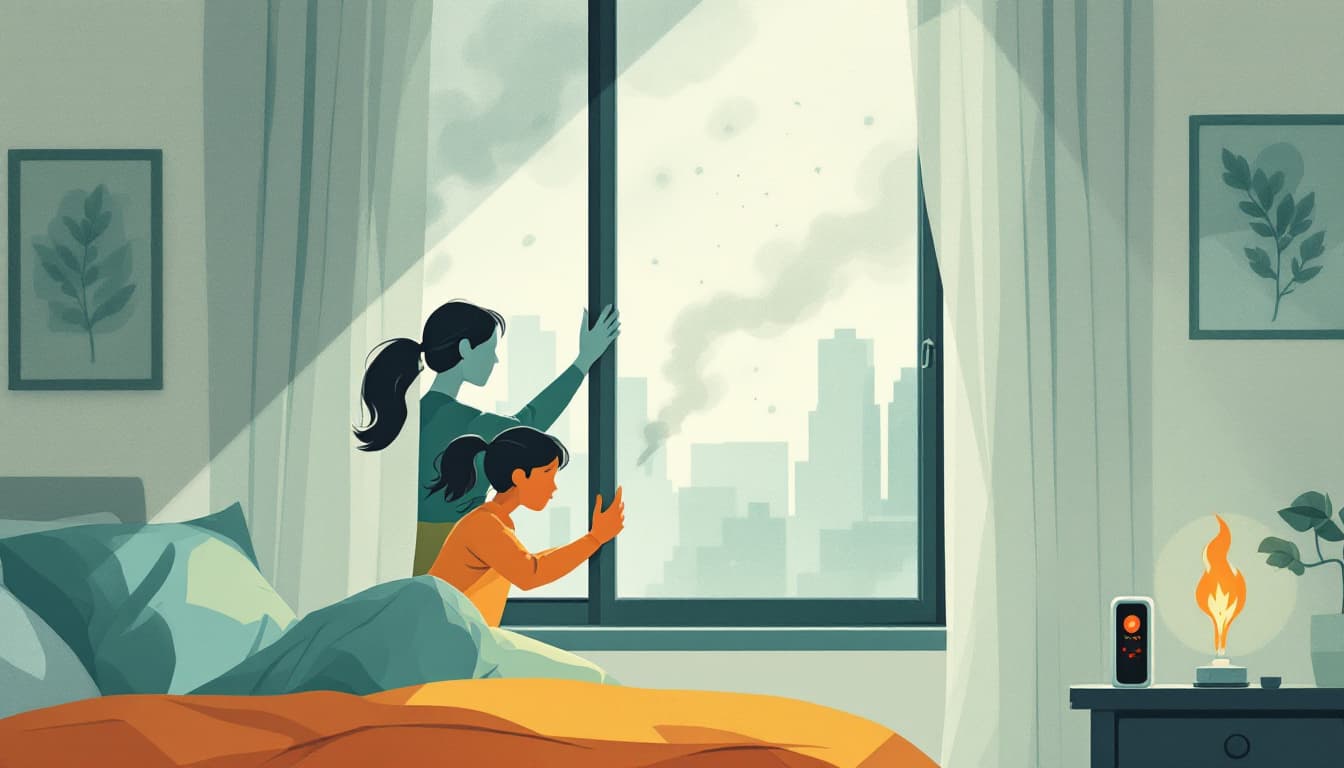
Designate one room as your clean-air room. Pick the room where your household spends the most time during a smoke event — often a bedroom or main living area. Run a HEPA purifier there, keep the door closed, and use that room as the default during high-AQI days. You don't need to purify the whole house. You need one reliably clean space. This matters especially for households with children, the elderly, or anyone with asthma — all populations that NC Health News has flagged as higher-risk during smoke events.
Download AirNow and set a location alert for your county. The EPA's AirNow app is free, pulls real-time monitoring data, and lets you set alerts when AQI crosses a threshold you define. For most NC households, setting an alert at AQI 100 (Unhealthy for Sensitive Groups) gives you a few hours' lead time to close windows and get the purifier running before conditions peak. The nearest monitor to your home matters — check whether your county has a monitor or whether the app is interpolating from a station 40 miles away. In rural western NC, that gap can be significant.
Seal the low-hanging gaps. A $5 roll of foam weatherstripping applied to the worst-fitting windows in your clean-air room makes a measurable difference in particle infiltration. You don't need to weatherize the whole house. Focus on one room. The gap under an interior door can also be sealed with a simple door sweep or even a rolled towel during active smoke events.
Keep N95 masks accessible at home, not just in your car. If you need to go outside during a high-smoke day — to let the dog out, check the mail, deal with an emergency — an N95 rated respirator filters PM2.5 effectively. Surgical masks and cloth masks do not. Store a small supply somewhere accessible in the house, not buried in a go-bag.
The bigger picture
North Carolina households have spent decades not thinking much about air quality as a preparedness variable. That's a reasonable response to the conditions that existed. The conditions are shifting. This isn't about stocking a bunker or buying a $1,200 whole-home air filtration system. It's about a $25 filter swap and a free app. The families who handle disruption well are usually the ones who made small, boring improvements before the smoke showed up.
Durability looks like this: you wake up to a hazy orange morning over the Piedmont, you check the app, you close the windows, you turn on the purifier, and you get on with your day.