Jordan Lake's surface elevation has been dropping for weeks. If you live in Cary, Apex, or anywhere else that draws from that reservoir, you've likely seen the outdoor watering restrictions. A report this week from CBS17.com confirmed what many Triangle residents already sense: extreme drought is entrenched across central North Carolina, and meaningful precipitation relief isn't on the near-term forecast.
This isn't a crisis article. It's a planning article. The difference matters.
What's actually changing
North Carolina sits inside a drought classification system managed by the U.S. Drought Monitor. "Extreme drought" — the D3 designation — means topsoil moisture is severely depleted, stream flows are well below normal, and reservoir levels are under stress. Central NC counties, including much of the Piedmont, are currently in that range.
For urban households on municipal water, the immediate risk isn't your tap running dry. It's a cascade of smaller pressures: mandatory conservation stages, outdoor watering bans, potential surcharges for heavy use, and reduced pressure during peak demand hours. For households on private wells — common in Johnston, Chatham, Harnett, and rural Lee counties — the risk is more direct. Shallow wells can fail during sustained D3 or D4 conditions.
The secondary pressure is food. The NC Department of Agriculture tracks drought impacts on the state's produce sector, and the Piedmont's truck farms and berry operations are under stress right now. That will show up in local farmers market prices and, with a lag, in grocery store produce sections by late summer.
None of this is catastrophic. All of it is worth managing proactively.
What we'd actually do
Check your municipality's current drought stage and know what Stage 2 or Stage 3 restrictions would actually prohibit.
Most Triangle-area water utilities — Raleigh, Durham, OWASA, the Town of Cary — publish their drought contingency plans online. Stage 2 typically bans outdoor irrigation except for food gardens. Stage 3 can restrict car washing, decorative fountains, and new landscaping. Pull up your utility's plan now, before the restrictions tighten, so you're not caught mid-project.
Fill a modest emergency water supply this weekend — not a bunker's worth, a week's worth.
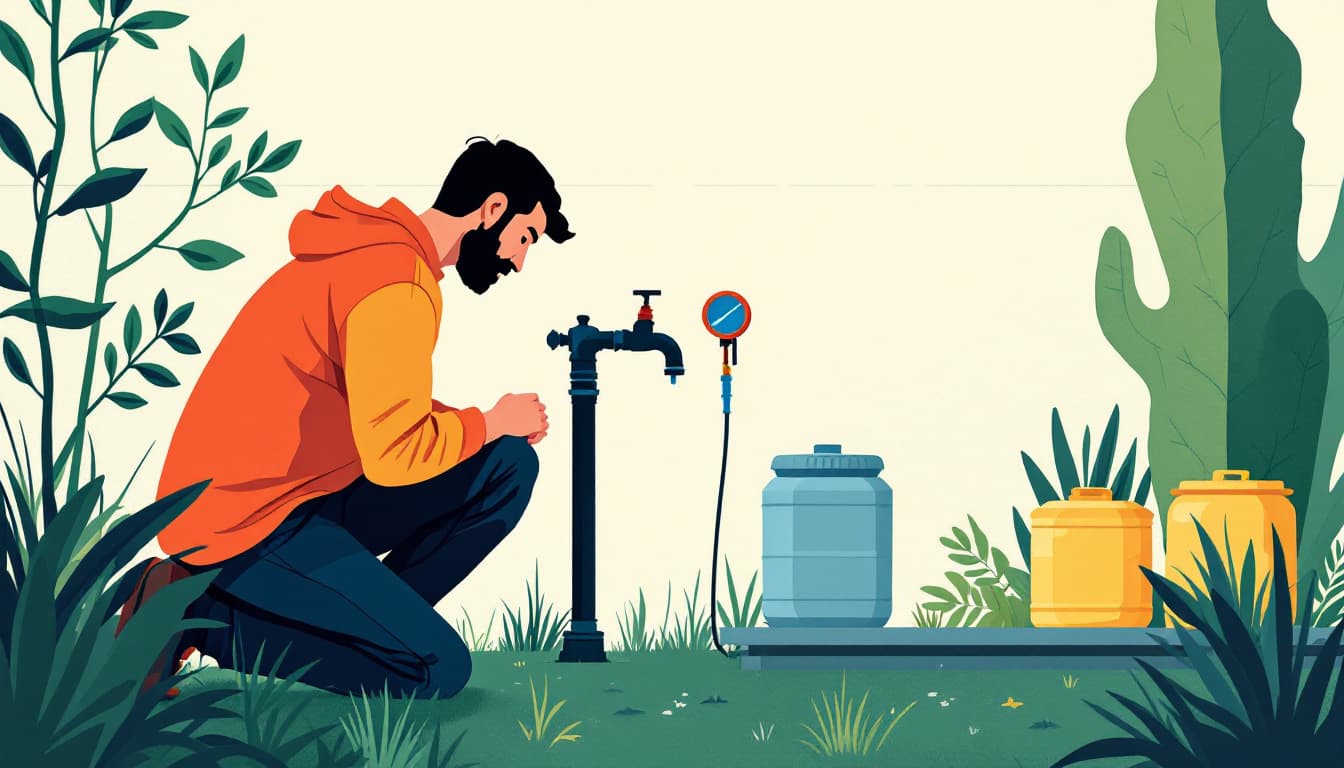
FEMA and the NC Division of Emergency Management both recommend one gallon per person per day as a baseline. For a family of four, that's 28 gallons for a week. That fits in a stack of food-grade 7-gallon containers from any sporting goods or hardware store, costs around $30-$40, and stores in a garage or closet. If municipal pressure drops during a Stage 3 event or a pump failure, you have a buffer. This isn't doomsday prep; it's the same logic as keeping a spare tire.
If you're on a private well, have it tested and ask your driller for the static water level on record.
Well drillers in NC are required to file completion reports with the NC Division of Water Resources. You can request your well's record through their online database. Knowing whether your well is 40 feet deep or 200 feet deep tells you whether this drought is a real near-term threat or mostly irrelevant to your situation. If you're shallow and the drought deepens, discuss options with a licensed well contractor before you're calling them in an emergency.
Audit your household's actual daily water use before any restrictions force your hand.
The average NC household uses somewhere in the range of 60-80 gallons per person per day according to utility benchmarks. Cutting that by 20% isn't hardship — it's shorter showers, full dishwasher loads, and not running the hose on the driveway. Knowing your baseline means you can hit any mandated conservation target without scrambling.
Plant or protect food garden water efficiency now, not when the ban hits.
Drip irrigation and mulching can cut garden water use by 30-50% compared to overhead sprinklers. Both are available at any hardware store. NC Cooperative Extension has county-specific guides for Piedmont water-wise gardening. If you have a summer vegetable plot, this is the week to switch delivery methods, not the week your utility announces a ban on sprinkler use.
The bigger picture
Drought cycles in the Southeast aren't new — the Piedmont saw serious D3 and D4 conditions during 2007-2008 and again during parts of the 2010s. What's changed is the rate at which the Triangle's population draws on the same water infrastructure. More people, same reservoirs.
The goal of household resilience isn't to survive an apocalypse. It's to not be the family calling 311 in a panic because you didn't plan for a dry summer in a state that regularly has dry summers. A week of stored water, a utility policy you've actually read, and a drip line on your tomatoes puts you in a fundamentally different position than the household that did none of those things.
That's a manageable gap to close, and it closes this weekend.