A hot Sunday afternoon in the San Fernando Valley. The AC shuts off mid-cycle. The router goes dark. You reach for your phone to check whether it's your circuit breaker or a neighborhood-wide event — and you have no idea where to look.
A report this week from eciks.org reminded Los Angeles residents that LADWP maintains a real-time outage map at ladwp.com, where you can see active outages by address and get rough restoration estimates. That's genuinely useful. What the article doesn't cover is what to do in the 90 minutes before restoration estimates are posted, or the 18 hours after they slip.
What's actually changing in LA's grid
Southern California's grid is under compounding stress. LADWP serves roughly 1.5 million customer accounts across a service territory that runs from the harbor to the mountains — and that territory increasingly faces heat events, Santa Ana wind conditions, and wildfire-related Public Safety Power Shutoffs (PSPS) in the same seasons. The California ISO has flagged summer grid reliability as a recurring concern in its annual assessments. LADWP has its own infrastructure aging challenges separate from the state-managed transmission system.
None of this means the lights are about to go out permanently. It means the question is no longer whether your household will experience a multi-hour outage but how often, in which seasons, and whether you're ready for it.
The gap most households fall into: they know the LADWP map exists but have done nothing with that knowledge before the outage starts. Checking a map with a dying phone battery, in a house with no flashlights, next to a refrigerator that's been warm for four hours, is not a plan.
What we'd actually do
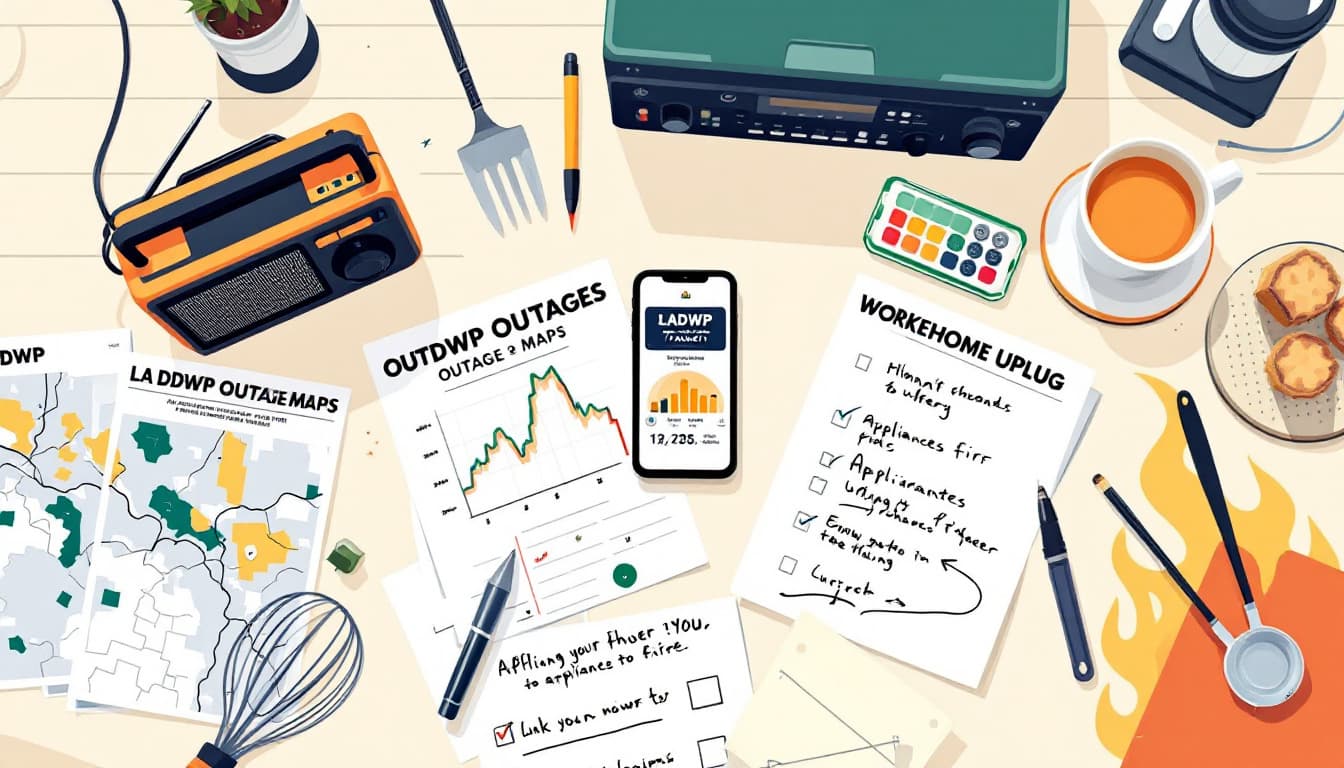
Sign up for LADWP outage alerts before you need them. LADWP allows customers to register for text and email notifications tied to their account address. This takes about three minutes on the LADWP website. When an outage hits your area, you get a message rather than discovering it when the coffee maker stops mid-brew. The alert also includes early restoration estimates that don't show up on the public map immediately.
When you're not scrambling in the dark, walk through ladwp.com and save the outage map URL as a home-screen shortcut on your phone. Small friction reduction matters when your stress is high and your battery is at 22 percent.
Know the PSPS distinction. A standard equipment failure restores in two to eight hours in most LADWP incidents. A Public Safety Power Shutoff — called during extreme fire-weather conditions — can run 24 to 72 hours or longer. They are announced in advance. Sign up for the Los Angeles Emergency Management Department's Notify LA system (emergency.lacity.gov) separately from LADWP alerts; these two systems do not automatically overlap. If you live in a hillside, canyon, or brush-adjacent neighborhood in LA County, PSPS is a specific, named risk you should plan for explicitly.
Put a 72-hour food plan in writing. The FDA guideline is that a full, unopened refrigerator holds safe temperature for about four hours; a chest freezer for 24 to 48 hours depending on how full it is. Write those numbers on a sticky note on your fridge. During an outage, the decision rule is: stop opening the fridge, monitor elapsed time, and cook or move perishables at the four-hour mark if power hasn't returned. This is not about stockpiling. It's about having a decision in place before you're tired and hot and tempted to just check if the chicken is still cold.
Buy one thing under $40. A battery-powered or hand-crank LED lantern covers the most common household failure point during outages — navigating the house safely after dark. This is not a prepper flex. It is a $25 purchase that prevents a fall down a dark staircase. If you already have one, test it this week.
If you depend on powered medical equipment, register now. LADWP and LA County both maintain Medical Baseline and life-support customer registries that prioritize restoration and provide advance PSPS notice. If anyone in your household uses a CPAP, home oxygen, dialysis equipment, or any other electrically dependent medical device, registration is free and takes one call. The number is on the LADWP website under "Medical Baseline Program."
The bigger picture
Los Angeles isn't uniquely fragile, but it isn't uniquely resilient either. The grid is large, aging in patches, and increasingly tested by weather events that didn't drive planning assumptions 30 years ago. The goal isn't to build a bunker against blackouts. It's to reach the 95th percentile of readiness — the point where most outages become inconveniences rather than emergencies — with a few hours of preparation and no major purchases.
The LADWP map is a good tool. A household that knows how to use it, has alerts configured, understands the PSPS system, and has a written food-safety plan is materially better off than one that doesn't. That's a low bar. Clear it now, before June heat arrives in the Valley.