A News4JAX report this month captured something worth paying attention to: water officials fielding viewer questions about drought restrictions and spending their airtime explaining what isn't driving them. Data centers didn't cause this. New housing developments didn't either. Officials were essentially clearing the air around convenient scapegoats.
That's a signal. When public officials have to get in front of cameras to redirect blame away from visible, politically charged targets, it usually means the real cause is less satisfying — slower, harder to point at, and less likely to be fixed by stopping construction on the edge of town.
What's actually changing
Drought restrictions in Florida and other parts of the Southeast have historically been short-cycle events: a dry spring, a usage ban, a wet summer, back to normal. What's shifting is the duration and the baseline. Aquifer recharge rates — the speed at which groundwater replenishes after use — depend on rainfall patterns that have been less reliable across the region for several years running. When officials rule out discrete culprits like data centers, what remains is diffuse: less average precipitation over longer periods, increased residential demand from population growth spread across many small users, and aging distribution infrastructure that loses water before it ever reaches a tap.
None of that makes for a satisfying villain. And none of it gets resolved by a single policy decision.
The household implication is straightforward: water restrictions are becoming a recurring feature of life in parts of the Sun Belt and Southeast, not an anomaly. Families who treat each restriction as a temporary inconvenience and go back to normal habits once it lifts will face this cycle repeatedly — with escalating fines and, eventually, mandatory rationing that isn't optional.
What we'd actually do
Audit your outdoor water use first. Outdoor irrigation accounts for the majority of residential water consumption in warm climates, and it's the first target of any restriction order. Walk your irrigation timer settings this week. Most systems set up during wetter years are still running on those schedules. Cut run times by 25% and observe whether your lawn actually suffers — in most cases, it won't.
Lawn irrigation is the single highest-leverage change most households can make. Turf grass in a drought-stressed region is an expensive habit. You don't have to rip it out, but running the system every other day instead of daily, or shifting to early-morning cycles that reduce evaporation, can cut outdoor consumption meaningfully with no infrastructure investment.
Know your utility's restriction tiers before you hit them. Most water utilities publish their drought response plans online, including what triggers each restriction stage and what the fines are. Find yours now. Stage 1 restrictions are voluntary; by Stage 3, violations carry real penalties. Knowing the thresholds means you can adjust ahead of enforcement rather than after a notice.
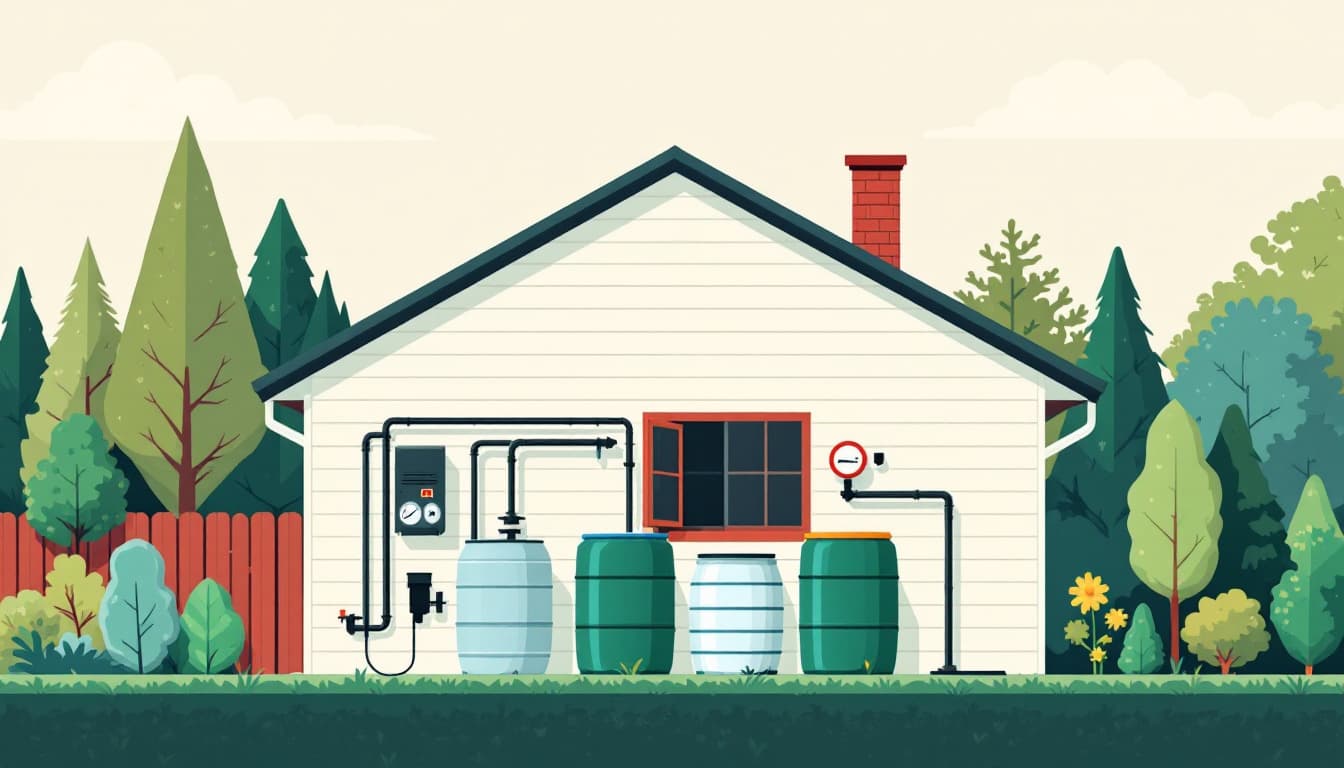
Install at least one water barrel or cistern for outdoor use. A 50-gallon rain barrel at a downspout costs $30–$80 and captures enough runoff from a single moderate rain event to water a container garden or flower beds for weeks. It won't replace municipal supply, but it insulates your outdoor plants from restriction orders and costs nothing to operate. Check local ordinances first — a small number of municipalities still restrict rainwater collection, though most have moved away from that.
Have a three-day stored water supply inside the house. FEMA's baseline guidance of one gallon per person per day for three days is the floor, not the goal. A family of four needs at minimum 12 gallons on hand for drinking and basic hygiene. Fill clean containers from the tap and rotate them every six months. This has nothing to do with doomsday scenarios — it addresses the real and recurring possibility of a boil-water notice, a main break, or a pressure-loss event during peak summer demand.
The bigger picture
Water is the preparedness issue that most middle-class families underestimate because it has always come out of the tap. The drought cycle now visible across parts of Florida and the broader Southeast is a preview of what long-term household resilience actually requires: not bunkers or bulk food, but durable habits around the resources that are quietly becoming less guaranteed.
The officials interviewed by News4JAX were doing something useful by correcting misinformation. The more useful follow-on question — what does this mean for my water bill and my lawn in five years — doesn't get answered on the evening news. That one's on us.