A report this week from bendbulletin.com confirmed what anyone who's been watching the weather already suspected: fires are growing in Central Oregon, and the State Fire Marshal has issued an emergency declaration. Emergency declarations at the state level aren't symbolic. They unlock mutual aid agreements, allow out-of-state crews to enter under coordinated command, and can fast-track resource deployment to counties that are already stretched.
That matters to households in Deschutes, Crook, Jefferson, and Klamath counties right now — and it matters to the Willamette Valley too, where smoke from east-of-the-Cascades fires has historically pushed air quality into hazardous territory within 24 to 48 hours of ignition.
What this declaration actually changes
Oregon's fire emergency activation isn't the same as an evacuation order. Most households in affected areas won't be told to leave — not yet, and possibly not at all. But the declaration signals that state and local agencies believe current resources are insufficient for current fire behavior. That's the part worth sitting with.
ODF and local fire districts will be coordinating closely with the Oregon Office of State Fire Marshal. Evacuation level systems in Oregon use a three-level structure: Level 1 is "Be Ready," Level 2 is "Be Set," Level 3 is "Go Now." If you live in a rural or wildland-urban interface area and you haven't registered with your county's emergency alert system, you may not receive those notifications at all.
Smoke, even at Level 1 conditions, creates real respiratory risk. Recent summers have pushed Central Oregon's Air Quality Index well past the 150 threshold that triggers health advisories for healthy adults — not just for people with asthma or heart conditions.
What we'd actually do
Register for your county's emergency alerts today, not when smoke is already in the air. Deschutes County uses AlertSense, Klamath County uses Nixle, and Jefferson County uses a system through the county sheriff's office. None of them auto-enroll you based on your address. You have to opt in. This takes under five minutes. If you rent, register anyway — renters are just as exposed and are frequently left out of neighbor-to-neighbor alert chains.
Write down your evacuation route and a second one. Highway 97 and Highway 20 are the primary corridors out of Central Oregon during emergencies. Both have historically bottlenecked during large evacuations. Know which county roads can get you north to Warm Springs, south toward Klamath Falls, or west over McKenzie Pass if Highway 20 is congested. Don't rely on Google Maps — cell service degrades quickly when an area is actively evacuating and towers are loaded.
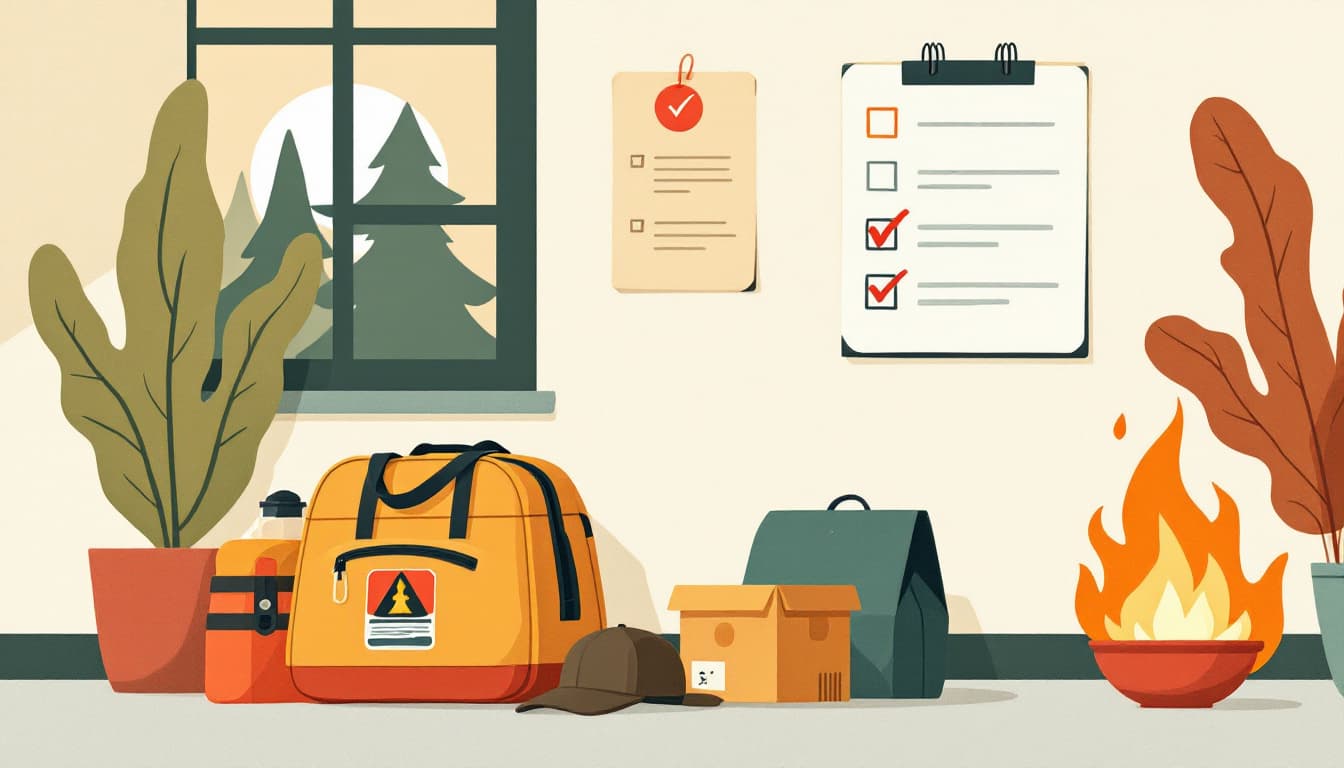
Locate and pack your go-bag in the next 48 hours, not the next month. A usable go-bag for a family of four weighs under 30 pounds and fits in a large backpack or one duffel. The honest list: three days of medication, copies of insurance and ID documents (paper and a USB drive), $200 in small bills, a change of clothes per person, a phone charger, and water for 24 hours. Most households already own 90% of this — the gap is that it isn't assembled in one place.
Pick up two N95 masks per household member before smoke arrives. Once AQI goes above 150 in the Bend area, local hardware stores sell out within hours. Oregon households in fire-adjacent zones should treat N95s as a seasonal staple alongside smoke detectors, not as emergency gear you scramble for. A box of ten costs under $20 at most hardware stores when supply is normal.
Check your renters or homeowners policy for wildfire and smoke damage coverage. Oregon's Department of Consumer and Business Services has published guidance on what standard policies typically cover after wildfire-related smoke and ash damage. Many households discover after the fact that smoke damage inside a home is covered differently than structural fire damage. A 15-minute call to your insurer before fire season peaks is worth more than any gear purchase.
The bigger picture
Central Oregon burns. That's not a new story — the high desert east of the Cascades has always been fire-adapted terrain. What's shifted is fire behavior: faster spread, longer seasons, more simultaneous ignitions that strain mutual aid systems. The Fire Marshal's emergency declaration is a bureaucratic tool designed for exactly this kind of pressure.
The goal for your household isn't to live in fear of a catastrophic scenario. It's to close the small, fixable gaps — the county alert system you haven't registered for, the go-bag that exists in theory, the evacuation route you've never actually driven. Durable households don't wait for Level 3. They use Level 1 as a reminder that the work is supposed to be done already.