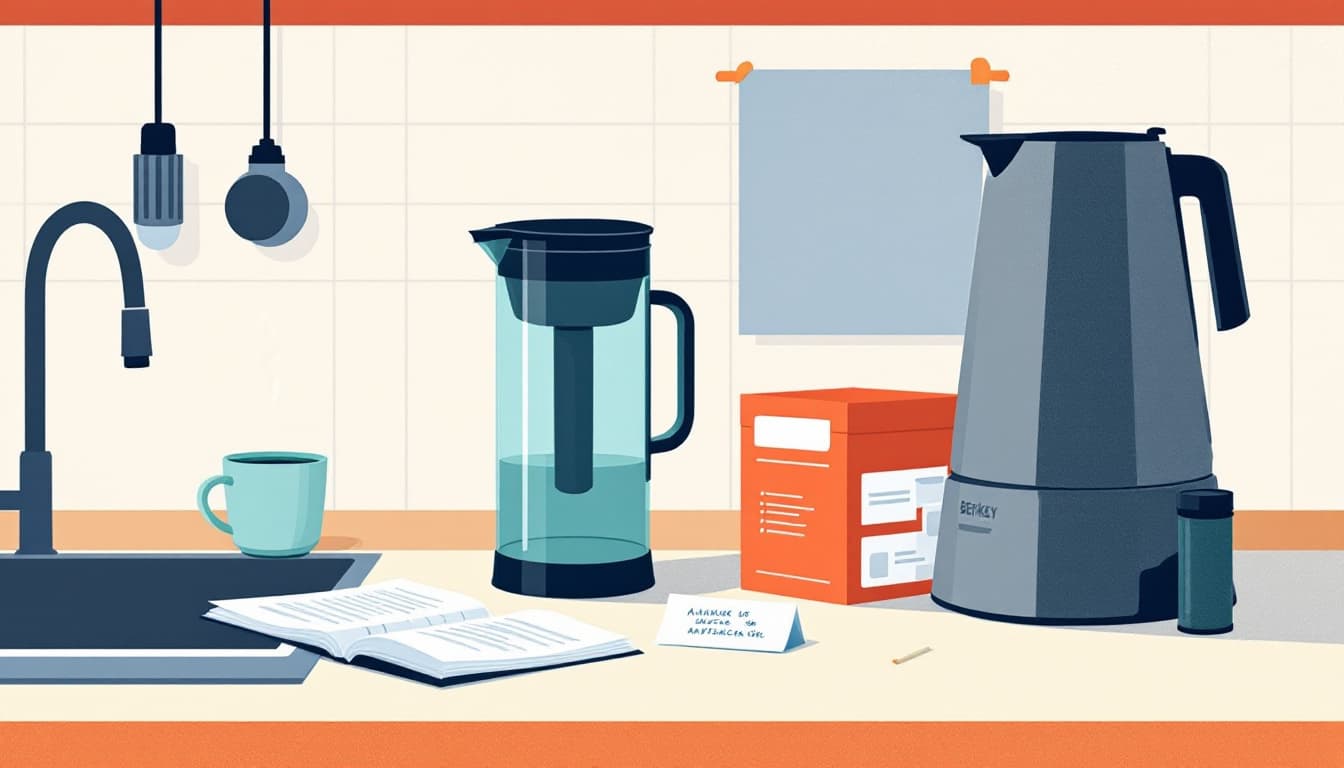
For roughly the last decade, the Big Berkey was the consensus answer when households asked "what's the best water filter to buy?" Preparedness sites recommended it. Off-grid YouTubers tested it. The gravity-fed countertop design — half a million gallons of filter life per pair of Black Berkey elements, no plumbing, no power — made it the default for households thinking about water resilience.
For the last two years, you mostly haven't been able to buy one. And the editorial landscape is still adjusting to that fact.
What actually happened
In 2022, the EPA's pesticide office took the position that Berkey's Black Berkey filter elements should be regulated as pesticide devices under the Federal Insecticide, Fungicide, and Rodenticide Act, the federal statute that governs how pesticides are sold and labeled in the United States. The agency's reasoning hinged on the trace silver content embedded in the Black Berkey filter media, which serves as an antimicrobial agent inside the filter element. Under FIFRA, any product that makes pesticidal claims or contains active pesticidal ingredients can be classified as a pesticide device, which subjects it to a different set of registration, labeling, and reporting requirements than a normal consumer water filter.
By late 2022 and into early 2023, the EPA had issued Stop Sale, Use or Removal Orders — SSUROs in the agency's terminology — across the Berkey supply chain. New Millennium Concepts Ltd., the Texas company that owns the Berkey brand, paused production and filed a federal lawsuit against the EPA in August 2023, asking the court to throw out the pesticide-device classification.
The case has been slow. A federal district court dismissed it in 2024 on jurisdictional grounds, finding that NMCL had filed in the wrong venue. NMCL appealed, and the case is currently sitting before the Fifth Circuit Court of Appeals as of mid-2026. There is no settlement. There is no resolved classification. New Black Berkey filter elements are not being manufactured at scale. Some inventory still exists with third-party sellers, and the product appears intermittently on Amazon with murky pricing and questionable provenance.
What this means for households who already own a Berkey
If you have a Berkey unit and the elements were installed before the SSUROs, you have not been told to stop using it. The EPA action is against the sale of new units and replacement elements, not against ownership or use of units already in households. The filter elements themselves don't become unsafe; they continue to function for their rated capacity.
What this does mean is that when your existing Black Berkey elements eventually need replacement — six thousand gallons of filtered water per element, which for most households is many years out — you may not be able to buy replacements through normal channels. That's the household-level consequence to plan around.
What we'd do if we were buying today
Two years ago we would have recommended a Big Berkey to most households without much hesitation. Today the recommendation is different, and the editorial landscape reflects that. The Berkey-alternative roundups that dominate search results for "best gravity water filter" in 2026 lead with products that didn't have meaningful market share before the EPA action — Boroux Legacy, ProOne Big+, Santevia, Culligan MaxClear, Membrane Solutions Gravity Filter Pro. Several of these are legitimately good. Some are repackaged versions of older products that suddenly had an opening when the category leader went off the market.
The honest answer for households shopping today is that the category has gotten more confusing, not less, and that "buy the most-recommended product" is no longer a defensible shortcut. We are reworking our own water-filter review around this and will publish updated picks once we have hands-on time with the Boroux Legacy and ProOne Big+ — the two products that come up most often in serious testing.
For households that want a filter installed this week, the Sawyer Squeeze ($40) and the LifeStraw Personal ($20) are not gravity systems but they do filter water. They are not full substitutes for a Big Berkey, but they cover an emergency filtration scenario at one-tenth the price point. We'd buy a Sawyer today, keep our existing Berkey in service, and wait for the dust to settle on the EPA case before making a new gravity-system purchase.
The broader signal
The Berkey story is not really about water filters. It's about the regulatory risk that's quietly inside any preparedness purchase. Category-leader products that become household defaults attract regulatory attention — sometimes for good reasons, sometimes for bad ones — and a household that bought "the most-recommended option" can find itself locked into a product whose manufacturer is in protracted litigation.
The hedge against this isn't to avoid the category-leading products. It's to not stack a household's entire resilience plan on one brand. A household with one Berkey on the counter, one Sawyer in the go-bag, and a couple of LifeStraws in the cars is more resilient than a household with three of the same product — not just to physical disruption, but to the slow regulatory disruptions that don't show up in any "what to prep for" list until they do.