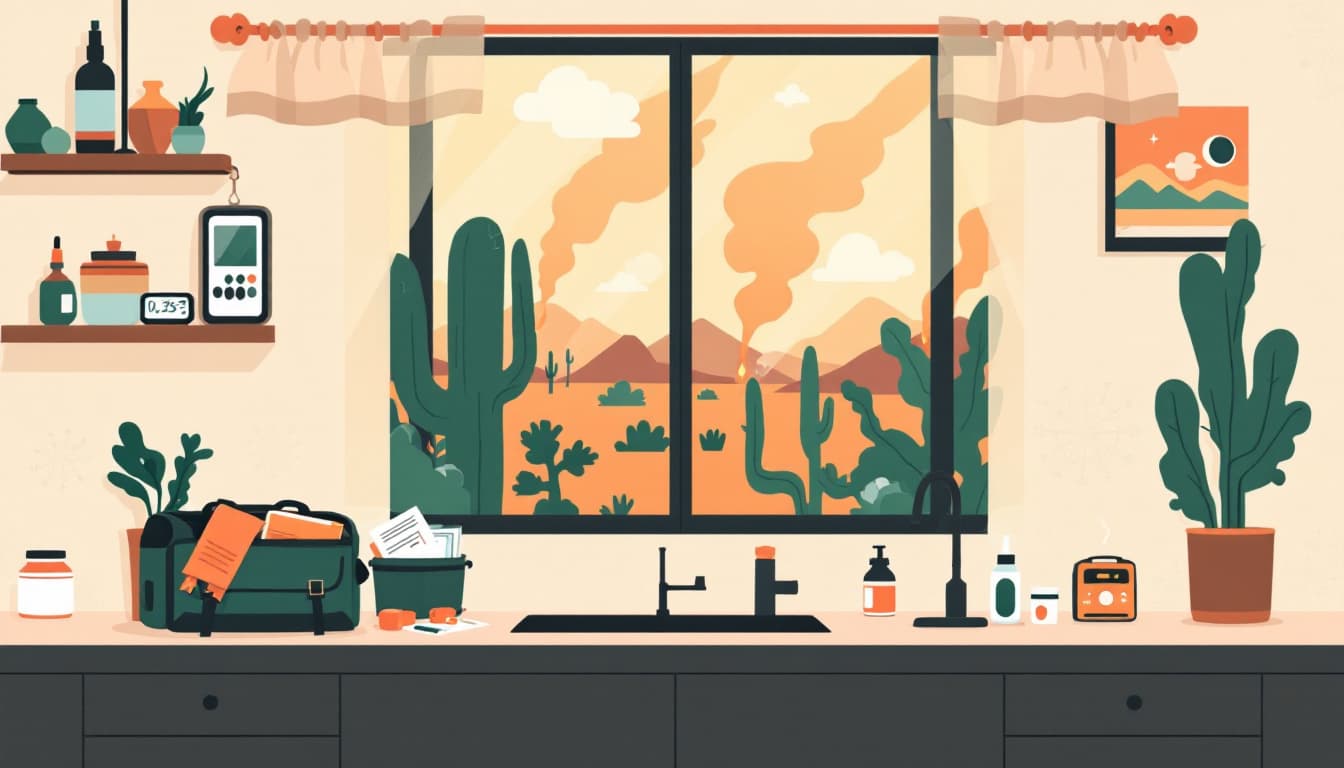
ABC15 Arizona is reporting active air quality alerts across the state this week, flagging a combination of ground-level ozone and drifting wildfire smoke. That pairing is worth paying attention to, because the two hazards are different in origin, different in chemistry, and require somewhat different household responses.
What's actually happening
Ozone alerts in Arizona are not unusual in summer. The Phoenix metro generates precursor pollutants — vehicle exhaust, industrial emissions — that bake into ground-level ozone under intense heat and sunlight. The Arizona Department of Environmental Quality (ADEQ) typically issues ozone action days from May through September, with the worst readings in the afternoon when the sun has had hours to work.
Wildfire smoke is a separate category. The fine particles (PM2.5) in smoke are small enough to penetrate deep into lung tissue, and they behave differently from ozone: smoke concentrations shift with wind, can spike overnight, and don't follow the predictable daytime peak that ozone does. In recent summers, smoke from fires in northern Arizona, New Mexico, and California has reached the Valley floor. When smoke and high ozone arrive together, ADEQ's Air Quality Flag program may show red or purple conditions — meaning the air is hazardous for sensitive groups at minimum, and unhealthy for everyone during extended outdoor exposure.
The monitoring tool matters here. The EPA's AirNow app pulls from Arizona's monitoring network and updates hourly. It also displays the AQI separately for ozone and PM2.5, which is useful: a red ozone day with a moderate PM2.5 reading calls for different behavior than the reverse.
What we'd actually do
Check AirNow before 7 a.m., not at noon. Ozone peaks in the afternoon, but wildfire smoke can be worst in the early morning when temperature inversions trap particles close to the ground. Looking at the forecast once daily misses this. Make the AirNow app a morning habit during summer months, and look at both the 24-hour PM2.5 reading and the ozone forecast separately.
Seal your home before it gets hot. Most Arizona households run the AC through summer, which provides meaningful filtration — but only if the house is reasonably sealed. On poor air quality days, close fresh-air intakes on HVAC systems if yours has a manual damper. Run the system on recirculate rather than fresh air. This is free and takes thirty seconds. Check door weatherstripping and window seals now; gaps that merely raise your electric bill in June become air quality problems when smoke is present.
Upgrade your HVAC filter before August. Standard fiberglass filters (MERV 1-4) do almost nothing for PM2.5. A MERV 13 filter will significantly reduce fine particle infiltration and typically costs $20-30 at a hardware store. Confirm your HVAC system can handle the increased static pressure before upgrading — most residential systems built in the last fifteen years can manage MERV 13, but check your unit's documentation or call your HVAC company. Change it every 60-90 days during heavy smoke seasons.
Keep N95s in the house, not just the car. Surgical masks and cloth coverings don't filter PM2.5 at meaningful levels. N95s do. A box of ten costs roughly $15-20 at most Arizona hardware stores. You don't need a large stockpile — enough for each household member to have two or three masks is sufficient to cover multi-day smoke events. Store them somewhere cool and dry; heat degrades the electrostatic filter material over time, which matters in Arizona where car interiors routinely exceed 150°F in July.
Know which members of your household are highest-risk. ADEQ air quality advisories typically list sensitive groups first: people with asthma or COPD, children under 18, adults over 65, and pregnant women. If someone in your home falls into those categories, the threshold for keeping them indoors on alert days should be lower than for healthy adults. Have a plan for what "staying inside" actually means — which room, which activities — before the next advisory rather than improvising.
The bigger picture
Arizona summers have always been hard on the lungs. The combination of ozone chemistry, heat, and increasing wildfire activity in the broader Southwest means summer air quality planning is a legitimate household priority, not an edge case. The families who handle this well aren't the ones who bought expensive air purifiers in a panic — they're the ones who made a few low-cost adjustments in June and built a habit of checking conditions before sending kids outside.
Durability here looks like a MERV 13 filter, an app on your phone, and a box of N95s in the linen closet. That's a $50 investment and fifteen minutes of setup. Do it before the next alert, not during it.