
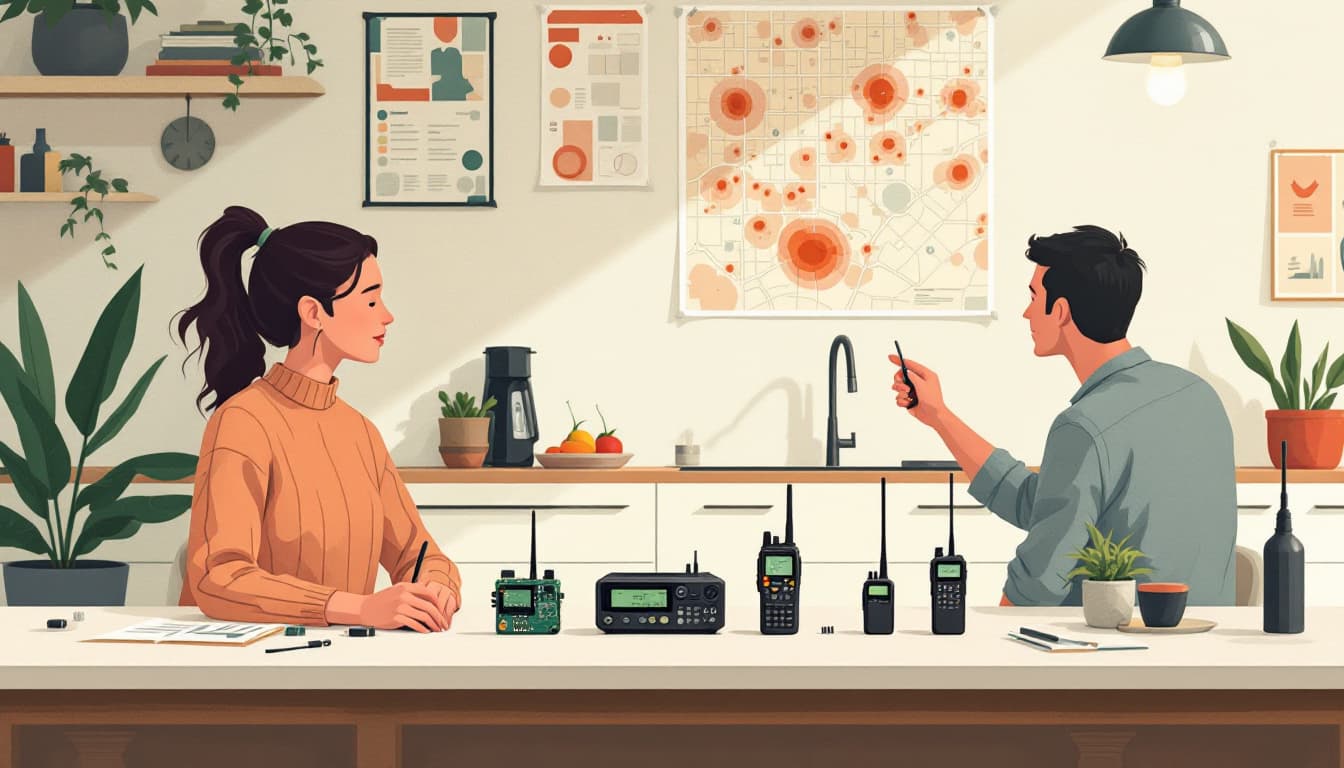
This is the preparedness category that has changed the most in the past 24 months, and it's the one where bad advice on Reddit can cost you the most money. Specifically: a lot of preppers are buying Baofeng UV-5R handheld radios on the assumption they'll have communications during a grid-down event. They won't, unless they (a) have an amateur radio license, (b) have someone else on the network who also has one, and (c) are within the line-of-sight range of that someone, which is shorter than most buyers expect.
The Meshtastic ecosystem changed this. So did the maturing of the goTenna platform. Today, you can build a household communications network that genuinely works without cell towers, without internet, without a ham license, and without depending on a single point of failure, for under $200 total.
The three real options
There are three legitimate paths a household can take. They are not interchangeable.
Path 1: Amateur radio (ham). Best for: serious operators with time to learn and a license. The capability ceiling is the highest of any option — global comms, voice, digital modes, repeaters. The floor is also the highest: ARRL Technician license study, a $200-$500 radio, and a real time investment. We are deeply pro-ham radio. We do not recommend it as a household's first preparedness comms purchase, because the failure mode of "I bought a radio I don't know how to use and it sits in a drawer" is the most common outcome.
Path 2: Commercial mesh (goTenna Pro X2 and similar). Best for: organizations, SAR volunteers, large family groups with shared property, rural property managers, anyone who needs a turn-key, encrypted, ruggedized solution and has the budget. The goTenna Pro X2 is the gold standard and remains the right answer for these use cases.
Path 3: Open mesh (Meshtastic). Best for: most households. License-free, low cost per node, active development community, increasingly large geographic coverage in U.S. metros. The hardware tier you pick depends on your tolerance for tinkering, but the network protocol is the same.
For most readers, Path 3 is the answer. The remaining question is what hardware to buy.
What we mean by "real range"
This is the number every product page lies about. The marketing claim is always "5-10 miles" or "up to 30 miles." The reality is that line-of-sight, antenna quality, terrain, and node density determine actual range, and they almost never combine to produce the marketing claim.
Drawing on community range reports (the Meshtastic Discord channel and the r/meshtastic range-test threads aggregate hundreds of real-world data points) and goTenna's own published field data:
- Direct node-to-node, no obstructions: 2-4 miles with stock antennas, 5-8 miles with upgraded antennas, on both LilyGO and Heltec.
- Through suburban density: 0.5-1.5 miles reliably.
- Through forest: 0.3-0.8 miles.
- goTenna Pro X2 line-of-sight: Consistently 5+ miles, occasionally double that in flat open terrain.
The way you extend range on any mesh network is by adding nodes. A six-node neighborhood network where every node is within a mile of two others can cover a 10-15 square mile area reliably. This is the actual use case that justifies these systems.
How we'd set up a household
For a typical suburban or exurban household new to off-grid comms:
Step one: two devices, today. Buy a pair of LilyGO T-Echos, $178 total. Set them up on Meshtastic with channel encryption enabled. One stays at home, one goes with whoever is mobile (commuting, traveling, etc.). You now have a working two-node mesh.
Step two: a third node, this month. A Heltec V3 on a USB power bank in an upstairs window can extend the range of your two-node setup by 30-50%. Total additional cost: $50 with a battery.
Step three: get on the regional mesh. If you live in a metro with active Meshtastic coverage (the Meshtastic community map has current data), connecting to the regional mesh costs nothing and extends your range to anywhere those nodes can reach.
Step four (optional): one goTenna for the family lead. If your household has a primary "emergency operator" — the person who would coordinate during a crisis — a single goTenna Pro X2 that interoperates with their Meshtastic-equipped family members via a paired smartphone gives them encrypted long-haul comms with other goTenna users (emergency services in some jurisdictions; SAR volunteers; large mesh networks in some metros).
What we didn't recommend
The Baofeng UV-5R. It is the right tool for an entirely different job. If you have a Technician-class amateur radio license, it's a fine starter HT. Without the license — and without a network of licensed contacts on the same frequencies — it is a $25 piece of plastic, not a comms plan.
Generic LoRa modules from AliExpress. The savings versus a Heltec or LilyGO are marginal. Quality variance is significant — community reports show high failure rates during firmware flashing and inconsistent radio performance. Hard to recommend to a non-tinkerer.
The original goTenna Mesh (the consumer SKU, not the Pro X2). Discontinued, no longer supported by goTenna's app infrastructure. Don't buy used.
Honest caveats
Meshtastic is an open-source project under active development. Some firmware updates have caused regressions; the community generally fixes them quickly, but if you need a finished product that will not change underneath you, the goTenna Pro X2 is the better answer.
The 900 MHz ISM band that Meshtastic uses in North America is unlicensed but not unmonitored. Treat your traffic accordingly. Enable encryption. Don't say anything on the network you wouldn't say on a postcard.
And finally: comms gear is only useful if the other people on your plan have compatible gear and know how to use it. The single best thing you can do after buying these radios is to use them, casually, weekly, with whoever is on your network — so that on the day you need them, the muscle memory is there.

