
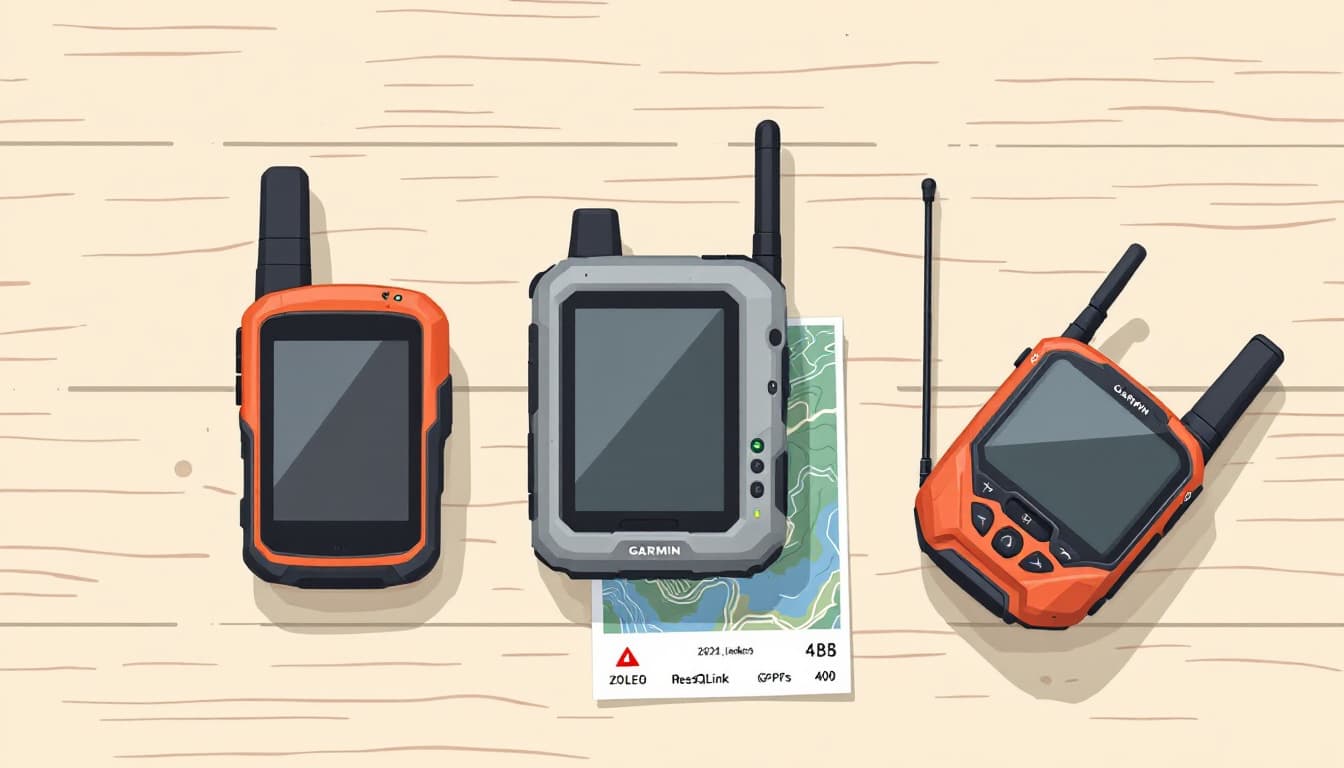
Why your household needs at least one of these
Cell service fails in exactly the moments you most need it: a backcountry injury, a flash flood that takes out the tower, a sailing trip beyond the coastal fringe. For most families, a satellite communicator or personal locator beacon sits in the same mental category as a fire extinguisher—you'd rather have it and not need it. The difference is that modern devices have gotten good enough, and affordable enough, that the calculus has genuinely changed. This isn't gear for survivalists. It's for the household that camps a few times a year, has a teenager who hikes with friends, or simply lives somewhere rural where 911 response times are measured in tens of minutes.
The category splits cleanly into two types: two-way satellite messengers (you can talk to rescuers, family, and coworkers) and one-way personal locator beacons, or PLBs (you press a button and the government SAR system comes to find you). Neither is wrong. The right answer depends on whether you want ongoing communication capability or a pure emergency backstop with no monthly bill.
What we actually looked for
For two-way messengers, the practical questions are: Which satellite network does it use, and does it have genuine global reach? Does it work without a paired phone, or is the phone a hard dependency? What does the subscription actually cost per month, including suspend fees when you're not traveling? For PLBs, the calculus is simpler but the registration step is non-negotiable—a beacon that hasn't been registered with NOAA is dramatically slower to act on, because rescuers don't know who you are or where you were headed.
We weighted real-world usability—gloved hands, dead phone batteries, wet conditions—more heavily than spec-sheet numbers. Battery life matters mostly at the extremes. Subscription cost matters a lot, because a device you cancel after two months of sticker shock helps nobody.
The premium pick: Garmin inReach Mini 3 Plus
The Mini 3 Plus earns its price by solving the one genuine problem with every phone-dependent communicator: your phone dies, gets wet, or gets lost, and suddenly your expensive satellite messenger is a paperweight. The Mini 3 Plus composes and sends messages entirely on its own color touchscreen. That's not a small thing at 2 a.m. in a tent with a dead phone. The Iridium network it runs on has true global coverage, poles included—not "good coverage" or "most of the US" but actual global. Photo and voice messaging are genuinely useful for communicating the nature of an emergency, not just a GPS pin. The tradeoff is real: you're paying roughly 400 dollars up front and a subscription from around 15 dollars a month, every month. If you're an occasional car camper, that math may not pencil out. If you're the household that's regularly in serious terrain, or whose members travel internationally, this is the device that will perform when everything else has failed.
The value pick: ZOLEO Satellite Communicator
The ZOLEO's smartest design decision is also the least obvious one: it hands off between Wi-Fi, cellular, and Iridium satellite automatically. This means on most trips, you barely consume your satellite message allotment, because the device routes through your phone's data connection until that connection disappears. Plans start around 20 dollars a month for a meaningful number of satellite messages, and every tier includes unlimited SOS and check-ins. The detail that family members appreciate most is that ZOLEO gives your device its own SMS number—your spouse can text you back from their regular Messages app without downloading anything. The dependency on a paired smartphone for full functionality is a genuine limitation, and worth naming honestly: if your phone is compromised, the ZOLEO becomes a check-in button and SOS device only. For most households, that's still a meaningful safety net at a meaningfully lower price.
The budget pick: ACR ResQLink 400
Calling the ResQLink 400 a "budget" pick requires a small asterisk—at around 260 dollars it costs more than some entry-level two-way messengers. What you're buying is the elimination of any subscription, forever. Register it once at beaconregistration.noaa.gov (this step is mandatory—do not skip it), and the device works for the life of its five-year battery on the government COSPAS-SARSAT network at no further cost. The newer MEOSAR constellation it supports means near-instant satellite detection rather than the 45-minute-plus delays of the older system. The limitation is real and worth stating plainly: this device cannot receive any message, cannot confirm your SOS was received, and cannot tell rescuers anything beyond your GPS coordinates and your registration details. For occasional hikers and families who want a set-it-and-forget-it emergency backstop, that's often exactly enough.

