
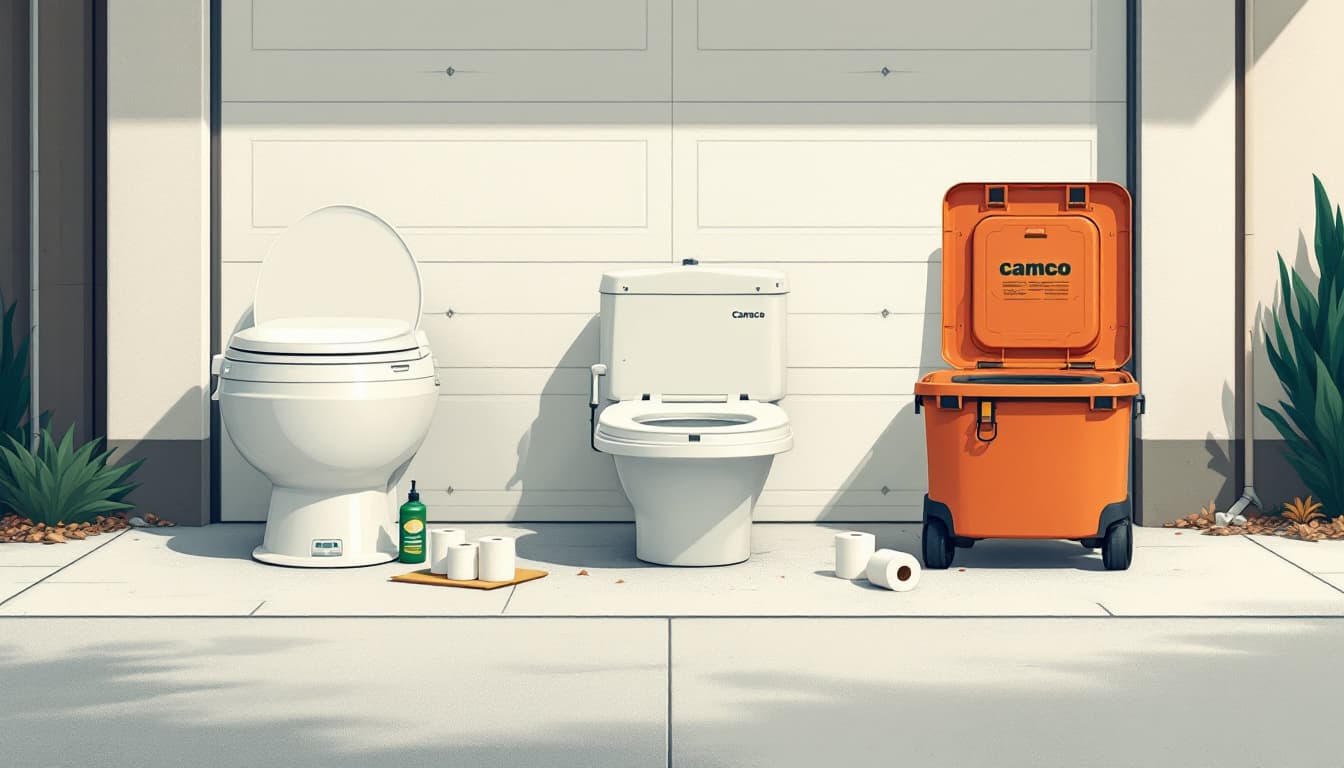
Why sanitation belongs in your preparedness kit before almost anything else
When a winter storm knocks out power and freezes your pipes, or a municipal water main fails, the first thing people panic about isn't food — it's the toilet. Sanitation failure is a genuine public-health emergency even in short-duration outages, and it's also one of the easiest preparedness gaps to close cheaply. A functional emergency toilet requires no special skills, no installation, and no ongoing subscription. You buy it once, store it in a closet, and forget about it until you actually need it. Yet a surprising number of otherwise well-prepared households have nothing.
The question isn't whether to have an emergency sanitation solution — it's which one fits your space, your household size, and how long you're planning to be self-sufficient.
What we actually looked for
Portable emergency toilets sort into two basic families: self-contained flush units with dual tanks (fresh water on top, sealed waste below) and no-flush bucket-style units that depend on liner bags. We looked at real-world capacity — how many uses before you're emptying or replacing something — odor control, ease of emptying, weight and storability, and total cost of ownership including consumables. We also considered the experience gap: a flush mechanism matters more than it sounds when you're three days into a grid-down situation with a family.
We deliberately excluded products whose consumable costs make long-term household stockpiling impractical. A portable toilet you can only afford to use occasionally isn't a preparedness tool.
The tiers explained
Premium — Thetford Porta Potti 565E Curve (~$175): This is what RV owners and offshore sailors use, and that lineage matters. The electric flush runs on AA batteries and genuinely feels close to a residential toilet. The dual tank-level indicators mean you're never surprised by a full waste tank at an inconvenient moment, and the rotating pour spout makes emptying the 5.5-gallon waste tank about as dignified as that task is ever going to be. For a family of four, plan on emptying every two to three days. The main tradeoffs are bulk — this doesn't tuck away as neatly as the other two — and the battery dependency, which is a minor logistical consideration but worth noting. At this price point, you're paying for comfort and a near-normal experience during an abnormal situation. If you have older family members, anyone with mobility limitations, or you're planning for outages longer than a weekend, the Thetford is where to start.
Value — Camco 41541 (~$80): This is the pick for most households. The bellows-pump flush works without batteries, the sealed slide valve genuinely locks in odor between uses, and a 330-lb weight rating means it accommodates virtually any adult. It's roughly 11.5 lbs empty and compact enough to live under a bed or in a hall closet without complaint. The seat sits lower than a standard toilet, which some users notice, and the manual pump requires a bit more effort than the Thetford's electric mechanism — but neither of those is a dealbreaker. It even includes odor-treatment samples so you're not scrambling for supplies on day one. If you buy one thing in this category, this is it.
Budget — Reliance Luggable Loo (~$27): Don't let the price fool you. The Luggable Loo is a legitimate HDPE bucket with a snap-on hinged seat and lid, and it works exactly as intended. The bucket itself has no moving parts to fail, requires zero water or power, and weighs about 3 lbs — making it the only option here that belongs in a go-bag or car kit. The ongoing cost is the liner bags, and you should budget for quality ones (Double Doodie and Poo Powder systems are compatible); thin kitchen bags are not an adequate substitute. At $27, buying two for a multi-bathroom home is entirely reasonable. Use it as a utility bucket between emergencies and you'll never feel like you wasted the money.
The honest summary on consumables
All three solutions require some consumable: the Thetford and Camco need toilet treatment chemicals and periodic tank emptying at an appropriate dump point; the Luggable Loo needs liner bags every use. Plan your supply accordingly. A 72-hour kit for a family of four should include at minimum a week's worth of whatever consumable your chosen unit requires — emergencies rarely respect optimistic timelines.

