
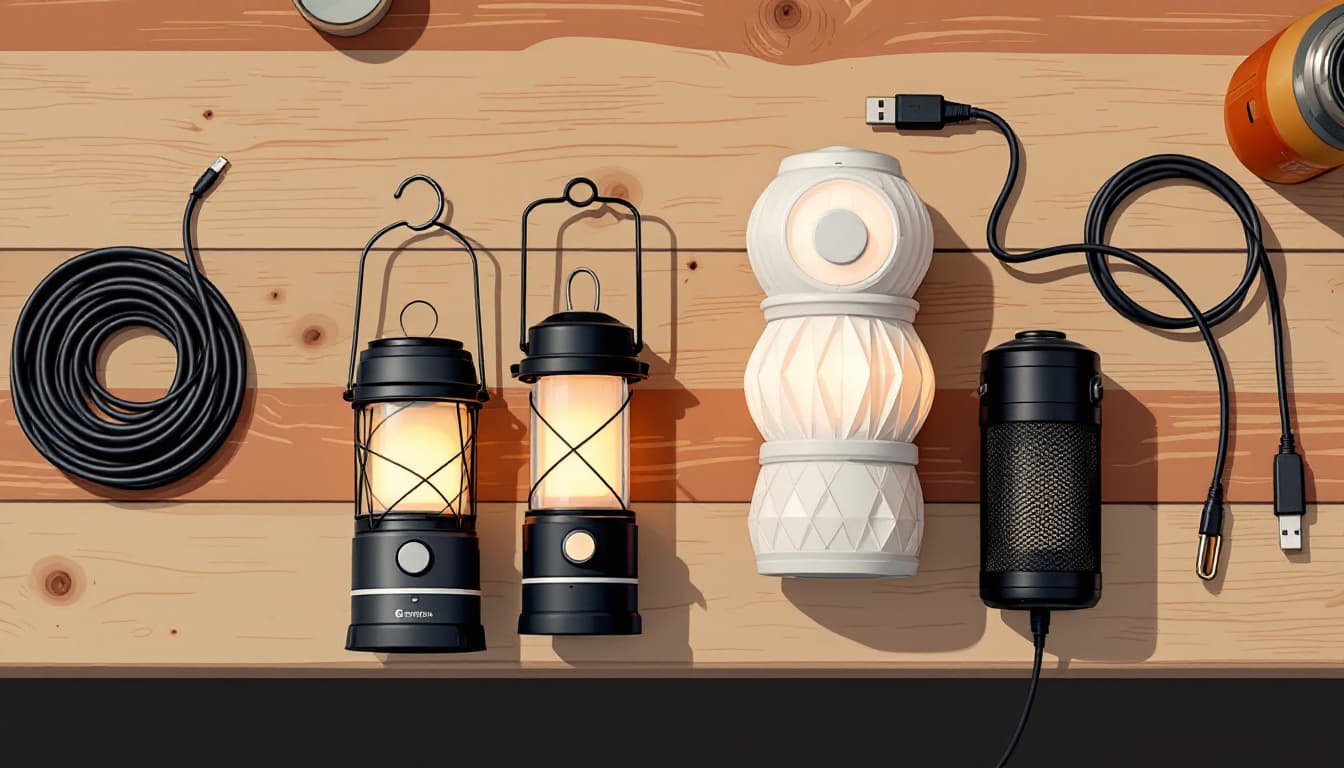
Why every household needs a rechargeable lantern
A power outage is rarely dramatic. Most of the time it's a downed line in a storm, a tripped grid during a heat wave, or a utility crew working through the night a few streets over. What actually matters in that stretch of dark hours is boring and practical: can everyone see well enough to make dinner, find the bathroom, and not trip over the dog. A flashlight solves that for one person pointed in one direction. A lantern solves it for the whole room.
That's the case for keeping a rechargeable lantern charged and within reach, not buried in a box of disposable D-cell gear you'll discover is dead exactly when you need it. Rechargeable lanterns plug into the same USB-C cables and wall bricks already scattered around most homes, which means keeping one topped off costs nothing extra and takes no special planning.
None of this requires a bunker mentality. It's the same logic as keeping a spare phone charger in the car — cheap insurance against a genuinely common inconvenience, not a hedge against collapse.
What we actually looked for
We prioritized real runtime over headline lumen numbers, because a lantern that blasts 1500 lumens for a few minutes and then dies is less useful during a multi-hour outage than one that holds a steady, comfortable glow for half a day. We also weighed charging method (USB-C over micro-USB where possible), battery capacity, and whether the diffuser actually spreads light evenly across a room instead of throwing a single hot spot on the ceiling — and we checked current stock and pricing directly on Amazon rather than trusting older roundups, since availability in this category turns over quickly (our original premium pick, the BioLite AlpenGlow 500, is currently unavailable, which is exactly the kind of thing a stale recommendation misses).
Products got disqualified for two main reasons: thin review histories with no track record to check, or brightness claims that reviewers and lab tests couldn't back up. Every pick below has either an independent lumen measurement or thousands of verified owner ratings behind it.
The premium pick: BioLite AlpenGlow 250 (~$60)
The AlpenGlow 250 is the lantern in this guide you'd want to use even on a night when nothing's wrong. Its ChromaReal LED technology renders colors more accurately than a typical single-tone camping lantern, with 8 total color and light modes including a shake-to-change feature — useful for a dinner table as much as a power outage. A USB-A charge-out port means it can top off a phone in a pinch.
We'll be direct about the tradeoff that pushed this down from our original pick: BioLite's larger AlpenGlow 500 is currently unavailable on Amazon with no restock date, so we're recommending the smaller 250 instead. It's dimmer (250 lumens versus 500), IPX4-rated rather than fully waterproof, and stock on this listing has also been thin. If you want a lantern that earns a permanent spot on a shelf or nightstand rather than one that only comes out during emergencies, it's still the best of the three here — just confirm current availability before you buy.
The value pick: Lepro 1000LM LED Camping Lantern (~$32)
The Lepro 1000LM is the safest single recommendation in this guide, and the reason is boring in the best way: over 33,000 Amazon ratings averaging 4.6 stars, which is a deeper track record than anything else here by a wide margin. Four light modes give it real flexibility — a roughly 300-lumen warm setting that stretches to about 12 hours, a 700-lumen daylight mode good for about 8 hours, and a 1000-lumen combined burst for when you actually need to see clearly across a room or yard.
It charges over USB-C, the same cable as most modern phones and headphones, and the collapsible design flattens down small enough for a glovebox or closet shelf. There's no color-changing or dual-tone lighting like the BioLite offers — this is a lantern built to do one job reliably, not to be fun.
For most households, this is the one lantern to buy if you're only buying one. It's bright enough, lasts long enough on a charge, and has enough of a track record that you're not gambling on an unknown brand during the one week a year you actually need it.
The budget pick: Glocusent 135 LED Ultra Bright Camping Lantern (~$27)
Under $30, the Glocusent punches well above where it should. A 1500-lumen peak, five brightness levels, three color temperatures, and a genuine SOS flashing mode is more feature depth than we expected to find at this price, and the 5000mAh battery is rated for up to 200 hours of runtime on its lowest setting — the longest of any lantern in this guide. It carries a 4.8-star average across 1,034 Amazon ratings, the highest rating of any pick here.
The corners that got cut are the expected ones: lighter plastic construction that won't survive job-site abuse, no power-bank output for charging a phone, and the lowest water-resistance rating (IP44) of the three lanterns. The 1500-lumen "Super Bright" mode is also time-limited to about 3 minutes by design, meant for emergency bursts rather than sustained use.
This is the pick for outfitting a household beyond the first lantern — one for the car, one for a kid's room, one for the camping bin — without the compromises usually associated with the cheapest option on the shelf.

