
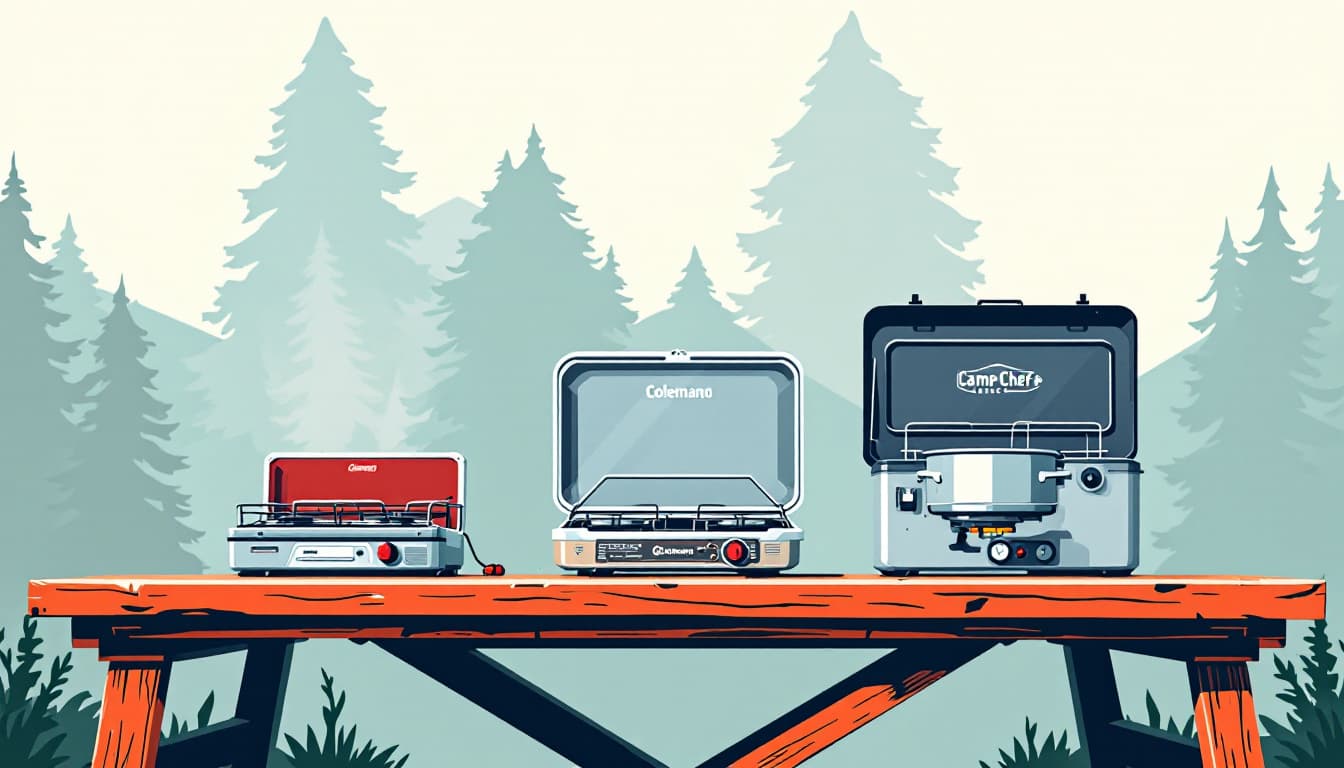
Why your kitchen needs a backup plan
A power outage that lasts more than a few hours stops being an inconvenience the moment you realize you can't cook. Electric ranges, induction cooktops, and microwaves — which now account for the majority of American home cooking setups — go dark with the grid. A camp stove, kept in a closet or garage with a modest fuel supply, is one of the cheapest and most practical household insurance policies you can buy. It's not a survivalist statement; it's the same logic as owning a spare tire.
The good news: this is a genuinely mature product category with stable supply. Propane in 1 lb cylinders is the most accessible emergency fuel in North America — available at hardware stores, grocery stores, and gas stations — and all three picks below accept them. The better news is that $30 can get you something genuinely useful, and $227 can get you something that handles a real family's cooking load without compromise.
What we actually looked for
BTU output matters, but it's not the whole story. A stove that works fine on a calm test day can be useless in a backyard during a January ice storm if it has no windscreen. We weighted fuel flexibility heavily this year: a stove that only runs on propane is a liability if local propane supply is disrupted and butane canisters are what's left on the shelf. We also looked at ignition reliability (piezo starters mean no fumbling for a lighter in the dark), form factor (a stove that's genuinely storable is one you'll actually own when you need it), and review depth — a product with 50,000 verified buyer reviews has been stress-tested by the public in a way no lab review can replicate.
The case for fuel flexibility: Gas One GS-3400P
At under $30, the GS-3400P does something none of the other picks do: it runs on either butane canisters or standard 1 lb propane cylinders, whichever you can find. That dual-fuel design, which Gas One has patented, is the single most emergency-relevant feature in this roundup. When a hurricane clears the propane shelf at every hardware store in a 30-mile radius, butane canisters — sold at Asian grocery stores, restaurant supply shops, and online — become the backup. The GS-3400P covers both. It also weighs just over 3 lbs, making it the only pick here that fits reasonably in a go-bag or vehicle emergency kit. The tradeoffs are real: one burner, modest BTU output, and no windscreen, so cook in a sheltered spot. But as a first emergency stove — or a dedicated backup for an apartment — nothing in this price range touches it.
The reliable workhorse: Coleman Classic 2-Burner
The Coleman Classic has more verified Amazon reviews than the other two picks combined, and a 4.7-star rating across that volume is genuinely hard to fake. It's the stove your neighbor has, that park rangers recommend, and that Coleman has been iterating on long enough to get the details right: independently adjustable burners, wind-block panels that fold out from the lid, and pressure regulation that keeps the flame steady as the canister empties. At around $55, you get two burners — meaning you can heat soup while you boil water, or cook protein while you warm sides — which closes most of the gap with the premium pick for ordinary household meals. The weaknesses are honest ones: propane-only, about 1 hour of runtime per canister on high, and no butane fallback. Stock a few extra cylinders and this limitation is manageable.
When output actually matters: Camp Chef Everest 2X
The Everest 2X is built for households that cook real food in real conditions. Two 20,000 BTU cast-aluminum burners — 40,000 BTU total — means water boils fast, cast iron gets hot, and you're not standing around waiting. The 3-sided folding windscreen is integrated into the lid, not an afterthought, and it functions in actual outdoor conditions. The matchless piezo ignition works without matches or a lighter. Most importantly, it accepts a 20 lb bulk propane tank via adapter (sold separately), which transforms it from a camping stove into a multi-day household cooking station during extended grid-down events — runtime on a bulk tank is orders of magnitude longer than 1 lb cylinders. At $227 and 15 lbs, this is a deliberate investment, not an impulse buy. It won't fit in a go-bag and it's propane-only. But for a family of four or more cooking real meals across a week-long outage, it's the pick that won't frustrate you.

