
A novel built in the dark
There is a particular pleasure in discovering that a book which arrived quietly — serialized in self-published installments, passed around by word of mouth — turned out to be one of the defining works of its genre. Hugh Howey's Wool is exactly that kind of discovery, even for readers coming to it years late. It does not feel like a debut phenomenon or a viral artifact. It feels like a book that always existed, waiting to be found: fully realized, patiently constructed, and quietly devastating.
The comparison that comes to mind most often — and that Howey himself has probably grown tired of hearing — is Ursula K. Le Guin. Not because the prose styles are similar, but because both writers understand that world-building is character-building. The society you construct tells us everything about the people trapped inside it.
Life in the silo
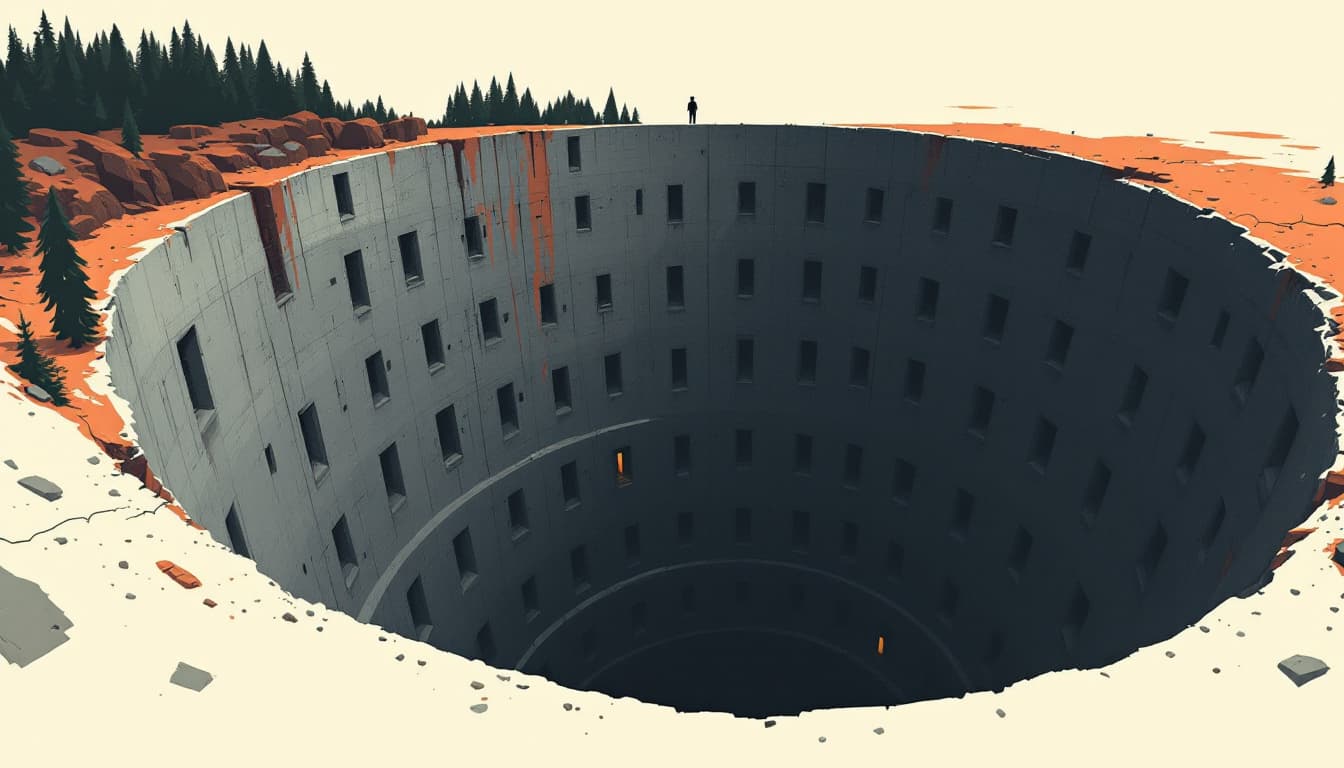
The premise is deceptively simple. Humanity — or what remains of it — lives inside a vast underground silo, buried so deep that the outside world is visible only through a single camera feed projected on a screen. The air outside is toxic. The hills are grey and dead. To be sent outside to clean the lens of that camera — "cleaning," in the silo's grim parlance — is a death sentence, the society's ultimate punishment for its worst criminals.
Howey withholds the precise history of how the world came to this state, and wisely so. The mystery is the engine. What we learn instead is the texture of silo life: the mechanical castes and social hierarchies, the marriages planned around the lottery that governs who may have children, the bureaucratic religion of the Order, the long staircase that is both the silo's spine and its most potent metaphor. Going up means power and light; going down means labor and heat and the deeper, older knowledge that the people above would prefer stayed buried.
Craft: structure, prose, and the characters who carry it
Wool began as a short story — the opening section — and Howey expanded it after reader demand made that the only rational choice. The seams of that expansion are almost invisible, which is its own kind of craft accomplishment. The novel is structured in five parts, each with a different central perspective, and the transitions between them build pressure rather than releasing it. By the time the book's true protagonist, a mechanic named Juliette, comes fully to the center of things, we have been prepared for her through layers of other lives. It is an unusual structural gamble that pays off enormously.
Howey's prose is clean and functional in the best sense — it does not call attention to itself, but it earns its moments of beauty. He has a gift for physical specificity: the smell of grease and recycled air, the particular quality of light that comes from fluorescent tubes rather than sun, the way a long climb up concrete stairs registers in the thighs. This groundedness keeps what could be a purely allegorical story from floating away into abstraction. The silo feels real because Howey makes you feel its weight.
Juliette herself is one of the more satisfying protagonists in recent genre fiction. She is competent without being superhuman, perceptive without being implausibly prescient, and her background as a mechanic — someone who fixes broken things — resonates through every level of the novel's thematic architecture. Her relationships feel earned rather than convenient. The secondary cast is equally strong: an archivist whose quiet heroism is one of the book's most moving throughlines, an ambitious deputy whose villainy is rooted in ideology rather than simple evil, a sheriff whose brief arc in the opening section functions as a kind of overture, setting the novel's themes in miniature.
What works, and what to watch for
What works, overwhelmingly, is the control. Howey never loses the thread. In a story this reliant on slow revelation, it would be easy to let the mystery become the only point — to sacrifice character for plot mechanics. Wool refuses that trade. When revelations arrive, they land not because they are surprising twists but because they feel inevitable: the kind of truth that, once spoken, you cannot imagine not having known.
The novel is also genuinely tense. There are sequences — particularly those involving Juliette's more physical predicaments — that are almost unbearably suspenseful, executed with the confidence of a writer who trusts restraint over spectacle.
If there is a criticism to be lodged, it is that the middle section occasionally slows while Howey repositions pieces for the final act. The pacing is not broken, but it loosens. And readers who want their dystopias to explain themselves thoroughly may find the deliberate ambiguity around the silo's origins frustrating by book's end — though the sequels address this, and the withholding here is a feature, not a bug, if you trust the author enough to follow him further.
Who should read it
Wool belongs on the shelf of anyone who cares about speculative fiction — not just as a genre exercise but as literature that uses its impossible premise to say something real about governance, memory, trust, and the stories societies tell themselves to survive. It is accessible enough for readers who rarely pick up science fiction, and it is layered enough to reward those who have read everything in the genre. It is, quite simply, a great novel, and the fact that it found its enormous audience without the machinery of traditional publishing is one of the more heartening stories in recent literary history.

