
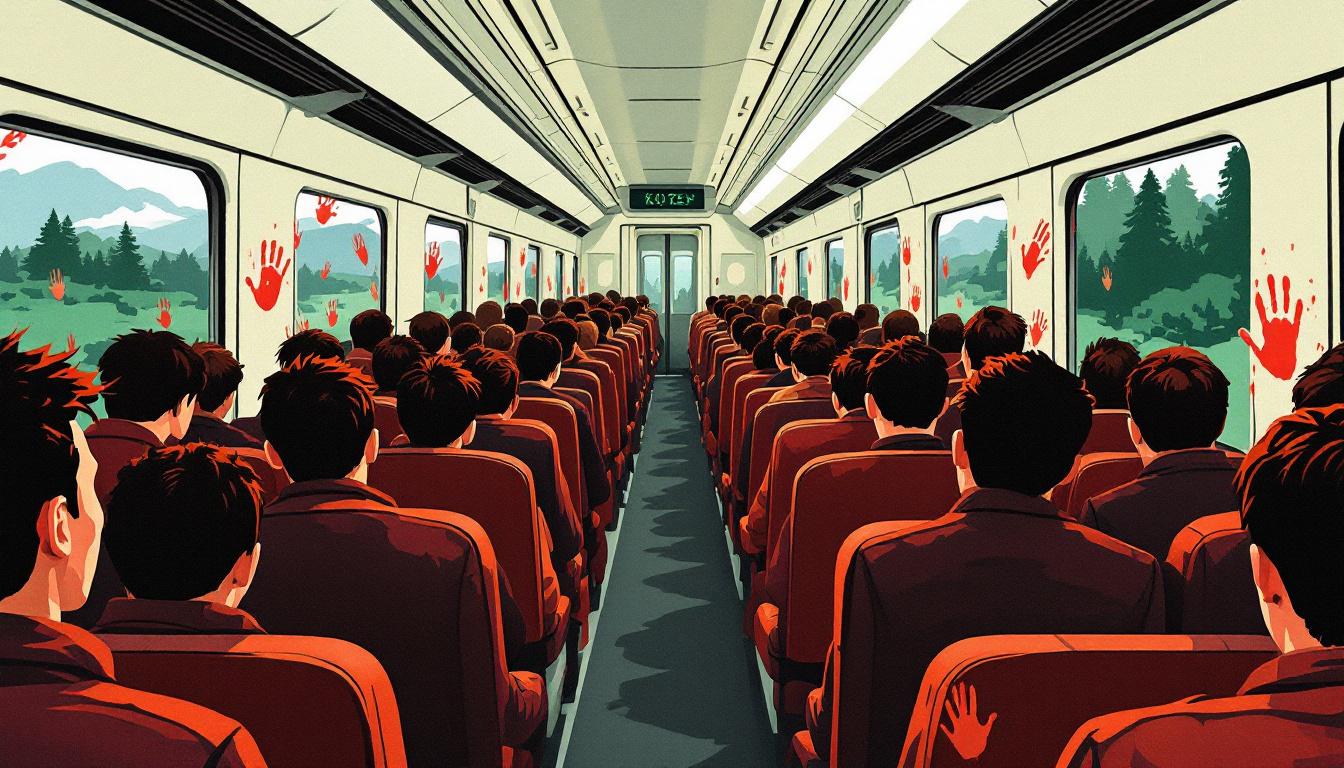
The zombie film that remembered to care
Ten years on from its Cannes midnight premiere, Train to Busan remains something of an embarrassment to its Western genre peers. Here is a film made on a modest budget, set almost entirely inside the carriages of a KTX bullet train, that manages to be more emotionally coherent, more thematically purposeful, and more genuinely frightening than most of the sprawling American prestige horror that surrounded it. Director Yeon Sang-ho had made his name in bleak animated features before this live-action debut, and that background shows: he understands how to strip a story down to its load-bearing bones.
The shape of the thing
A fund manager — distant, professionally distracted, the kind of father who forgets his daughter's birthday recital — boards a train from Seoul to Busan with his young girl for what should be a routine trip. Something has already gone wrong in the world outside. By the time the train clears the first few stations, that wrongness has boarded with them.
That is all you need to know going in. The film's genius is structural: a train is a closed system, a series of connected tubes with only two directions of travel. Yeon uses that geometry mercilessly, designing set pieces that exploit the specific, nightmarish logic of the space — the sliding doors between carriages, the luggage racks overhead, the blind corners of the vestibules. The outbreak doesn't sprawl across a city. It comes at you down a single aisle.
Craft, in the specific
What separates Train to Busan from competent genre exercise is the quality of its character work in the margins. The ensemble that assembles around the central father-daughter pair is carefully stratified: a heavily pregnant woman and her gruff, working-class husband; a pair of elderly sisters; a group of high school athletes; a corporate executive whose decisions in a crisis become the film's moral axis. These are not just bodies to be turned or saved. Each is given a readable interior life in just a few strokes of dialogue or behavior — a habit, a tone of voice, a small act of cowardice or grace.
Gong Yoo, playing the father, carries the film's emotional weight with considerable restraint. He's not asked to be a hero in the conventional sense; he's asked to be a man discovering, too late and under the worst possible pressure, what actually matters to him. His transformation feels earned rather than convenient. Ma Dong-seok, as the working-class husband, provides a counterweight that could easily have been comic relief but instead becomes the film's moral center — a man whose instinct is simply to put himself between harm and everyone around him, without drama or deliberation. The contrast between these two performances is where the film's class commentary lives, and Yeon is wise enough to let it breathe rather than underline it.
The zombies themselves deserve a word. The infected here move with an ugly, almost mechanical urgency — bodies torquing and convulsing in ways that suggest something deeply wrong with the nervous system rather than supernatural menace. The choreography is extraordinary, particularly in sequences involving hundreds of bodies massing and cascading through carriages. And crucially, the film keeps its outbreak logic consistent: you know the rules, the film plays by them, and the tension comes from watching characters work within constraints rather than from arbitrary surprises.
What doesn't quite land
The film earns its sentimentality in most places, but not all. There are moments — particularly in the final act — where the emotional manipulation becomes slightly schematic, where the music swells half a beat before it should and the camera lingers a moment too long. Yeon's instincts are almost always right, but he occasionally over-explains feelings that the performances were already communicating. The corporate villain, too, is the film's one genuine weakness: he is drawn in broad strokes that feel borrowed from an older, less sophisticated playbook. The film's view of class is sharp and genuine, but this character sometimes reads like a placeholder for it rather than an embodiment of it.
These are minor complaints against a film that sustains genuine dread for most of its running time and pulls off a climax that is both structurally inevitable and emotionally surprising — not an easy trick.
Who should watch it
If you have written off Korean cinema as an acquired taste, Train to Busan is an almost frictionless entry point: it has the accessible grammar of a mainstream Hollywood blockbuster but the emotional and thematic intelligence that Hollywood genre filmmaking too rarely bothers with. If you are fatigued by zombies as a genre — by the endless Walking Dead iterations and their bleak, nihilistic endurance tests — this film is a corrective. It believes that people can be worth saving. It believes that decency is a choice, and that the choice is interesting to watch.
Horror fans, parents, and anyone who has ever sat across from a person they loved and realized they'd been failing to see them: this one will find you.

