
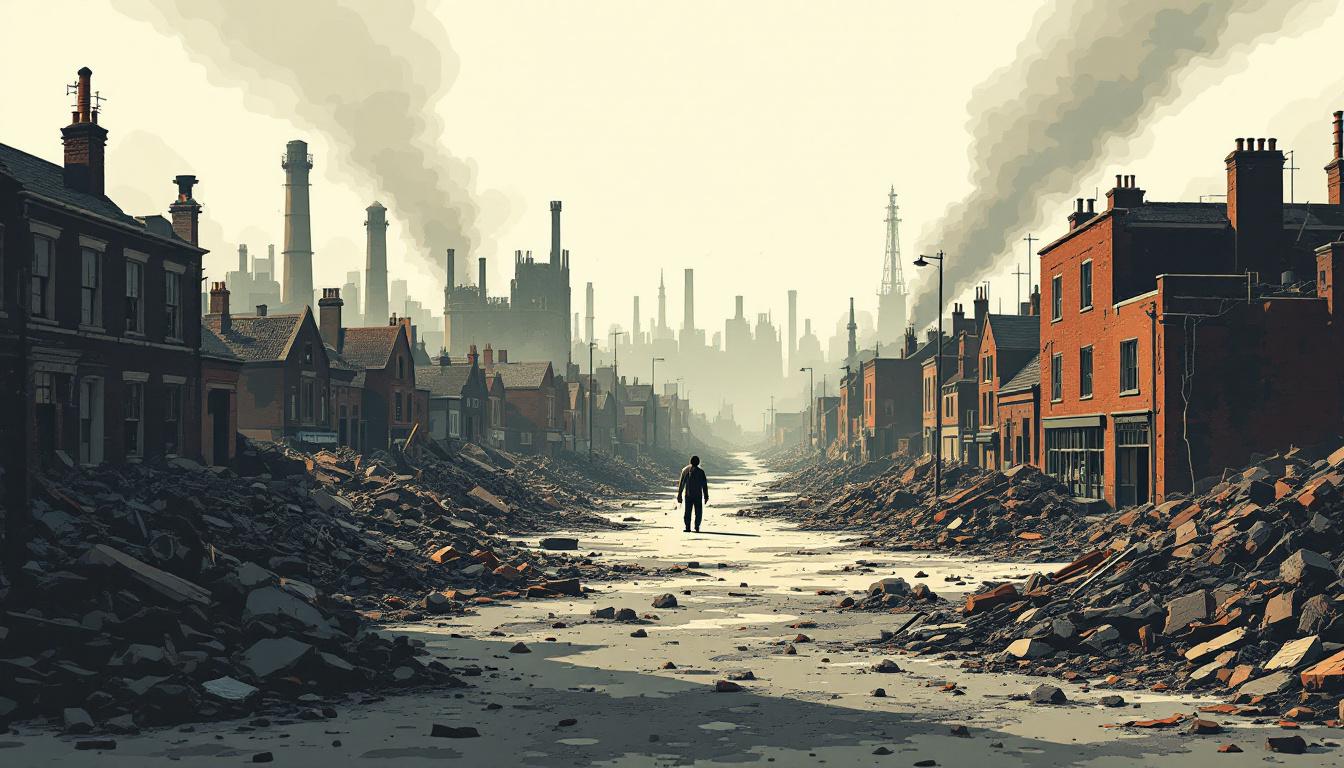
Still burning, forty years on
There is a particular category of artwork that people describe as "important" precisely because they never want to experience it again. Threads has occupied that category since its first BBC broadcast in 1984, when it reportedly caused a minor national crisis of anxiety and drew millions of viewers who sat in front of their television sets in a kind of stunned silence. Four decades later, the film has not softened. It has not aged into quaintness. If anything, in a period when the language of nuclear deterrence has crept back into public discourse, it feels newly, uncomfortably relevant.
Mick Jackson — who would later make Hollywood entertainments of a very different temperature — made this film as though his only obligation was to tell the truth, and the result is one of the starkest pieces of dramatic filmmaking the British public broadcaster has ever commissioned.
Two families, one city, no escape
The setup is deliberately ordinary. Sheffield, in the industrial north of England, in an unnamed but recognisable near-present. Two working-class families whose lives are about to become entangled through a young couple expecting a child. The film takes its time establishing routines, relationships, small domestic textures — a deliberate choice, because Jackson and writer Barry Hines (the novelist behind Kes) know that the horror will only register fully if we first believe in what is being destroyed.
Threaded through these domestic scenes, almost in a different register entirely, is a quasi-documentary track: news bulletins, government broadcasts, archival-style titles on screen telling us casualty projections and radiation dose rates with the flat authority of a public health pamphlet. The tension between these two modes — the intimate and the bureaucratic — is where much of the film's psychological power lives.
Craft: restraint as a weapon
Jackson directs with what can only be called radical restraint. The attack itself, when it comes, is not presented as cinema spectacle. There are no heroic angles, no swelling score. What you get instead is a succession of small, fragmentary images — a cat, a pint of milk, someone's washing on a line — and then a light that bleaches everything to white. The sound design in this sequence is extraordinary: not silence, but a kind of compressed, pressurised absence before the noise arrives. It's among the most effective representations of nuclear detonation in dramatic film precisely because it refuses to aestheticise the thing.
What follows the attack occupies the film's larger and arguably more important section. Jackson and Hines were clearly determined to dramatise not just the immediate blast and firestorm but the long, grinding catastrophe of aftermath: the collapse of infrastructure, the failure of government civil defence plans, the unravelling of social order, and eventually the multigenerational consequences of fallout on survivors and their children. This is where Threads separates itself entirely from most nuclear-war fiction. The film has the courage of its convictions, and its convictions are bleak.
The documentary inserts — those clinical text cards with their figures and projections — become more painful as the film progresses, not less. They create a distancing effect that works against itself: the more the film insists on data and category, the more the human cost registers as unbearable.
What works, what strains
The performances are uniformly grounded and largely non-showy, which is exactly right. The lead actress carries the film's emotional weight across a span of years with remarkable economy; there's very little sentimentality available to her, and she doesn't reach for any. The supporting cast of Sheffield locals and character actors similarly resists the temptation toward dramatic flourish that would have undermined the film's documentary pretensions.
If Threads has a weakness, it may be in its second half, which is so relentlessly punishing that it begins to approach a kind of numbing — an irony, perhaps, given that psychological numbing is itself one of the survival mechanisms the film explicitly addresses. There are passages in the later sections where the cumulative grimness tips from devastating to something closer to exhaustion. This is not quite the same as saying the film is wrong to go there; it may in fact be the most honest thing Jackson does. But it tests the audience's willingness to remain engaged rather than simply endure.
The film also carries, inevitably, the visual grammar of its era. Shot on video for much of its run, with the grainy, slightly washed-out quality associated with BBC drama of the period, it looks markedly different from contemporary streaming prestige production. Some viewers will find this a barrier. I would argue it functions instead as authentication — this is what the news looked like, and Threads wants you to feel that.
Who should watch this
Not everyone. This is a film that takes a great deal out of you, and it is not designed to send you away with any consolation. If you have read widely in Cold War history and want to understand why the culture of the 1980s was so saturated with nuclear anxiety, Threads is an indispensable primary document. If you are interested in the possibilities and limits of dramatic television as a form of argument — as a kind of civic intervention — it belongs on a very short shelf alongside the best work in that tradition. And if you are the sort of person who reads seriously about resilience, catastrophic risk, and what civilisational collapse might actually look like stripped of romanticism, it will challenge and reward you in ways that most fiction in this space simply doesn't.
It is not entertainment, really. It is a film that uses the form and conventions of drama to make an argument about policy, about deterrence, about the gap between governmental reassurance and physical reality. That argument remains unresolved. That is why the film remains alive.

