
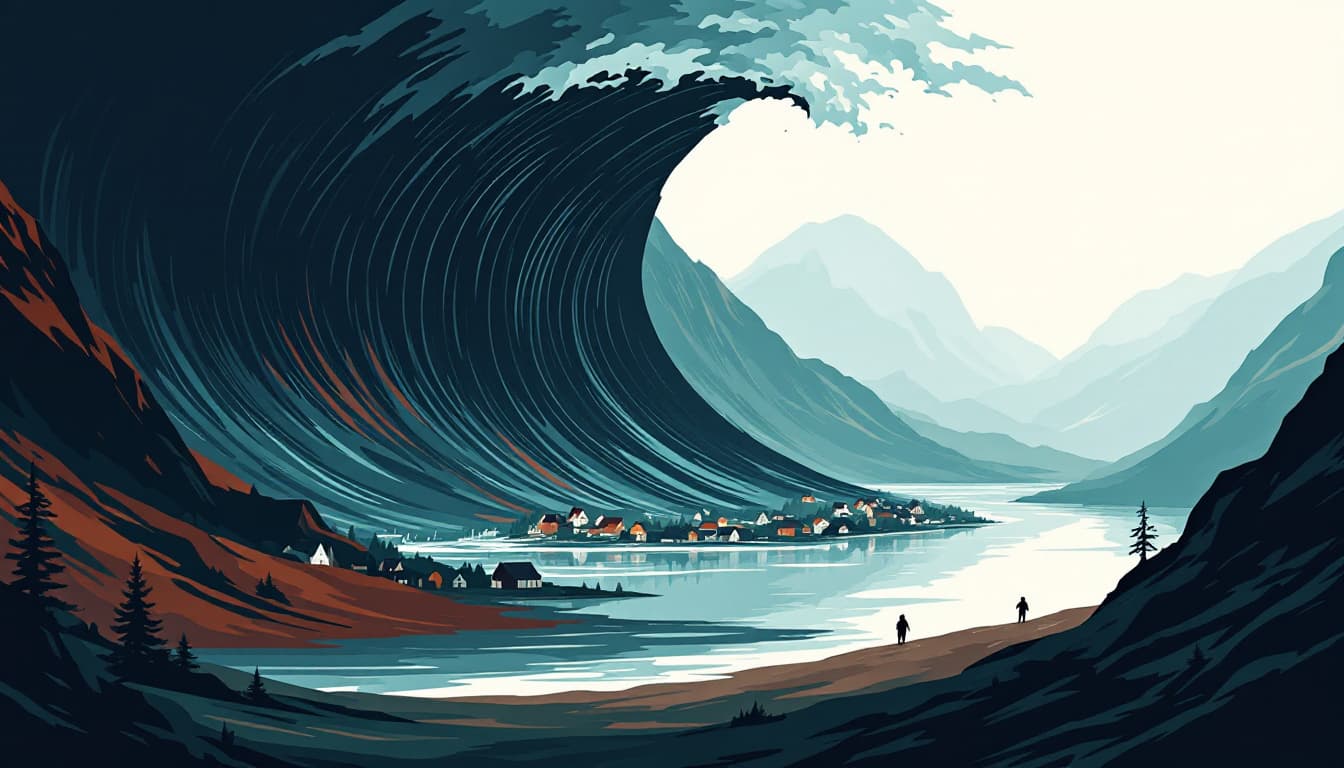
The fjord as apocalypse
There is something quietly brilliant about setting a disaster film in Norway's Sunnmøre region, where the mountains rise so steeply from the water that the whole landscape feels like a held breath. Director Roar Uthaug understood this before he shot a single frame. The village of Geiranger, a UNESCO World Heritage site and one of the most photographed places in Europe, sits at the foot of a mountain called Åkerneset — and Åkerneset has a crack in it. Geologists have been monitoring that crack for decades, knowing that when it finally gives way, the resulting rockslide will send a tsunami-scale wave down the fjord with perhaps ten minutes of warning. The Wave takes that real, documented threat and builds a film around it. That decision alone lifts it several rungs above the CGI-demolishes-a-landmark school of disaster cinema.
What it's about
The setup is efficient and unfussy. A geologist who monitors the mountain is preparing to leave his post for a corporate job in the city when the instruments begin behaving strangely. The evacuation siren sounds. The wave comes. What follows is survival — for him, for his family scattered across the valley, and for the community around them. Uthaug is careful to establish the geography early so that when catastrophe arrives, we understand exactly who is where and what separates them. It sounds simple. Most disaster films can't manage even this.
Craft and performance
The film belongs almost entirely to Kristoffer Joner in the lead role, and he earns that ownership. Joner plays a particular kind of quiet competence — the professional who understands exactly what is happening and is therefore more frightened, not less. He doesn't do the Hollywood thing of transforming into an action hero under pressure; he does the more interesting thing of being an ordinary man who is simply unwilling to stop moving. There's a restlessness to his performance that feels true, a physical anxiety that reads across the subtitles without any loss of translation. His family, played by Ane Dahl Torp and a pair of young actors, are drawn with slightly less care by the screenplay, but Torp in particular gets enough scenes of her own to register as a full person rather than a motivation device.
Uthaug's direction is confident in the film's first half. He builds dread through accumulation — one more anomalous reading, one more hesitation, one more anxious glance at the mountain — and he holds back the wave itself long enough that when it comes, it arrives as genuine shock rather than anticipated spectacle. The sequence itself is extraordinary: massive in scale, brutal in its physics, and shot with a clarity that most Hollywood productions, paradoxically, fail to achieve. You understand where the water is going and how fast. You understand what the people in its path are facing. That geographic legibility is cinematography doing real narrative work.
What works and what doesn't
The film is at its best when it trusts the strangeness of its situation. The ten-minute warning window is a genuinely nightmarish premise, and Uthaug milks it for everything it's worth before the wave arrives. The Norwegian landscape does things no studio backlot could replicate — the scale of the mountains makes human beings look appropriately tiny and exposed, and that visual grammar keeps reinforcing the film's central argument: nature is not dramatic here, it is simply enormous, and we are not built for it.
Where the film stumbles is in the survival sequences that follow the wave itself. There is a prolonged section involving flooding, trapped characters, and a desperate rescue attempt that is tensely staged but increasingly familiar. The beats arrive in an order that any fluent moviegoer will anticipate, and the film begins to feel less like a Norwegian disaster film and more like a Norwegian version of an American disaster film — which is not quite the same thing. The screenplay reaches for emotional catharsis through jeopardy in the way that genre formulas demand, and it works, but it works at the cost of the film's more interesting identity. The closer The Wave gets to its ending, the more it sounds like something you've heard before.
There's also a supporting character — a hotel manager of sorts — whose arc feels imported from a different, glossier production. He exists to complicate the moral landscape in ways that the film's tighter, more urgent sections don't particularly need. It isn't that the character fails; it's that he introduces a register of drama that sits awkwardly against the film's otherwise grounded naturalism.
These are real frustrations, but they are the frustrations of a film reaching for more than it quite grasps, which is a more interesting failure than the kind that comes from not trying.
Who it's for
If you have any patience for subtitles and any interest in seeing a disaster film that takes its geography and its science seriously, The Wave repays the viewing handsomely. It is better than most of its American counterparts in the genre, and worse than its own best half-hour might suggest it could have been. That's a reasonable accounting for a film that, for stretches, is quietly excellent.
Fans of Nordic cinema will find it somewhat atypical — more genre-driven than the austere fare Scandinavia is known for — but that's not a criticism. Uthaug went on to direct Tomb Raider for Hollywood, and you can see the apprenticeship at work here, for good and ill.

