
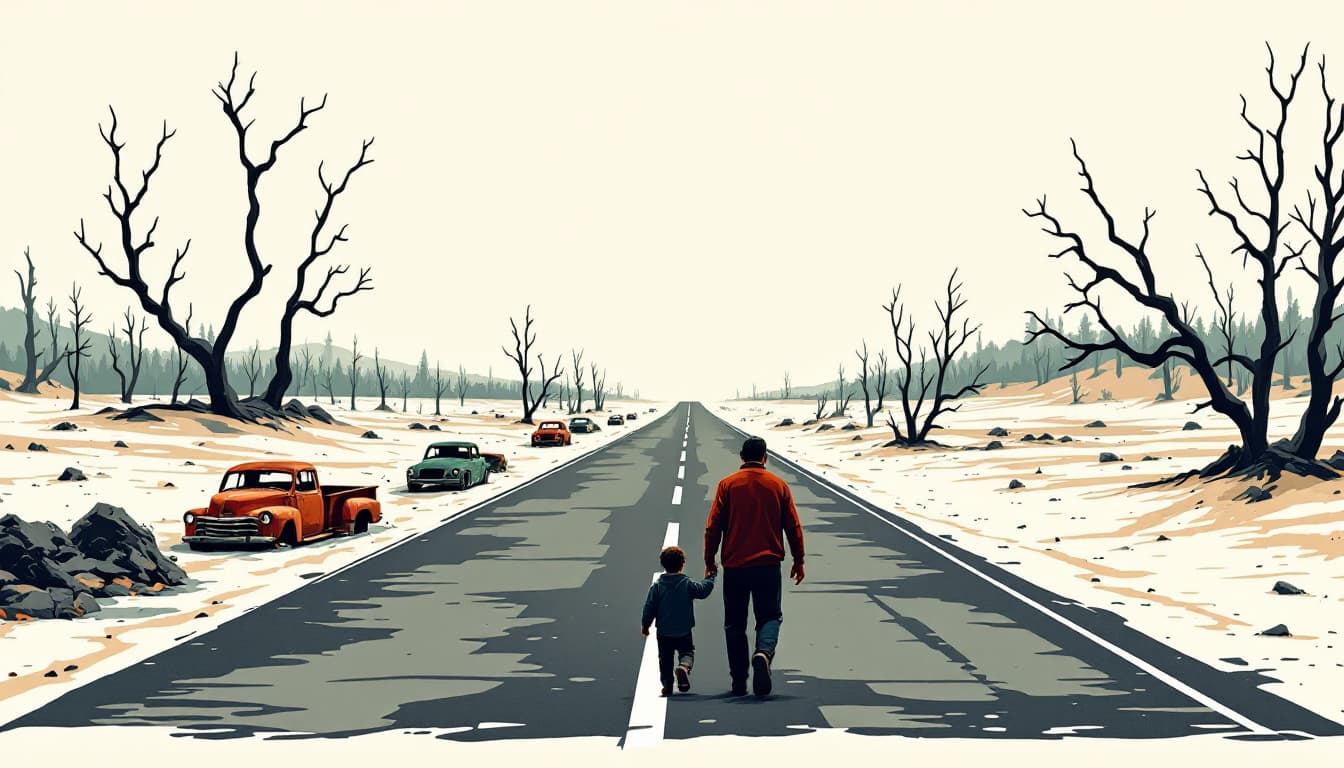
A film that asks something of you
There's a particular kind of courage required to make a film like The Road. John Hillcoat's 2009 adaptation of Cormac McCarthy's Pulitzer Prize-winning novel refuses nearly every consolation that Hollywood survival cinema typically offers: no faction wars, no hidden bunker full of supplies, no charismatic villain to defeat, no cathartic explosion to release the tension. What it offers instead is two people — a father and his young son — walking south through the ruins of the United States, trying to stay alive and, more urgently, trying to stay human. That is both the whole of the plot and the whole of the film's moral argument, and Hillcoat is faithful to both with an integrity that is genuinely rare in studio-adjacent cinema.
The premise
Something has ended the world. McCarthy's novel never specifies what, and Hillcoat wisely maintains that reticence — a detail that initially frustrated some reviewers but which is, in fact, the right artistic decision. The cause is irrelevant to the experience of survival, just as the cause of a house fire is irrelevant to the family standing on the pavement in the cold. What matters is this: the sky is a permanent grey, nothing grows, the coasts are choked with the wreckage of civilization, and most of what remains of humanity has turned predatory. The father, played by Viggo Mortensen, is guiding his son — played with remarkable naturalism by young Kodi Smit-McPhee — toward the southern coast in the hope that warmth, or safety, or something worth finding, might be waiting there. Neither father nor audience is given much reason to believe this. The journey is the film.
Craft: what Hillcoat and his collaborators achieve
Hillcoat made his name with The Proposition, a brutal and beautiful Australian western, and he brings the same instinct for landscape-as-character to this material. Working with cinematographer Javier Aguirresarobe, he renders post-apocalyptic America in colours that seem to have been wrung nearly dry — greys and tans and the occasional shock of fire, a palette that feels genuinely like a world where photosynthesis has stopped. There are sequences — a descent into a basement, a discovery on a rural road — that lodge in the memory the way certain nightmares do, not because of gore but because of what they imply about the fragility of everything we take for granted.
Mortensen is simply extraordinary. It is a performance without vanity: gaunt, filthy, racked by a cough that the film circles around like a slow-moving storm. He carries the full weight of McCarthy's central tension — the father is both his son's greatest protector and, in some fundamental sense, his greatest danger, a man whose love has curdled at the edges into something that could become monstrous if circumstances demanded it. Mortensen holds this ambiguity without ever making it feel like an actor's calculated choice. It simply lives in him. Smit-McPhee, meanwhile, is one of those child performances that seems to have been achieved by some inexplicable alchemy: he is never precious, never cute, never performing childhood for an adult audience. His scenes with Mortensen achieve a kind of authentic gravity that is genuinely moving.
Nick Cave and Warren Ellis provide the score — spare, cello-heavy, occasionally almost too beautiful for the images it underscores — and the film is all the better for it. When music does swell, even slightly, it earns that swell.
What works and what doesn't
What works is almost everything tonal and performative. The film understands that this is a story about love under conditions specifically designed to destroy love, and it never loses sight of that.
What is slightly less successful is the film's handling of its supporting cast. Several well-known actors appear in brief roles — sequences that, in McCarthy's novel, have the quality of fables encountered by the roadside. On screen, the recognisable faces of these performers occasionally rupture the film's hermetic world just enough to remind you you're watching a film. One encounter, in particular, with a character who represents a kind of spectral moral test, works less well than it does on the page, feeling somewhat truncated when it needed more space to breathe. The novel's patience — which is, frankly, its greatest virtue — is the one thing a two-hour film cannot fully replicate.
There are also moments where the film's admirable restraint tips slightly into a pacing that will lose viewers who came expecting conventional survival-thriller momentum. This is not a criticism of the film's artistic choices so much as an honest warning: The Road is an experience that requires surrender, and some audiences will resist that.
Who it's for
This is not a film for a Friday night when you want to unwind. It is a film for a Sunday evening when you're prepared to sit with something difficult and emerge, slightly changed, on the other side. Fans of McCarthy's novel will find it a faithful and often inspired adaptation — not perfect, but serious in exactly the ways that count. Viewers new to the material will find one of the most emotionally rigorous works of post-apocalyptic cinema ever made. It deserves the comparison to the best of the genre, and it earns that status not through spectacle but through sustained, humane attention to what it means to keep going when there is almost no reason to.

