
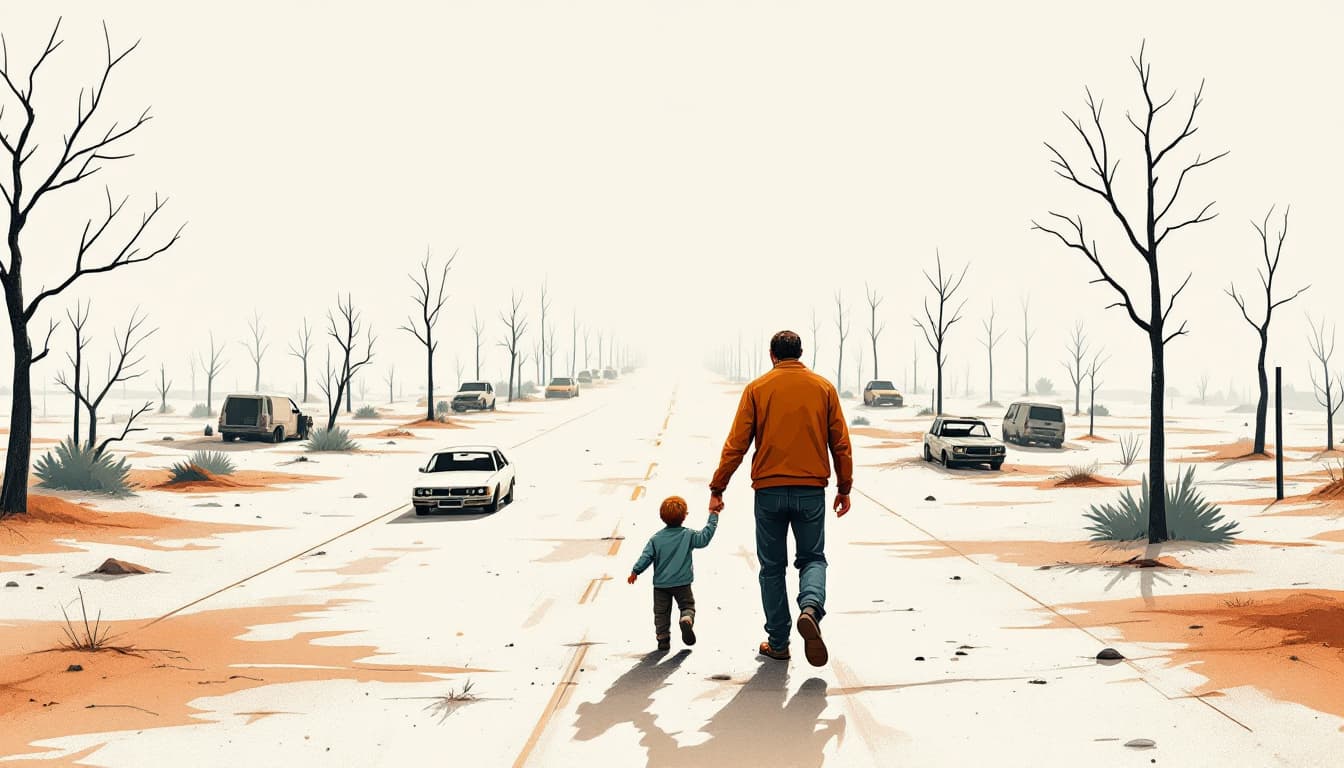
The fire in the dark
There is a sentence near the beginning of The Road that stops most readers cold. A man wakes in the dark beside his sleeping son and watches him breathe. McCarthy writes it plainly, with almost no ornamentation, and yet something in the rhythm and the context makes the moment feel geological in its weight — as if love itself were a fact of nature, like gravity, indifferent to the ruin surrounding it. That tension — between tenderness and catastrophe, between the instinct to hope and the evidence against it — is what The Road is about, and McCarthy sustains it for 287 pages without once blinking.
Published in 2006 and awarded the Pulitzer Prize for Fiction in 2007, the novel arrived as something of a departure for McCarthy, whose previous work — the Border Trilogy, Blood Meridian, No Country for Old Men — had largely been rooted in the American Southwest and its mythologies of violence and landscape. The Road keeps the landscape and the violence but strips away the myth. What's left is a gray, ashen world and two people trying to cross it.
The premise
A man and his young son — never named — are walking south through a post-catastrophe America. Whatever destroyed civilization is never explained, and McCarthy is wise to keep it that way. The sky is choked with ash, crops have failed globally, and most of humanity has perished. Those who remain sort themselves, more or less, into the desperate and the monstrous. The man and the boy push a shopping cart, scavenge for cans, sleep under tarps, and try, above all, not to be found by the wrong people. They are, the man tells the boy, "carrying the fire." It's the novel's central metaphor and its moral argument, and McCarthy earns it.
Craft: prose, structure, and character
The prose is McCarthy doing what McCarthy does at the height of his powers: stripped of quotation marks and most punctuation, the sentences move with a cadence that is simultaneously biblical and contemporary — less a stylistic affectation, here, than a formal expression of a world in which the ordinary social contracts have dissolved. Why mark dialogue when speech itself has become precarious? The effect is that reading the novel feels like hearing it spoken aloud by someone very tired and very certain of what they're saying.
The structure is episodic by necessity. McCarthy gives us a series of encounters and survivals arranged along the spine of the journey south. What prevents this from feeling repetitive is the precision of each scene and the way McCarthy uses the physical world — the cold, the weight of the cart, the taste of tinned peaches found in a cellar — as both concrete survival detail and emotional notation. When the man and boy discover a cache of food and the boy tastes a Coca-Cola for what may be the first time in his conscious life, it is funny and heartbreaking and strange in ways that summarizing it cannot convey.
The two central characters are rendered asymmetrically, and deliberately so. The man is drawn with great psychological specificity: his pragmatism, his guilt, his recurring dreams of the world before, his capacity for ruthlessness when he believes it necessary. The boy is rendered more archetypally — he is conscience, he is innocence, he is the reason — and this risks making him feel less like a child than like a symbol. McCarthy threads this needle carefully. There are moments where the boy's moral insistence feels almost too pure, too steady for a child of his circumstances. But McCarthy seems aware of this, and the dynamic between the father's hard pragmatism and the son's stubborn ethical clarity becomes the novel's real argument: not about survival tactics, but about what surviving is for.
What works and what doesn't
What works is almost everything. The pacing is relentless without being exhausting. The horror, when it comes — and it comes — is deployed with restraint that makes it more rather than less disturbing. McCarthy never lets the novel become torture porn or genre thriller; he is always after something larger, and you feel that ambition in every paragraph.
If there are reservations, they cluster around the novel's final movement. Without venturing into spoiler territory: McCarthy resolves his story in a way that some readers find earned and others find too consoling given the book's rigorous bleakness. I am not entirely in either camp. The ending feels thematically coherent — it follows the logic of the fire metaphor to its conclusion — but there is a slight softening of tone in the closing pages that sits oddly against the granite harshness of everything preceding it. Whether that's a flaw or a mercy may depend entirely on what you need from fiction.
The other minor complaint is that the female characters who appear are sketched rather than rendered. This is a known McCarthy limitation, and The Road does not escape it, though it must be said the novel's emotional architecture doesn't depend on them in the way some of his other books do.
Who it's for
The Road is not a comfort read. It is not, despite what the back-cover copy might suggest, a thriller, and readers looking for plot mechanics will be restless. It rewards — demands — a certain kind of patient, attentive reading. But for those willing to give it that attention, it is one of the more genuinely moving novels produced in this century, a book that asks hard questions about love, duty, and the persistence of goodness without pretending the answers come easily.

