
A quiet apocalypse, beautifully rendered
There's a particular kind of end-of-the-world story that forgoes spectacle in favour of stillness — no roving gangs, no mushroom clouds on the horizon, just the cold, slow comprehension that something irreversible has already happened. The Midnight Sky, George Clooney's 2020 Netflix adaptation of Lily Brooks-Dalton's novel Good Morning, Midnight, belongs firmly in that tradition. It is serious, handsome, and austere. It is also, frustratingly, a little inert.
That's not a verdict you'd expect from a film with Clooney behind and in front of the camera, Alexandre Desplat scoring it, and enough production money to make the Arctic look genuinely alien. The ambition is evident in every frame. The execution, though, is uneven — and the emotional payoff the story keeps promising arrives, when it does, a beat or two too late.
The premise
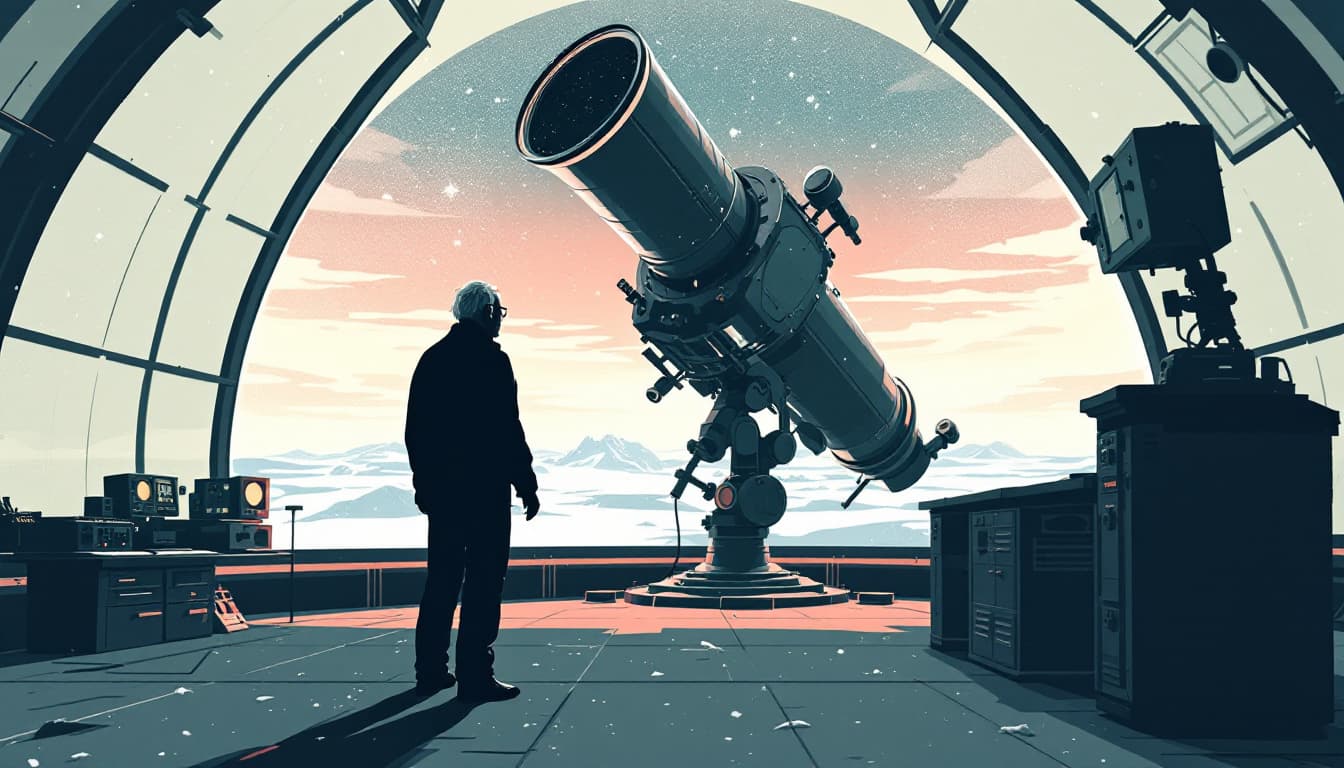
The world, we understand, has been rendered largely uninhabitable by some unnamed catastrophe. Clooney plays Augustine, an ageing, ailing astronomer who has chosen to remain at a remote Arctic research station rather than evacuate with everyone else. He is alone, and apparently content to be so — until he discovers a young girl left behind in the confusion, with whom he cannot communicate in any ordinary way.
Intercut with Augustine's isolated vigil is the story of a crew aboard a spacecraft returning from a mission to one of Jupiter's moons — a journey they undertook in hope, now arriving home to find the world they left no longer waiting for them. The film moves between these two timelines, linking them thematically even as the logistics of the connection reveal themselves slowly.
Craft: what Clooney gets right
As a director, Clooney has always been drawn to restraint — Good Night, and Good Luck and The Ides of March share a preference for understatement — and here he pushes that instinct toward something more meditative than thriller. Several sequences are genuinely striking. A harrowing mid-film set piece on the ice, involving a desperate journey across frozen terrain in deteriorating conditions, is as tense and physically convincing as anything in the film — properly frightening, efficiently staged. For a few minutes, The Midnight Sky stops being contemplative and becomes urgent, and the contrast is almost startling.
The visual palette throughout is extraordinary. Cinematographer Martin Ruhe shoots the Arctic with a blue-grey beauty that makes isolation feel both punishing and paradoxically gorgeous. The spacecraft interiors are credibly functional rather than gleaming — worn, cluttered, lived-in — and Ruhe's work there avoids the antiseptic gloss that dates so many sci-fi productions. Desplat's score threads through all of it with characteristic intelligence, never quite telling you how to feel, which suits the film's tone even when that tone tests your patience.
The ensemble aboard the spacecraft — including Felicity Jones, David Oyelowo, and Kyle Chandler — is largely strong. Jones in particular brings warmth and specificity to a role that could easily have been functional. The script gives the crew moments of genuine camaraderie, and those scenes are among the film's most alive.
What works and what doesn't
The central performance is where the film's ambivalence cuts deepest. Clooney is clearly committed to Augustine — buried under unflattering make-up, moving with deliberate physical fragility — and yet the character remains oddly opaque. Augustine's backstory, delivered in flashback, should anchor us emotionally to a man choosing to die at his post; instead those sequences feel obligatory rather than illuminating. We're told repeatedly that Augustine sacrificed human connection for his work, but we don't feel the weight of that choice, which makes the film's eventual emotional gestures feel slightly unearned.
The young girl who accompanies him — named Iris in the film — is a narrative device that borders on the clichéd. The device is handled with some sensitivity, but the limitations of the storytelling are clearest whenever she appears; the scenes between them strain toward poignancy without quite achieving it, because we can see the mechanism working.
There's also a pacing problem that no amount of visual elegance can fully conceal. At nearly two hours, The Midnight Sky moves with a deliberateness that risks tipping into languor. Some films earn that rhythm — Interstellar, which this clearly admires, earns it because its emotional architecture is load-bearing. Here, the quietness occasionally feels less like confidence and more like a film uncertain how to modulate its own mood. The spacecraft storyline, though well-performed, generates less tension than it should, and the intercutting occasionally dilutes rather than deepens the drama.
What saves the film from being merely handsome and hollow is its genuine thematic seriousness. The Midnight Sky is interested in legacy, in the specifically masculine failure to inhabit one's own life while living it, and in what it means to send a message into a void with no certainty it will be received. These are not small ideas, and the film circles them with real intelligence. It just doesn't quite close the distance.
Who should watch it
If you're drawn to contemplative, visually-led science fiction in the vein of Annihilation or early Ridley Scott — films more interested in atmosphere and theme than plot mechanics — The Midnight Sky will likely reward a patient Saturday evening, provided you go in without inflated expectations. It's a film to respect more than to love.
Those looking for survival-oriented drama with genuine stakes and propulsive plotting should probably look elsewhere. The film's true subject is regret, not survival.

