
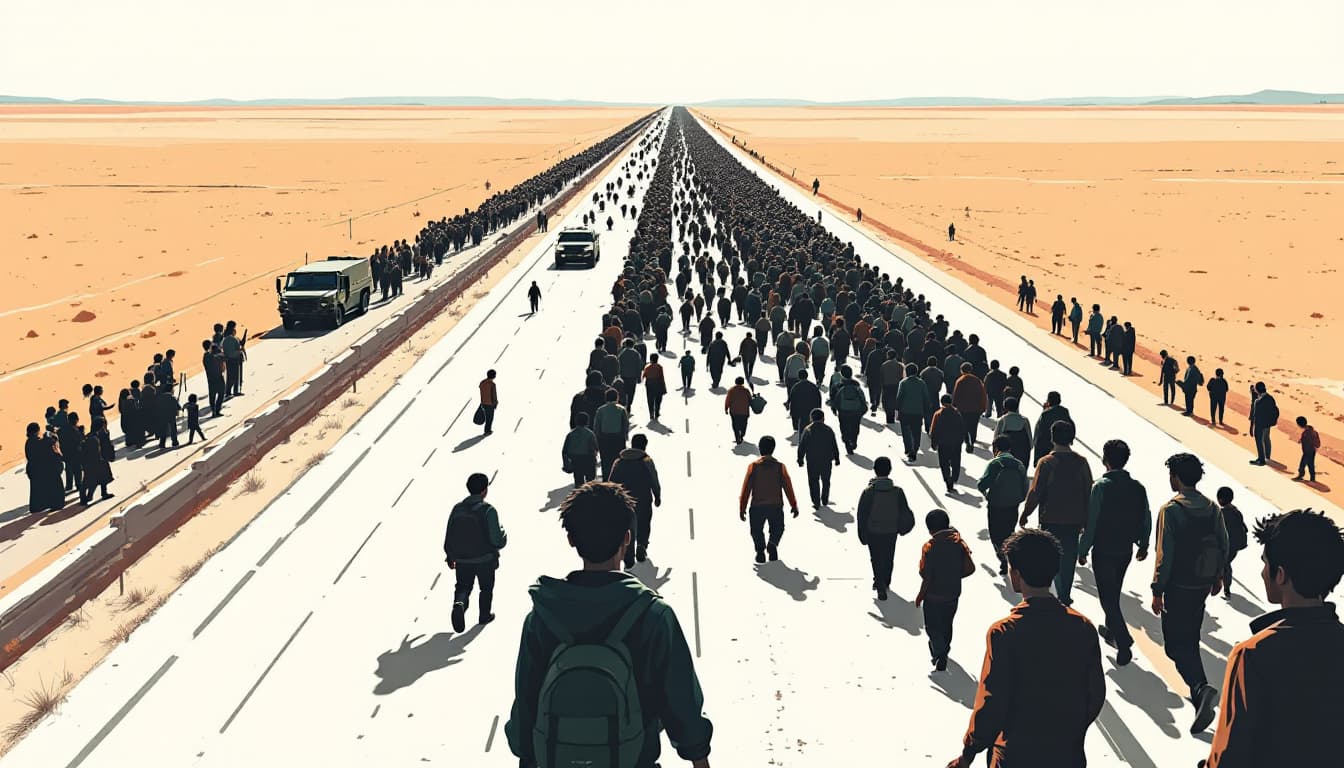
Francis Lawrence's The Long Walk, adapted from the early Stephen King novel he first published under the Richard Bachman pseudonym, withholds the one thing the genre almost always hands you: an explanation. We never learn exactly how America became the place we're watching. There is no opening crawl, no expository newscast, no flashback to the war or the coup or the collapse. We only see what this country produces — fifty teenage boys who have volunteered to walk down a road without stopping, knowing that slowing below pace three times means a bullet, and that only one of them will live to the end. That refusal to explain is not a gap in the storytelling. It is the storytelling.
A premise stripped to the bone
The conceit is simple and merciless, and Lawrence stages it with real discipline. The boys walk. They can't stop, can't sit, can't rest; soldiers in halftracks pace them, issuing warnings and then, eventually, doing what the rules require. The last one breathing wins money and a single granted wish. Everyone else dies on the asphalt as a watching nation treats the whole thing as inspiration. There is no master villain to topple in the third act, no system the heroes can outwit, no rebellion brewing in the wings. There is only the road, the rules, and the slow, dawning comprehension of why anyone would sign up for this in the first place.
That "why" is the film's true subject, and it's where Lawrence's adaptation is smartest. These boys are not conscripted at gunpoint. They volunteer, because the country around them offers so little — so little opportunity, so little dignity, so little plausible future — that a near-certain death with a sliver of hope attached reads, to them, as a rational wager. The movie understands that this is the real obscenity: not the spectacle of the Walk, but the arithmetic of despair that makes it an attractive bet. Lawrence frames the violence with restraint rather than relish, and the restraint is what makes it land; each death is sudden, graceless, and final, with none of the operatic build a lesser film would indulge.
Performances that catch you off guard
Cooper Hoffman and David Jonsson anchor the film with work far more tender than the premise promises. Their friendship — built mile by mile, in the small currency of shared jokes, half-confessions, and quiet acts of care — becomes the movie's beating heart and its cruelest weapon, because the form guarantees it cannot end well. Hoffman gives his protagonist a watchful, wounded decency; Jonsson is all wit and bravado with something frightened underneath. The ensemble of young actors around them finds real distinction in roles that could easily have been interchangeable casualties, so that even minor walkers register as specific human beings before the road takes them.
Mark Hamill, as the Major who presides over the contest, is chillingly banal — not a cackling tyrant but a functionary, evil rendered as procedure and routine. JT Mollner's screenplay trusts silence and small gestures over speeches, and Lawrence — a filmmaker who knows his way around dystopian spectacle from the Hunger Games pictures — pointedly withholds spectacle here. The camera stays close and patient. The gut-punches come from performance and accumulation, not from score swells or slow motion, and the film is far more disciplined than its premise might lead you to expect.
What works, what tests you
The film's relentlessness is both its point and its limitation. By design it is repetitive — a road, a pace, a countdown, a death, repeat — and there is a stretch in the middle where the bleakness flattens into something closer to endurance for the viewer too. A few of the boys' backstories are sketched rather than developed, casualties of a structure that can only pause so often. But the final act is extraordinary, and it earns an ending that is genuinely hard to shake precisely because the movie has made you care about young men you always knew were doomed. This is among the better King adaptations in years, and one of the few to honor the novel's despairing core rather than sand it down into something more marketable.
Who it's for
Viewers who can sit with sustained dread and unrelieved tragedy will find a beautifully made, deeply sad film that respects their intelligence. The squeamish, or anyone hoping for catharsis, uplift, or a last-minute escape hatch, should look elsewhere — The Long Walk offers none of those, and it is more honest, and more haunting, for the refusal.

