
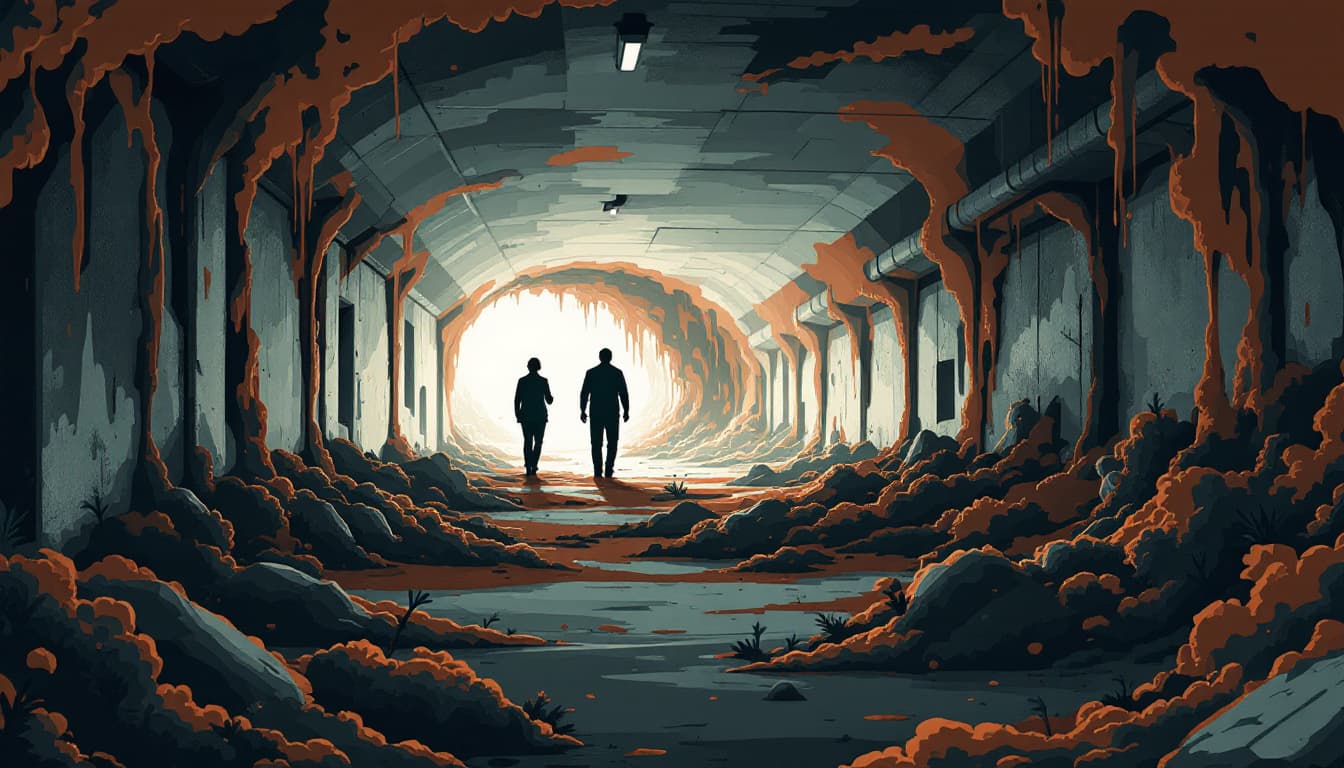
The weight of hope in a broken world
Video game adaptations have a long and largely inglorious history. The interactive medium's reliance on player agency — its whole point — tends to evaporate on screen, leaving writers scrambling to explain why the protagonist doesn't simply walk in a different direction. What Craig Mazin and Neil Druckmann have achieved with The Last of Us is something genuinely rare: a translation that understands which elements of the source were always cinematic and which were scaffolding for gameplay, and builds accordingly. The result is not a love letter to the game so much as an argument that the story always had a life beyond the controller.
Spores, smugglers, and a cross-country reckoning
The setup is elegantly bleak. Twenty years after a mutated Cordyceps fungus has colonized much of humanity — turning infected people into aggressive, degraded creatures — what remains of civilization huddles in heavily policed quarantine zones, where the cure for one disease is the authoritarianism of the state. Into this world steps Joel, a hardened survivor turned smuggler, tasked with escorting a teenager named Ellie across a shattered America to a resistance group that believes she may hold the key to a vaccine.
That premise could easily become a zombie-road-trip procedural. What Mazin and Druckmann are actually interested in is grief — specifically, the ways grief calcifies into a kind of protective brutality, and what it costs to let that armor crack. The show earns its darkness because it keeps the human arithmetic honest: every act of survival has a moral ledger, and the series is unafraid to show both columns.
Craft: performances, direction, and the show's best hour
Pedro Pascal's Joel is a masterclass in restraint. The performance works almost entirely in negative space — what the character won't say, won't remember, won't allow himself to feel — and Pascal conveys decades of suppressed catastrophe without a single scene of explanatory monologue. Bella Ramsey's Ellie could have been a grateful-kid foil; instead she's abrasive, funny, terrified, and ferociously alive, and the friction between her energy and Joel's shutdown is where the series generates most of its emotional heat.
The direction varies across the nine-episode run — this is television, so multiple directors share the load — but the show maintains a consistent visual grammar: muted palettes, long takes that let silence do structural work, and a confident use of overgrown geography that suggests nature's indifference rather than mere spectacle. The production design earns particular praise for resisting the temptation of ruin porn; these are spaces where people have actually been living and dying for two decades, and they feel it.
The third episode — a standalone focused on two peripheral characters across a much longer timeline — is the season's crown jewel and, arguably, one of the best single hours of television in recent memory. It takes an enormous structural risk and fully justifies every minute of its runtime. The fact that it works so well is also, paradoxically, a mild problem for the episodes that follow, which have to pull viewers back into the main narrative after something so complete and self-contained.
What works, and where the show strains
The series is most confident when it trusts its leads and its quieter registers. A sequence in which Joel and Ellie spend a night in the shell of a university, cautious and almost playful, tells you more about their evolving relationship than pages of dialogue could. These grace notes — small acts of humor or tenderness set against enormous threat — are what separate The Last of Us from grimmer, more nihilistic entries in the genre.
Where the show wobbles is in its pacing across the middle stretch. A few episodes feel engineered around a set piece or flashback rather than driven by genuine narrative momentum, and the antagonists — a fractured militia group known as FEDRA and the revolutionary organization that opposes them — are rendered with varying degrees of nuance. The political texture of the world is rich in implication but thin in execution; the show gestures at moral complexity between the factions without fully delivering it. Given that moral complexity is ostensibly the series' central project, this is a real gap.
There is also a tendency, most acute in the season's second half, to signal emotional beats a little too clearly — to over-score, over-linger, and occasionally to mistake suffering for profundity. The show earns its most devastating moments; not every moment of darkness is equally earned.
Who should watch it
The Last of Us is not a horror series, despite its monsters. It's a drama about parenthood, about what we protect and what that protection demands, and about whether hope is something you can rationally sustain or something that simply ambushes you. Viewers who came to the show for action will find enough — the set pieces are efficiently staged and occasionally stunning — but the series rewards patience and emotional availability. If you bounced off the game's combat or couldn't get past the interactive format, the show may actually serve you better; it has the time and the actors to let the story breathe.
Genre veterans may occasionally feel the scaffolding showing — the reluctant-guardian structure is well-worn territory — but Pascal and Ramsey are doing something real enough to transcend familiar bones. This is prestige television that mostly lives up to its pretensions, and in a landscape full of apocalyptic content that mistakes bleakness for depth, that matters.

