
When the Worst-Case Scenario Becomes Sunday Night Television
There's a particular kind of dread that good dystopian fiction generates — not the jump-scare variety, but the slow, creeping recognition that the machinery of the nightmare is plausible. Margaret Atwood built that dread into her 1985 novel with forensic precision, grounding every horror in documented historical precedent. Bruce Miller's 2017 Hulu adaptation inherits that quality and, in its strongest moments, amplifies it through the specific grammar of prestige television: close-up faces, color-coded dread, silence weaponized as effectively as any monologue.
Season one covers roughly the territory of the source novel, and it does so with more fidelity, and more cinematic invention, than the material has perhaps ever received on screen.
The World of Gilead
The premise: the United States, in the near future, has been overthrown by a theocratic authoritarian movement called Gilead. Environmental collapse and plummeting birth rates have driven the new regime to a brutal solution — fertile women are conscripted as "handmaids," assigned to powerful households and forced into ritualized, institutionalized rape in the hope of producing children. The story follows one such woman, known to us as Offred (Elisabeth Moss), as she navigates survival, resistance, and the constant negotiation between compliance and selfhood.
The show is careful to establish that this didn't happen overnight, and that's part of what makes it so uncomfortable. Gilead is built from existing social structures, existing prejudices, existing complacencies. The flashback structure Miller employs throughout the season — cutting between Offred's present captivity and her pre-Gilead life — earns its keep precisely because it shows a recognizable, ordinary world sliding toward the unthinkable in increments that each seemed, individually, containable.
Craft: What the Camera Knows That Words Sometimes Don't
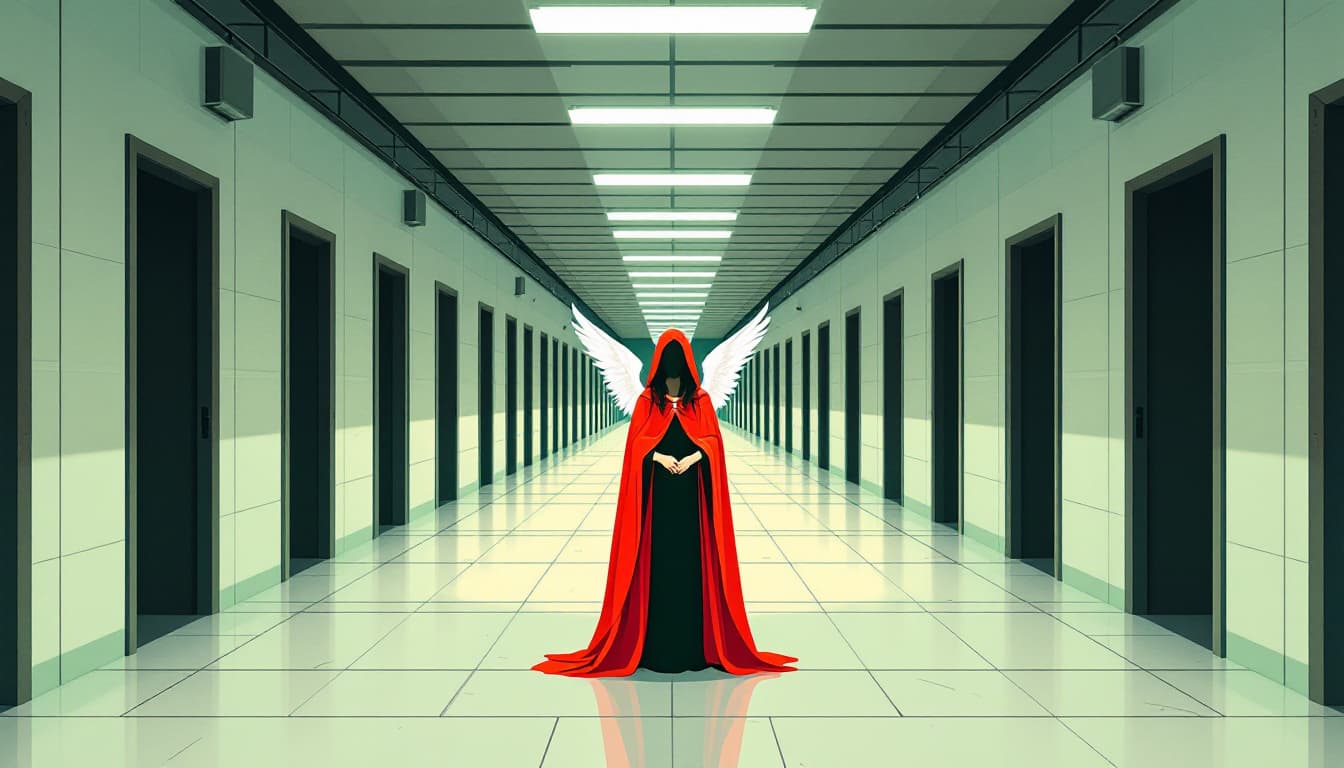
The series is, first and foremost, a visual achievement. Cinematographer Colin Watkinson shoots Gilead in a palette that is simultaneously beautiful and oppressive: the handmaids' red against bone-white snow, the architecture of power rendered in symmetry and shadow. The show understands that totalitarianism aestheticizes itself — that the ceremony of cruelty is part of its mechanism — and it deploys its own visual beauty in direct, sometimes uncomfortable tension with that idea.
Elisabeth Moss carries the season on her face. It's a performance built largely in silence and interiority — Offred's narration gives us her thoughts, but her body and expression must carry everything she cannot say aloud. Moss is extraordinary at this, communicating defiance, grief, calculation, and despair in the same sustained close-up. When the show is firing on all cylinders, she is the reason.
The supporting cast is strong across the board. Yvonne Strahovski brings genuine complexity to a role that could easily have been a flat villain, and Ann Dowd — as the terrifying, pragmatic Aunt Lydia — is doing some of the best work of her career. Joseph Fiennes is deliberately, effectively opaque as the Commander, a man whose menace lies partly in his apparent reasonableness.
Pacing in the early episodes is patient to the point of deliberate discomfort — this is a show that wants you to feel the weight of repetitive ritual, the claustrophobia of a life without privacy or agency. That patience pays off. By the time the season reaches its more volatile second half, the audience has been so thoroughly marinated in Offred's constrained existence that any act of resistance, however small, registers as seismic.
What Works, and What Doesn't Quite
The season is genuinely excellent for long stretches. The ritual scenes are staged with a cold theatricality that refuses to look away, and the show's insistence on the mundane — the small cruelties, the euphemisms, the bureaucratic banality of oppression — is more chilling than any overt brutality. An early episode that confines itself almost entirely to a single afternoon in a single room is among the best hours of television from that year.
Where the show stumbles, occasionally, is in its own self-consciousness. There are moments when the camera lingers on a symbolic image for just a beat too long, underlining what the scene has already made plain. The score, too, occasionally tips into emotional instruction when the material needs no assistance. Atwood's novel trusts its readers; the series sometimes doesn't extend the same confidence to its viewers.
The flashback structure, while largely effective, can also interrupt momentum at inopportune moments — particularly in the middle stretch of the season, where the present-tense narrative builds genuine urgency only to be interrupted by backstory that feels slightly less pressing than what we've just been pulled away from.
And while the season finale provides a moment of genuine ambiguity — true to the spirit of Atwood — the series occasionally strains against its source material's open-endedness in ways that anticipate the longer run of the show more than they serve this particular season.
Who Should Watch
If you have any tolerance for morally serious, emotionally demanding drama, this is essential viewing. It is not comfortable television — it is not meant to be — but it is rigorously made and genuinely thought-provoking in ways that outlast the watching. It rewards attention and repays discussion. Fans of The Americans, Black Mirror, or literary dystopian fiction in general will find much to admire.
Those looking for action-forward post-apocalyptic entertainment will find this slow and interior by design. That's a feature, not a flaw — but it's worth knowing going in.

