
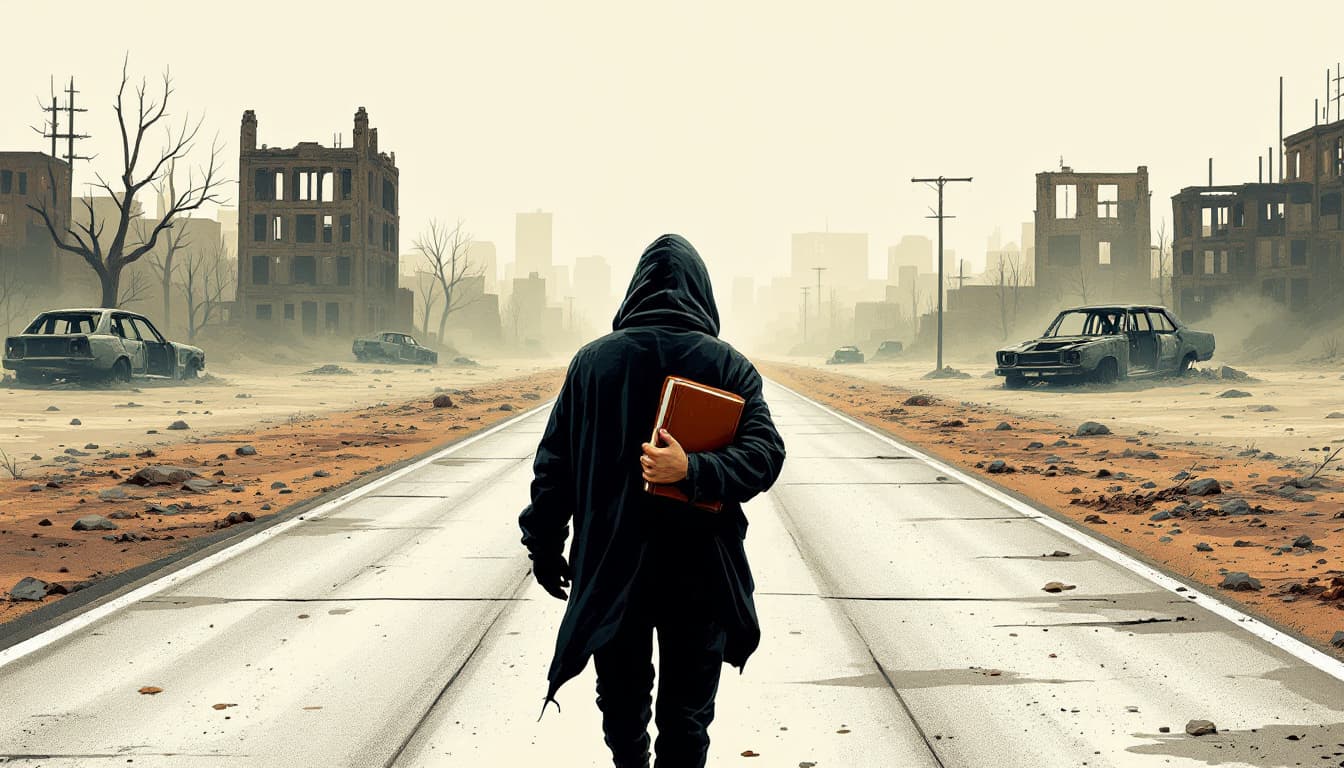
A walker in a dying world
There is a particular kind of post-apocalyptic film that wants to be more than entertainment — that reaches for myth, for scripture, for something to say about why human civilization might be worth saving in the first place. The Hughes Brothers' 2010 film The Book of Eli is unambiguously that kind of movie. It announces its intentions in nearly every frame: the bone-dry palette, the near-liturgical silence on the road, the slow-burn gravitas Denzel Washington brings to every scene he inhabits. The question is not whether the film is ambitious. The question is whether it fully earns those ambitions. The answer, honestly, is: mostly.
A lone figure, a long road
The setup is classical in the best sense. Decades after a cataclysm has scorched the world and shredded the social fabric, a solitary man walks west across the American ruins, carrying a book he protects with lethal competence and something close to religious devotion. He ends up in a small, brutally governed settlement where a self-appointed warlord — played with oily relish by Gary Oldman — understands exactly what that book represents and very much wants it for his own purposes. What follows is partly a road movie, partly a siege narrative, and partly an extended meditation on faith, memory, and the question of whether the past is worth preserving at all.
The film wears its allegorical intentions openly, which is either a strength or a weakness depending on your tolerance for parable-as-genre. The book at the centre of the story is not a MacGuffin in the conventional sense; it is genuinely the subject. The Book of Eli wants to argue that stories — particular stories, carrying particular values — are worth dying for. That is not a subtle thesis, and the Hughes Brothers do not handle it subtly.
Craft and performance
What rescues the film from its own earnestness, repeatedly and reliably, is Denzel Washington. This is a performance built on restraint. Eli speaks little, emotes less, and yet Washington fills every frame with a quality that is somewhere between serenity and coiled menace. You believe completely that this man has walked for thirty years and could walk for thirty more. You also believe, during the film's several action sequences, that he could dismantle a room of armed men with the unhurried efficiency of someone completing a household chore. The physicality of the performance is exact without being showy, and the stillness Washington brings to the quieter scenes gives the film an almost contemplative texture that distinguishes it from noisier genre entries.
Gary Oldman, for his part, does what Gary Oldman does in this kind of role — he makes a potentially cartoonish villain feel genuinely dangerous by playing the intelligence first and the menace second. His Carnegie is not a raving lunatic but a frustrated pragmatist, a man who understands power and simply wants more of it. The scenes the two leads share crackle with a quality the rest of the film doesn't always sustain.
The Hughes Brothers direct with real visual confidence. The cinematography renders the post-collapse American West as a place of terrible, austere beauty — all blown dust and washed-out light, with an almost monochromatic palette that occasionally breaks into startling colour. There is a long-shot action sequence, the kind of thing that looks effortless on screen and is obviously anything but, that is among the more technically accomplished pieces of action filmmaking from that period. The brothers clearly understand how to compose a frame for both beauty and threat.
What works, what doesn't
The problems are real, though not fatal. The pacing in the film's second act becomes genuinely sluggish in places, as if the narrative stops to admire its own atmosphere a beat or two too long. The film trusts its visuals — correctly — but occasionally confuses visual poetry with dramatic momentum, and the two are not the same thing.
Mila Kunis, who joins Washington as a reluctant companion partway through, is given a character whose arc is more functional than fully developed. She is there to be changed by Eli, to be educated by him, and to give the audience a surrogate perspective — but she is written thinly enough that the transformation feels more asserted than dramatised. This is a structural issue rather than a performance problem; Kunis does capable work with limited material.
The film's ending — and I will say nothing specific — will either feel transcendent or slightly too neat, depending on how much you share the filmmakers' convictions. It is a conclusion that has divided viewers since 2010 and will likely continue to do so. On reflection, it feels earned in thematic terms even if it leans into the parabolic a shade too hard for realist tastes. Whether that constitutes a flaw is genuinely a matter of what you ask from this kind of story.
Who it's for
If you are drawn to post-apocalyptic fiction that takes ideas seriously — that is interested in why civilisation might matter and not merely in the mechanics of its collapse — The Book of Eli repays the investment. Fans of The Road's bleak spirituality will find echoes here, though this film is considerably more action-oriented and ultimately more hopeful. It is also, frankly, a film for anyone who wants to watch Denzel Washington be magnificent for just under two hours, which is a legitimate and sufficient reason on its own terms.
It falls short of the genuine classic it occasionally resembles. But it is a serious, well-crafted piece of work, and in a genre that frequently settles for spectacle, seriousness is worth something.

