
The dread of not knowing what you're afraid of
There's a particular kind of horror that Jeff Nichols is interested in — not the horror of monsters or catastrophe, but the horror of a man watching his own mind betray him. Take Shelter (2011) opens with rain falling into a backyard, the sky the colour of a bruise, and a sense of wrongness so carefully constructed that you feel it in your sternum before you can name it. It's a remarkable opening. The question the film spends two hours wrestling with is whether it can sustain that atmosphere across its full runtime. The honest answer is: mostly, but not entirely.
A family at the edge of something
Curtis LaForche (Michael Shannon) is a construction worker in rural Ohio, a steady, quiet man with a wife, Samantha (Jessica Chastain), and a young daughter who is deaf. They're a recognisably functional working-class family — careful with money, planning for their daughter's cochlear implant surgery, managing a modest but decent life. Then Curtis begins having nightmares. Not vague anxiety dreams, but vivid, tactile visions of apocalyptic storms, of oil falling from the sky, of people he loves turning on him with sudden, animal violence.
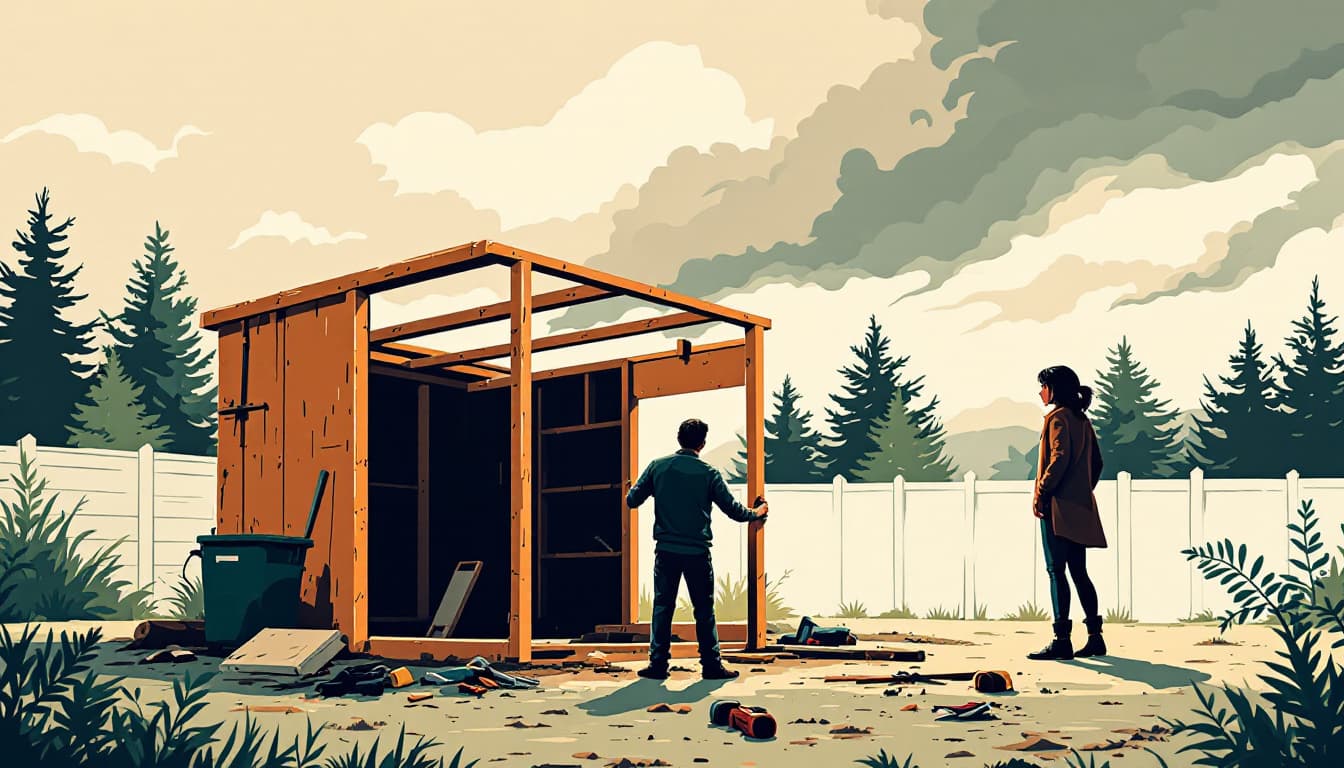
What Nichols does shrewdly is to refuse, for most of the film, to tell us which of two stories we're in. Is Curtis a prophet, or is he losing his mind? He has a family history of paranoid schizophrenia. He knows this. He reads library books about it, quietly, guiltily, the way a man researches a symptom he's terrified to name. And yet the visions keep coming. He begins expanding the tornado shelter in his backyard — secretly at first, then obsessively, spending money the family doesn't have, borrowing equipment from work, risking everything.
Shannon and Chastain make it matter
The film would collapse without its central performances, and it has two of the best of that decade. Michael Shannon's face is built for this role — angular, troubled, capable of conveying enormous internal pressure without histrionics. He plays Curtis's deterioration with a restraint that is almost painful to watch. There's a scene in a community diner where the pressure finally cracks open in public, and Shannon delivers it with the kind of raw, ungainly specificity that you can't manufacture. It's the film's centrepiece, and it earns every second.
Jessica Chastain matches him. Samantha is not written as a passive sufferer or a saintly spouse — she's frightened, frustrated, occasionally furious, and deeply in love with a man she's watching disappear. Chastain finds every note in that register without once tipping into melodrama. The scenes between the two of them carry the film's emotional weight with genuine conviction.
Nichols's direction is controlled and confident. He shoots the Ohio flatlands with a kind of epic quietness — wide skies, flat light, the particular texture of working-class American life rendered without condescension. The dream sequences are staged with real visual unease; he uses colour temperature and sound design to mark the membrane between Curtis's waking and dreaming states without ever being schlocky about it.
Where patience becomes a liability
And yet. Take Shelter runs at just over two hours, and there are stretches in the second act where Nichols's commitment to slow-burn atmosphere tips into genuine inertia. The film circles some of its thematic territory — the pressure on men to provide, the silence around mental illness in working communities — without always deepening it. A subplot involving Curtis's friendship with a colleague he harms feels underexplored. There are scenes that make the same point that earlier scenes already made, and you become aware of the film's deliberate pacing as a choice rather than an inevitability.
The ending has attracted significant debate, and it's worth acknowledging without spoiling it: Nichols reaches for something that is either boldly ambiguous or an evasion, depending on your tolerance for films that decline to commit. I found myself in a middle position — admiring the audacity of the move while feeling that it slightly lets the film off the hook it spent so long building. A work that has asked such precise, grounded questions perhaps deserves a more grounded resolution.
None of this is fatal. Take Shelter remains a serious, well-made film about a real subject. But it is also a film that sometimes mistakes patience for profundity, and there's a difference.
Who it's for
This is emphatically not a disaster movie or a genre thriller, and viewers approaching it as either will be frustrated. It is a slow, intimate character study that borrows apocalyptic imagery for psychological and metaphorical purposes. If you responded to films like Beasts of the Southern Wild or early Terrence Malick — work that prioritises texture and feeling over plot mechanics — you'll likely find it rewarding. Those who need a conventional narrative throughline will find it wearing.
At its best, Take Shelter is exactly what independent American cinema should be: specific, humane, technically accomplished, and willing to sit with difficult questions. At its most self-indulgent, it reminds you that restraint and slowness are different virtues.

