
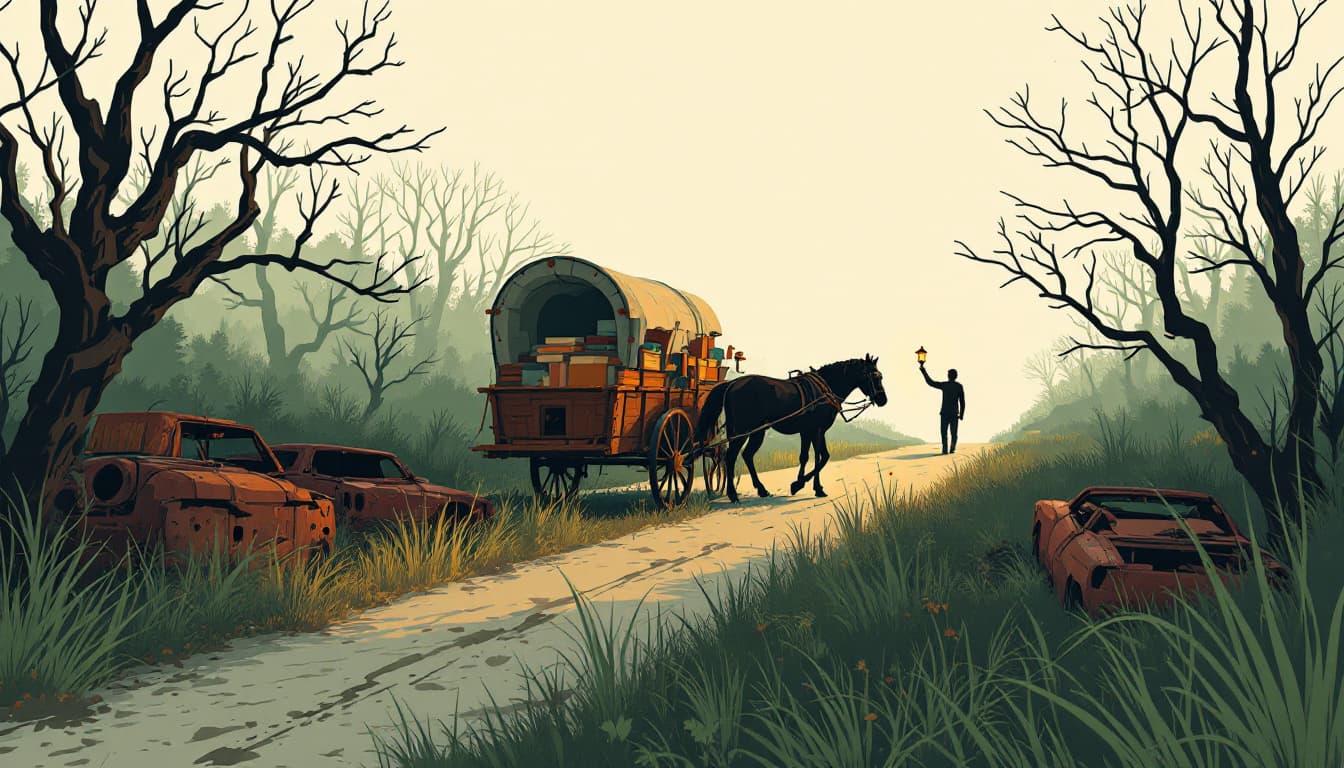
A different kind of end-of-the-world story
Most post-apocalyptic television plants its flag in the dirt and dares you to endure. The world ends; survivors scramble, suffer, and frequently shoot each other. The drama is transactional: threat, response, loss, repeat. Station Eleven, Patrick Somerville's adaptation of Emily St. John Mandel's beloved 2014 novel, does something genuinely unusual with the genre's furniture. It clears away the guns and the scavenging and asks, with complete seriousness: what did we love about the world before? And what are we willing to carry forward?
The answer, in this show's telling, is Shakespeare and music and the specific gravitational pull of other human beings. That could easily tip into preciousness. Somehow it almost never does.
The shape of the story
A lethal flu pandemic — the Georgian Flu — collapses civilization over the course of days. The series cuts between the night of the catastrophe, the fragile world twenty years later, and the years in between, weaving together a constellation of characters whose lives intersect around a single famous actor who dies on a Chicago stage at the moment everything falls apart. The Traveling Symphony — a roving company of actors and musicians who perform Shakespeare for scattered communities across the Great Lakes region — serves as the spine of the post-collapse narrative, with a young woman named Kirsten at its center.
That's the architecture, and it matters, because Somerville and his writers use it not as a gimmick but as an argument: that the past is always present, that grief and memory don't respect linear time, and that survival without meaning is just a slower form of dying.
Craft at every level
What strikes you first is how the show looks. The production design of the post-pandemic world is gorgeous in an unsettling way — overgrown airports repurposed as townships, a summer-camp compound that has calcified into something more ominous. Director Hiro Murai, who handles several episodes, brings the same painterly, uncanny eye he developed on Atlanta. Scenes breathe. There's negative space in both the frame and the script, which trusts the audience to feel things without being told how.
The performances are the real engine, though. Mackenzie Davis, as Kirsten in adulthood, does something I'd call controlled wildness — she's clearly shaped by the world that raised her, practical and watchful and capable of sudden, unpredictable tenderness. Himesh Patel gives the pre-collapse timeline its emotional ballast as a young actor navigating the night everything changed. And Gael García Bernal has a few scenes, in his particular role, that I won't detail beyond saying he makes you feel the seduction of a certain kind of charismatic certainty in a world that has lost all its old certainties.
The non-linear structure, which could have been an affectation, earns its complexity. When the show rhymes a moment from year zero with something twenty years later, it's not a cheap aha — it's genuinely moving, the way a line of poetry lands differently when you've lived another decade. There's an episode set almost entirely in the transitional years — the gap between collapse and the world Kirsten inhabits — that functions almost as a standalone short film, and it's among the most emotionally devastating hours of television from this decade.
What works, and what tests your patience
The show's central conviction — that art is survival infrastructure, that what makes us human is also what makes life survivable — is stated, restated, and illustrated with real delicacy most of the time. Mandel's novel is the rare speculative fiction that takes aesthetics seriously as a philosophical question, and Somerville honors that.
But there are moments, particularly in the middle stretch, where the meditative pace tips toward listlessness. A subplot involving a character's journey into a cult-adjacent settlement is thematically essential but occasionally repetitive in its beats — the menace is there, but the escalation can feel stalled. Viewers accustomed to tighter plotting may fidget. The show is plainly uninterested in thriller mechanics; it wants you to sit with ambiguity, and if that's not your mode, certain episodes will feel indulgent.
The antagonist figure is a genuinely interesting creation — not a mustache-twirling villain but a man whose logic is internally coherent and whose damage is legible. The show gives him enough dimension to be troubling without excusing him, which is exactly right. What it doesn't quite do is let the final confrontation breathe at the same level of complexity the rest of the series has earned. It resolves — but there's a slight deflation where you'd hope for revelation.
These are real criticisms, but they're criticisms of a show reaching for something difficult. The misses are those of ambition, not laziness.
Who it's for
If you came to Station Eleven hoping for tactical survival drama — resource management, threat assessment, the satisfying crunch of contingency planning — you will be disappointed and probably bored. This is not that show, and it doesn't pretend to be.
What it is, is one of the most thoughtful explorations of collective grief and cultural continuity ever attempted on prestige television. It's for viewers who want their genre drama to have an interior life, who are willing to trust a non-linear structure, and who don't need every episode to end on a cliffhanger. It rewards patience lavishly.
Watch it with someone you'd want beside you at the end of the world — ideally someone who can tolerate a conversation about it afterward.

