
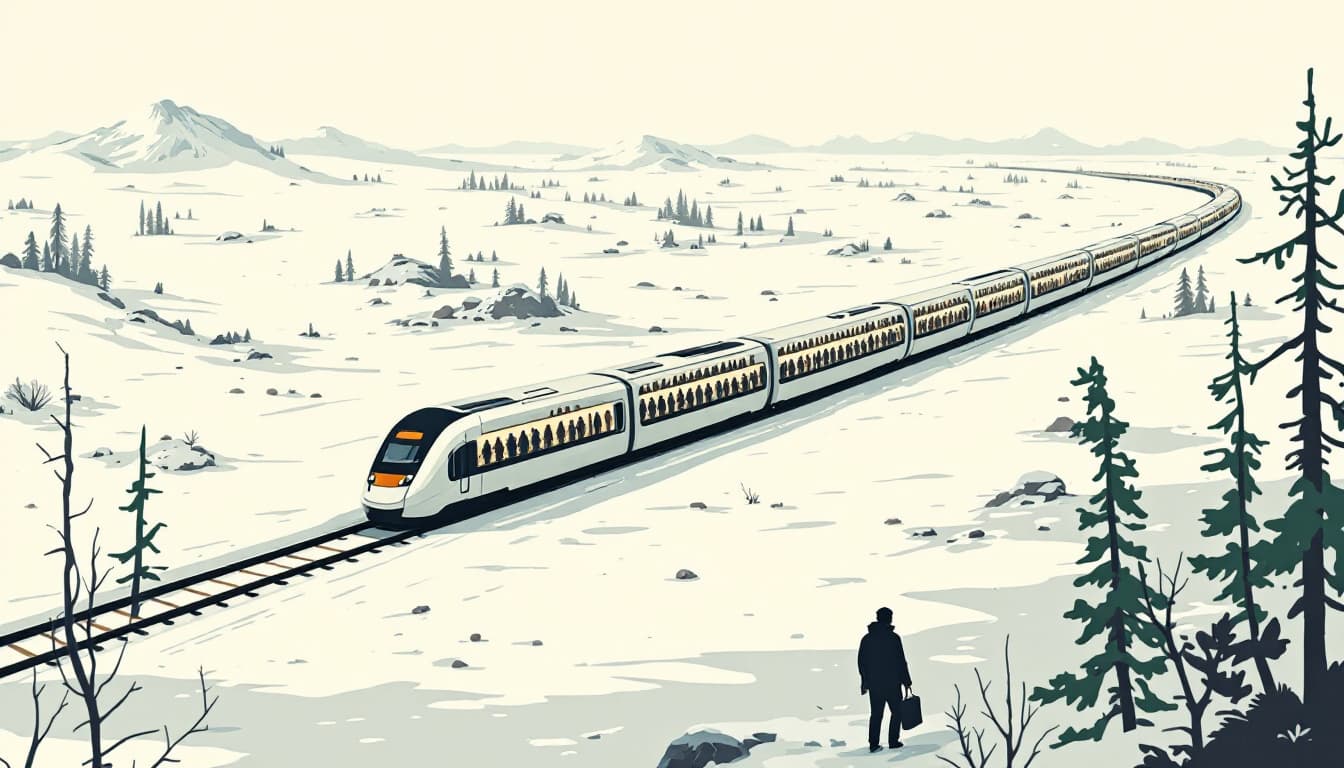
The train at the end of the world
There is a moment roughly midway through Snowpiercer when the allegory stops being an allegory and becomes something stranger and more uncomfortable — when you realise Bong Joon-ho is not merely making a point about inequality, but asking whether the point itself is part of the system it critiques. That moment of vertigo is what separates this film from a dozen other well-meaning dystopias. It lingers.
Bong adapted the film from a French graphic novel (Le Transperceneige), and the source's European pessimism is detectable beneath the English-language action-movie surface. The result is a genuine hybrid: crowd-pleasing in its kineticism, genuinely disturbing in its implications.
Premise: the world in seventeen carriages
A misguided attempt to reverse climate change has plunged Earth into a lethal deep freeze. The sole survivors of humanity are packed aboard a perpetually moving supertrain — the Snowpiercer — whose engine, kept running by its messianic inventor Wilford, has become both the world's only life support and its new social hierarchy made literal and physical. The wealthy live at the front in comfort and light; the poor are crammed into the tail in filth and protein bars made of compressed insects. Chris Evans leads the tail-end rebellion forward through the train, car by car.
The conceit is almost absurdly schematic, and Bong never pretends otherwise. Each carriage the rebels breach is a new social layer peeled back — a new revelation of what the front-dwellers have been permitted while the tail suffocates. The film's structure is essentially a side-scrolling video game, and it wears that linearity with confidence rather than apology.
Craft: controlled chaos in a metal corridor
Directing action inside a tube with no room to manoeuvre is either a catastrophic constraint or a gift, and Bong treats it as the latter. The fight choreography in the early carriages is close, brutal, and spatially coherent — you always know where everyone is relative to the train's direction of travel, which gives the violence a geography that most contemporary action films never bother to establish. A sequence conducted partially in darkness and lit only by the green glow of night-vision goggles is as formally inventive as anything in mainstream action cinema that year.
The performances are remarkable in their range. Chris Evans, still deep in his Marvel contract cycle, brings a physical exhaustion and moral ambivalence to his role that the role absolutely requires; he is not the clean hero the genre usually provides. Tilda Swinton, almost unrecognisable, delivers a performance of gleeful grotesque — a bureaucrat of violence so perfectly calibrated to the film's satirical register that she risks tipping the tone but never quite does. John Hurt brings weight and stillness to the tail's elder statesman. And in a film full of strong English-language work, it is worth noting that Korean actors — including the great Song Kang-ho — anchor some of the film's most emotionally grounded scenes without a word of English, communicating across the language barrier in ways that feel thematically pointed rather than accidental.
The cinematography by Kyung-pyo Hong uses the train's claustrophobia productively. The colour palette shifts as the protagonists move forward — from the grey-brown misery of the tail through increasingly vivid, almost grotesque saturation — until the front of the train feels like a fever dream of consumption. It is production design and photography working in genuine concert.
What works and what doesn't
What works is the film's refusal to be comfortable. The children are not safe from its implications. The rebels are not simply noble. The system's logic, when finally fully revealed, is horrible precisely because it has a certain awful coherence. Bong is interested in how people become complicit in their own oppression, and how revolutionary energy can be captured and redirected — themes that have not aged a day since 2013.
What doesn't always work is the pacing in the middle third. There are sequences where the exposition sits a little heavily, where the film slows to explain what the imagery has already communicated. Swinton's character, magnificent as the performance is, occasionally feels imported from a broader satirical register than the rest of the film — more Terry Gilliam than Bong Joon-ho, and that seam shows. And while the film's ending is genuinely bold, the final minutes risk tipping from resonant ambiguity into a kind of portentous vagueness that not every viewer will find satisfying. It earns its grimness; it is less certain it earns its glimmer.
The script also does the work that graphic novels delegate to visual shorthand — explaining the train's mythology in dialogue rather than image — and the exposition sometimes clunks. Bong would refine this kind of class-war storytelling in Parasite six years later with considerably more elegance, though Snowpiercer's scale and raw momentum remain singular.
Who should watch it
Anyone who enjoyed Parasite and wants to see Bong working at a larger scale — messier, louder, less perfectly engineered but equally serious — should seek this out. Fans of dystopian fiction who have exhausted the standard American YA adaptations will find it a bracing alternative: darker in implication, more willing to implicate the audience. It is rated for violence that is not gratuitous but is genuinely harsh. This is not a film for children, and it is not a film that wants to make you feel good about yourself by the end.
If you have only encountered Bong through Parasite and assumed his international work was softer or more conventional, Snowpiercer is a corrective worth boarding.

