
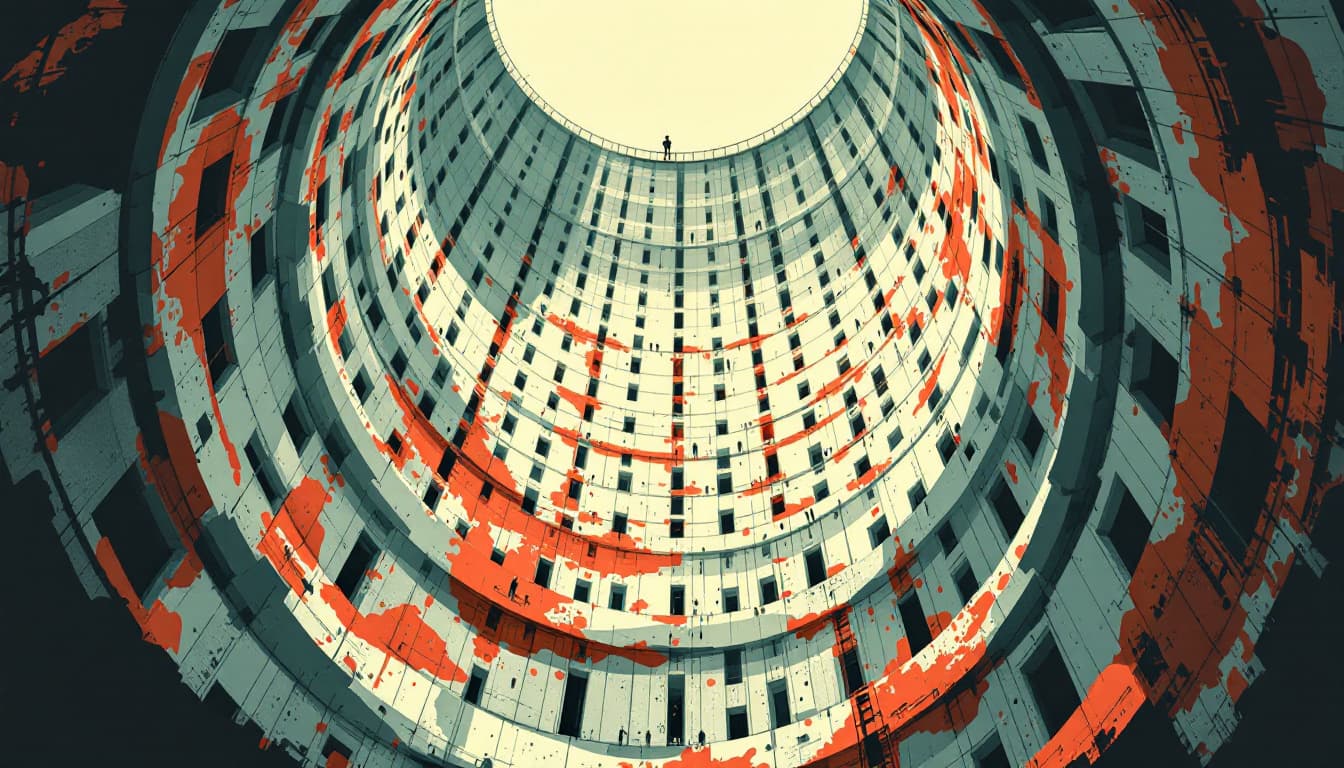
The underground as metaphor, and as set design
There is a moment early in Silo when a character steps toward a massive window and looks out at a ruined, amber-tinted landscape — hills of dirt, a dead sky, the visible husk of a civilization that ended a long time ago. It is the only view anyone in this story has ever had of the outside world, and the show frames it with exactly the right combination of longing and dread. That image encapsulates what Silo does best: it uses physical confinement to generate psychological pressure, and it sustains that pressure across two seasons with unusual discipline.
Adapted from Hugh Howey's self-published novel series — which became a genuine phenomenon before traditional publishing caught up — Silo arrives on Apple TV+ under showrunner Graham Yost, a writer with a long history of making procedural tension feel literary (Justified being the obvious credential). The collaboration produces something that feels distinct in the crowded dystopia genre: a show more interested in institutions and bureaucracy than in action-hero rebellion, more comfortable with ambiguity than resolution.
What you need to know without spoiling anything
The premise is elegant. Some ten thousand people live in a silo drilled deep into the earth, organized across hundreds of floors into a rigid society of workers, engineers, and administrators. No one knows exactly why they are there, how long they've been there, or what happened to the world above. Asking those questions openly is socially taboo. Asking them persistently can get you sent outside — a death sentence — to clean the optical sensors that feed the only exterior view the population has.
Into this world comes a new sheriff, played by Rebecca Ferguson, who arrives in the role with enough grief and stubbornness to make her investigation feel personal rather than procedural. She is not a savior archetype; she is someone doing a job that keeps pulling her toward a truth the silo's institutions are organized to suppress. The central mystery is about what happened, what is being hidden, and who benefits from the hiding.
Craft: patience as a virtue, and occasionally a vice
Rebecca Ferguson is the series' real structural achievement. She is on screen for almost every significant scene, and she carries that weight without vanishing into stoicism — she gives the character edges of humor, stubbornness, and genuine fear that keep the performance alive even when the plotting slows. The supporting cast is strong, particularly in the show's rendition of the administrative class, where the writing is shrewdest: these are not cartoonish villains but people who have convinced themselves that the lie they maintain is a mercy.
The production design deserves special mention. The silo itself — a vertical world of curving staircases, industrial landings, and strict social geography — is one of the more convincing built environments in recent genre television. The art department commits to the internal logic of this place: different floors have different materials, different light, different clothing. The physical world does ideological work. You understand the class structure intuitively before anyone explains it.
Yost's direction of the narrative is methodical. That is genuinely a compliment and occasionally a frustration. Silo is confident that if it establishes its world correctly, revelations will land with real weight — and it is largely right. But "largely" is doing some work in that sentence. There are stretches in the first season's middle act where the procedural machinery turns without generating enough dramatic heat, where the show's patience tips toward sluggishness. Viewers who came from the novels may find these sections easier to navigate; newcomers may find themselves checking how many episodes remain.
What works, what doesn't
What works: the show's treatment of institutional inertia and the psychology of complicity is genuinely sophisticated. Silo is not ultimately a story about a single tyrant to be overthrown; it is about a system in which everyone from the most powerful administrator to the most ordinary worker has absorbed the reasons why asking dangerous questions is a bad idea. That is a more adult and more uncomfortable premise than most dystopias offer.
The mystery itself is well-constructed. The show plants clues fairly — nothing feels cheated when pieces connect — and it respects the intelligence of an audience willing to pay attention. The first season ends on a note that recontextualizes everything before it in satisfying fashion without collapsing the larger mystery, which is precisely the right structural choice for a story with more seasons ahead.
What doesn't work as well: some of the secondary storyline threading in season two can feel like wheel-spinning, serving future plot needs rather than present dramatic ones. A couple of characters exist more as delivery systems for exposition than as people. And occasionally the show's commitment to ambiguity slides into deliberate opacity — withholding information not because the story requires it but because the delay flatters the show's sense of its own seriousness.
Who it's for
Silo rewards viewers who liked Severance or the early seasons of Battlestar Galactica — people who want their genre entertainment to carry genuine thematic weight and are willing to trust a slow-building narrative. It is not for anyone expecting kinetic action or a satisfying resolution on a tight timeline. It is very much a show that is building toward something, and it has, so far, given enough evidence that the destination is worth the journey.
If you are considering it and haven't read the books, start with the first episode and give it three. By then you will know whether its rhythms are for you. If they are, you're in for something genuinely good.

