
The Promise of Pure Velocity
There's a particular kind of thriller that announces its intentions on page one and never flinches from them. Blake Crouch's Run is exactly that kind of book — a novel so committed to forward momentum that it practically dares you to set it down. For stretches at a time, it succeeds magnificently at this narrow ambition. But ambition, even narrow ambition, is a contract with the reader, and Run doesn't always honor its end of the deal.
Crouch, best known in recent years for the Wayward Pines trilogy and the time-bending Dark Matter, wrote Run in 2011, and it has the feel of a writer working in an earlier, hungrier gear — pushing hard on the accelerator, less concerned with what's in the rearview mirror. That's both its appeal and its limitation.
What's Going On
The setup is elegantly brutal: a meteor shower produces some kind of auroral phenomenon visible across the sky, and in its wake, a significant portion of the population turns violently murderous — not zombie-shuffling, not virus-addled, but consciously, purposefully homicidal toward anyone who didn't witness the lights. The targets aren't random; those who didn't see the aurora are hunted. This creates an immediate and visceral social inversion — your neighbors, your town, your country's institutions have become the threat.
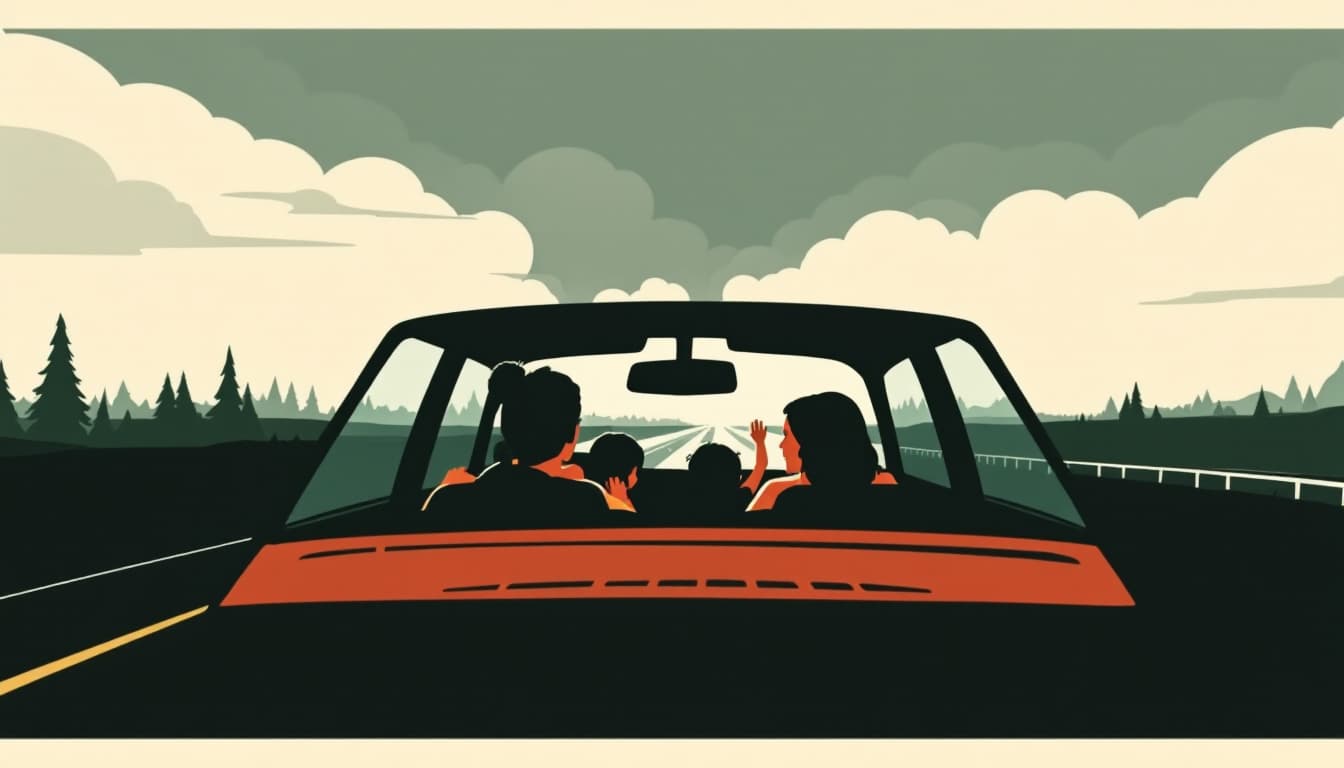
Our viewpoint family — a father, mother, and two children — are among the hunted, and the novel is essentially a sustained chase through a collapsing American landscape. That's the entirety of the engine, and it's more than enough to keep things moving.
Craft: Prose, Pacing, and People
Crouch writes in a stripped-down, declarative style that suits the material. Short sentences. White space. The prose functions like a rapid-fire news alert — urgent, clear, designed for speed. There's genuine craft in how he orchestrates tension across short chapters, and the rhythm of threat-and-brief-respite is well-tuned through the first two-thirds of the book. He understands that unrelenting danger actually deadens the reader, and he spaces out the moments of quiet — a night in an abandoned house, a conversation in the dark — with a reasonably calibrated hand.
Where the prose falls short is in texture. Crouch is a writer of events, not of surfaces or interiors. The American landscape through which this family flees is rendered in broad functional strokes: there's snow, there are mountains, there are burning towns. It gets the job done, but you won't finish this book with a felt sense of place the way you might after a McCarthy novel working similar American-ruin territory. That's an unfair comparison in one sense — Crouch isn't reaching for that register — but the absence matters because environment is almost a character in survival fiction, and here it's more backdrop than participant.
The family at the center is where Run becomes genuinely interesting and also genuinely frustrating. Crouch clearly understands that a thriller's emotional stakes live or die on whether you care about the people being threatened. He gives us a family with pre-existing fractures — a marriage that isn't entirely whole, children old enough to register the horror around them — and these elements create real dramatic potential. When it works, the domestic tension folded inside the survival plot gives the book a layer that pure chase fiction often lacks.
But Crouch doesn't develop this strand with the same rigor he brings to the action sequences. Characters make decisions that serve the plot's need for complication rather than emerging organically from who they've been shown to be. The emotional beats are hit but not fully inhabited; a revelation or a moment of tenderness will land, and then the novel moves on before it has time to resonate. You feel the craft of the plotting without fully feeling the people.
What Works, What Doesn't
The first hundred pages are close to excellent. The premise ignites cleanly, the threat is established with economy, and Crouch hooks the reader into that particular anxious reading state where you genuinely don't want to stop. Several set-piece sequences — a roadblock, a desperate search for supplies in a hostile town — are constructed with real skill, the kind of tight-quarters tension management that is harder than it looks.
The middle section sustains the momentum reasonably well, though a certain repetitiveness begins to set in. Threat arrives, family survives, moves on. The cycle turns enough times that even Crouch's efficient prose can't fully disguise the structural monotony. And the novel's mythology — what exactly caused this mass event, what governs who is and isn't affected — is kept deliberately vague. This is defensible; some horror is more horrible unexplained. But here the vagueness tips occasionally into hand-waving, and the lack of internal logic makes a few late-story developments feel arbitrary rather than inevitable.
The ending is both the novel's greatest risk and its most polarizing feature. Without saying what happens, Crouch makes a choice that is bold and that will strike some readers as earned and others as a cheat. I land somewhere in the middle: I admire the nerve, but the execution doesn't fully justify the audacity.
Who Should Read It
If you are the kind of reader who wants a thriller to move — who values propulsion and incident over interiority and lyricism — Run will give you an extremely satisfying weekend read. It is best consumed quickly, in long sittings, the way it was clearly written. Readers who prefer their genre fiction to have the thematic weight of, say, The Road or the slow-burn dread of early Cormac McCarthy will likely find it capable but thin.
For fans of Crouch's later work, it's interesting as an artifact — you can see the structural instincts that would eventually produce Dark Matter operating here in a more primitive, less refined form. And for readers discovering him in reverse, it's a reminder that the baseline skill was always there, even when the ambition was more modest.

