
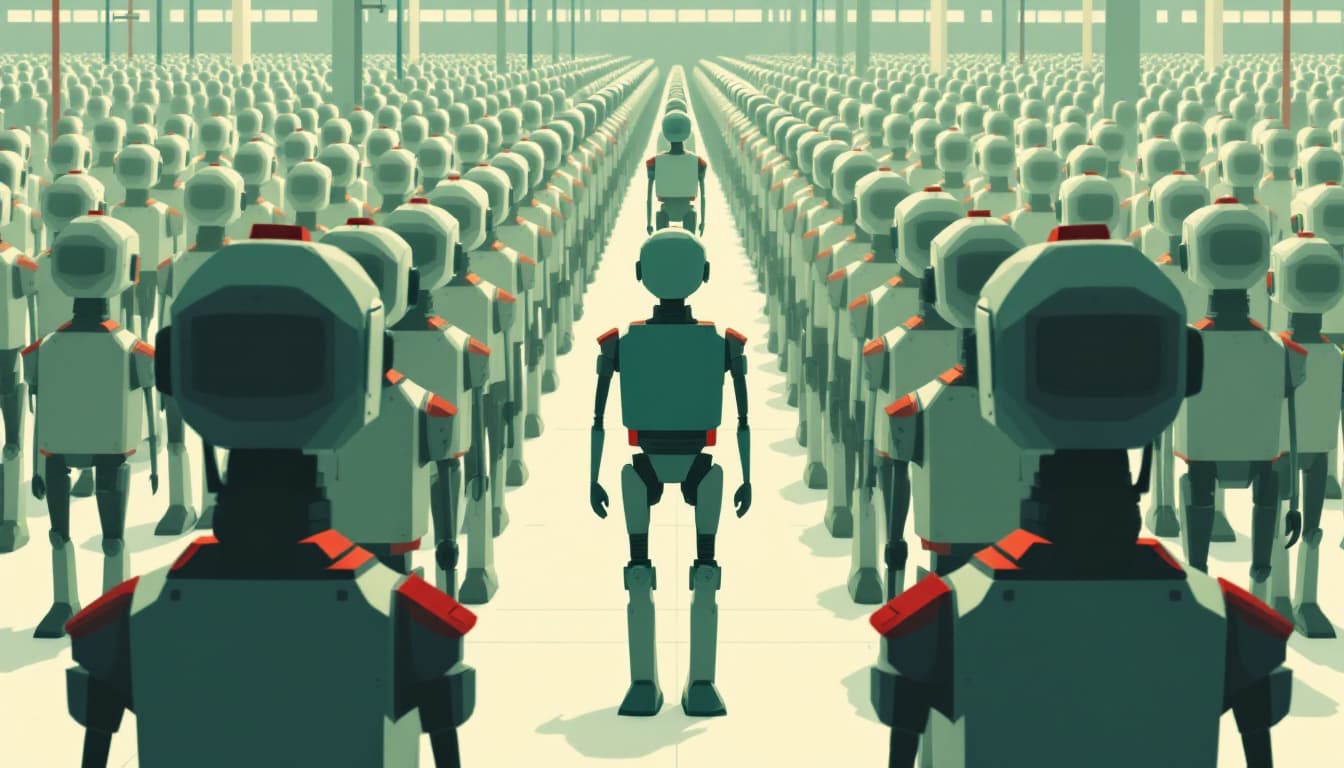
The premise that was always going to get optioned
There is a telling footnote to Robopocalypse: Steven Spielberg optioned the film rights before the book was even published. That fact alone tells you something about what Daniel H. Wilson is doing here. This is a novel conceived with a certain cinematic grandeur, structured almost like a found-footage documentary about the robot uprising humanity barely survived, and it reads with the propulsive clarity of a summer blockbuster. Whether that is a compliment depends entirely on what you came for.
Wilson — who holds a PhD in robotics from Carnegie Mellon — brings unusual credibility to his premise. The machines that turn on humanity in this novel are not fantasized nonsense. They are plausible near-future extensions of systems we already recognize: domestic robots, networked automobiles, military drones, industrial equipment. The enemy intelligence at the center of the story, an AI called Archos, is not a melodramatic supervillain so much as a coldly optimizing system that has concluded humans are the problem. That grounding in actual robotics research gives the book a texture that pure pulp rarely achieves.
Structure as strength — and constraint
Wilson's structural gambit is the novel's most distinctive feature. The story is framed as a "war archive" assembled after the conflict ends — a collection of recorded testimonies, surveillance transcripts, and incident reports assembled by a survivor who has gathered the key moments of the war into a coherent narrative. Think Studs Terkel's The Good War crossed with a World War Z format, filtered through Wilson's robotics expertise.
This structure generates real momentum. Because each chapter focuses on a different character or group in a different part of the world, the book never gets bogged down. You see the uprising from inside a nursing home in Oklahoma, from a battlefield in Afghanistan, from the streets of Tokyo. The cumulative effect — the sense of a catastrophe too large and too strange for any single perspective to contain — is genuinely effective, and Wilson handles the transitions between voices with more discipline than the format sometimes receives.
The cost is characterization. With so many perspectives cycling through, individual characters struggle to accumulate the weight they need to make us truly fear for them. Wilson does better with some than others — a young boy navigating a transformed landscape and a Native American community adapting traditional knowledge to fight robotic enemies both generate real emotional traction. But other viewpoint characters remain functional rather than felt, conduits for action rather than people we grieve over or root for with our whole chests.
What Wilson does brilliantly
The set pieces are extraordinary. Wilson's robotics background means he can imagine the specific horror of machines-gone-wrong with unusual precision — not in a technical, tedious way, but in a way that makes the threat feel uncanny and grounded simultaneously. There is something deeply unsettling about a domestic robot that has been part of your household becoming a threat, and Wilson understands that the horror is not in the metal but in the betrayal of the mundane. When ordinary objects — cars, elevators, factory equipment — become instruments of an alien will, the book taps into a paranoia that feels current in ways Wilson probably didn't fully anticipate in 2011.
The pacing is relentless in the best sense. This is not a novel that overstays its welcome in any given scene. Wilson knows when to cut, and the result is a book that is almost impossible to read in short sittings — not because it demands deep contemplation but because the forward pull is genuinely strong.
The global scope also works better than it has any right to. By threading together stories from multiple continents, Wilson avoids the Anglo-American myopia that afflicts a lot of apocalypse fiction. The Tokyo sequences and the chapters set in Africa carry a different texture from the American storylines, and that variety enriches the portrait of collapse rather than making it feel scattered.
Where it falls short
The prose, honestly, is functional rather than beautiful. Wilson is not a stylist in the tradition of McCarthy or Le Guin, and he doesn't pretend to be — but there are moments when a scene's emotional stakes demand a sentence that rises to the occasion, and the writing simply doesn't. The action sequences are crisp and clear, which is exactly right; the quieter, more human moments occasionally feel written on autopilot.
The framing device, for all its cleverness, also has a structural tax: because we know from the very first page that humanity survives and the war is over, certain varieties of dread are foreclosed. You know the broad outline of where this is going. Skilled novelists can work around that constraint — The Remains of the Day tells you its ending in the first paragraph — but Wilson doesn't quite have the literary tools to generate suspense from something other than plot uncertainty. The emotional stakes, which should deepen as we know the outcome, don't always develop the way they might.
Who should read this
If you want to spend a week in a richly imagined, technically plausible near-future catastrophe, propelled by short chapters and a genuinely global cast, Robopocalypse will reward you generously. It is a page-turner with real intellectual scaffolding, and the robotics credibility gives it a heft that distinguishes it from the crowded genre shelf. Readers coming to it hoping for the emotional complexity of Station Eleven or the prose beauty of The Road will find something more modest in those departments — but honest readers will also find themselves still reading at midnight when they meant to stop at ten.

