
The prophet who arrived thirty years early
There is a particular discomfort in reading a novel from 1993 that describes a Los Angeles of the 2020s — drought-scorched, economically stratified to the point of open feudalism, ruled by a demagogic presidential candidate whose campaign slogan promises to make America great again — and feeling not like you are reading prophecy but like you are reading journalism. Octavia E. Butler did not predict the future so much as extend the present she was already living. That clarity of vision is what makes Parable of the Sower such an unnerving and ultimately rewarding read.
What it's about, briefly
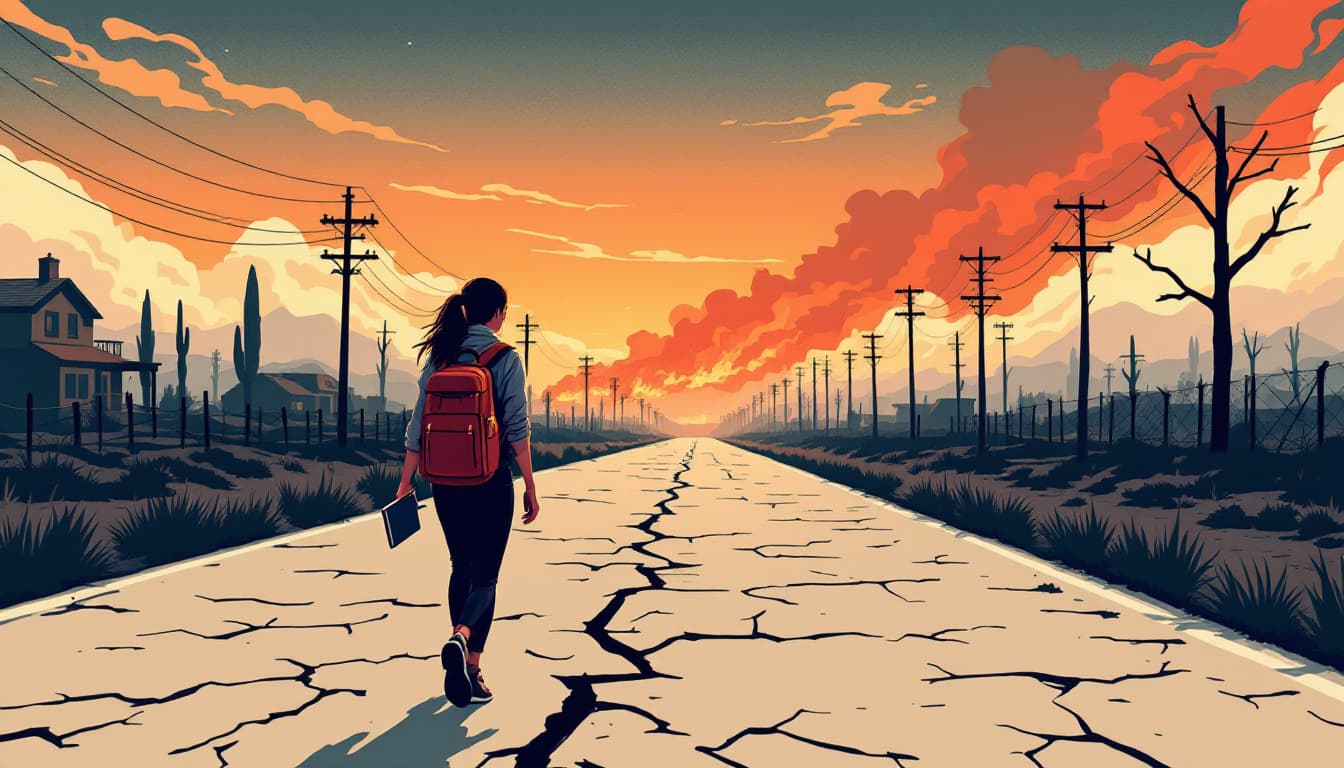
Told through the journal entries of Lauren Olamina, a teenage girl living in a walled community in Robledo, California, the novel begins with the slow unraveling of a neighborhood trying to hold civilization together while everything outside its walls burns. Lauren is a hyperempath — she feels others' pain and pleasure as involuntary physical sensation — and she is also, quietly and systematically, preparing for the collapse she can see coming while the adults around her prefer denial. When catastrophe finally tears her world apart, she sets out north on foot along a ruined highway, gathering survivors along the way and carrying with her the seed of a new philosophy she calls Earthseed, whose central tenet is that God is Change.
That's the frame. What Butler is actually doing is something more ambitious: she is writing a founding myth, asking what kind of mind and what kind of ethics might survive the wreckage of one civilization and plant the next.
Craft and character
Butler's prose in this novel is deliberately spare — journal-entry form demands it — but the sparseness is never thin. Lauren's voice is observational and clinical in a way that makes the emotional moments land harder precisely because she is not performing feeling for the reader. She catalogs, she reasons, she plans. When she grieves, it feels earned because we have watched her suppress grief for two hundred pages in service of survival.
The hyperempathy conceit is brilliant for reasons beyond the obvious metaphorical resonance. It functions as a genuine constraint that shapes every decision Lauren makes in violent situations. She cannot be cavalier about violence without paying a physical price. Butler uses this not as a superpower but as a liability — a source of vulnerability and moral complexity that keeps Lauren from becoming a simple action-hero. In a genre crowded with protagonists who dispatch threats with efficient detachment, Lauren's condition makes every confrontation cost something.
The supporting characters who accumulate around Lauren as the novel progresses are drawn with the economy you'd expect of a writer working at this level: a few precise details, a consistent behavioral logic, and enough left unsaid to feel real. Butler resists the temptation to give everyone a redemption arc or a clean purpose. Some people join, contribute, and then simply suffer the world's indifference. That refusal of narrative tidiness is one of the novel's most honest qualities.
What works, and where it strains
The novel's first third — the walled-community chapters — is its best sustained writing. Butler captures the specific psychology of people who know, on some level, that their situation is untenable but who have organized their daily lives around not quite admitting it. The tension between Lauren's father's faith and pragmatism and Lauren's cooler, almost merciless realism is the book's richest relationship, and its loss is the hinge on which the novel's emotional world turns.
The road sections that follow are compelling and sometimes devastating, but they are also somewhat episodic in structure — the journey accumulates encounters more than it develops a tightening dramatic line. This is arguably true to the journal form, and it never loses momentum entirely, but readers who want conventional narrative propulsion may feel the middle third stretch. The Earthseed verses that open each chapter are thought-provoking in aggregate, though individually some land better than others — a few feel aphoristic in a way that strains slightly against the gritty naturalism of Lauren's prose voice.
These are minor complaints against a novel that is doing something genuinely difficult: building a character who is simultaneously a survivor, a philosopher, and a teenager, and making all three registers feel true at once.
What Butler is really after
Parable of the Sower is ultimately a novel about the conditions under which new belief systems are born. Butler was deeply interested in power, in who gets to make meaning, and in whether cooperation can be organized around something other than fear. Earthseed — change as the only divine constant, adaptation as the highest virtue — reads partly as a critique of the rigidity that the novel's collapsing institutions cannot shed, and partly as a genuine attempt to articulate a philosophy robust enough to survive catastrophe. Whether you find it persuasive is almost beside the point; the intellectual seriousness with which Butler constructs it is what elevates the book above its genre peers.
There is also a racial specificity to Parable of the Sower that matters enormously and deserves naming. Lauren's experience of navigating a dangerous landscape as a young Black woman, the particular calculations she must make, the particular ways vulnerability compounds in her situation — Butler writes this not as a sermon but as lived texture. It sharpens the novel's realism and broadens its moral scope in ways that a less specific, more "universal" protagonist could never achieve.
Who should read it
Anyone who takes speculative fiction seriously. Anyone interested in how fiction thinks about social collapse rather than just dramatizing it. Readers who bounced off The Road's masculine minimalism and want an apocalypse that is equally unsparing but emotionally and intellectually richer. And yes, anyone who has ever wanted a genre novel to also be a genuine novel — with ideas, with a distinctive consciousness at its center, with something real at stake beyond plot.

