
The film that reminded Hollywood what action could be
When Mad Max: Fury Road arrived in 2015 after roughly fifteen years in development hell, the response was something close to collective astonishment. Not because anyone had stopped believing in George Miller — the Australian director's original trilogy had already earned its place in the canon — but because nobody quite expected him to come back swinging this hard, this late, and with something this strange and this good. He was in his seventies. The production had been legendarily troubled. The Namibian desert had apparently tried to kill everyone involved. And yet what emerged was, by any sane measure, one of the finest action films ever made.
It's worth sitting with that claim for a moment rather than rushing past it, because Fury Road earns it in ways that are specific and demonstrable, not merely hyperbolic.
What it's about (briefly)
The premise is disarmingly lean. In a scorched, resource-depleted future, a warlord's most trusted lieutenant makes a sudden and dangerous choice to defy him — loading a war rig with precious cargo and driving hard across the Wasteland. Max, the taciturn drifter of the series, finds himself caught up in the pursuit more or less against his will. What follows is, in structural terms, essentially a chase film. Miller has spoken openly about the fact that the movie is almost entirely one long pursuit. What he doesn't always mention is how much that formal constraint forces the film to put everything it has — character, theme, world-building, emotion — directly into the action itself rather than around it.
Craft: direction, performance, and the art of controlled chaos
The film's greatest achievement is making the impossible look not merely exciting but legible. Action cinema has spent the better part of three decades confusing visual chaos with intensity. Fury Road is the corrective. Miller and his cinematographer John Seamus shot in natural light with extraordinary care for spatial geography. At nearly every moment, you know exactly where each vehicle is relative to every other, which direction the pursuit is moving, who has the upper hand. The editing, while furious, is rhythmically precise. There is a kind of savage musicality to the cutting — sequences that function almost as set pieces within set pieces, each with its own internal logic and payoff. The film breathes.
Charlize Theron's Furiosa deserves a paragraph of her own. She gives a performance of controlled fury and barely-suppressed grief that anchors everything. It would be easy to play a character of this type as invulnerable and therefore uninteresting — Theron refuses that option. There are small moments, quickly glimpsed, where something flickers behind the armor, and those moments make the larger ones land harder. Tom Hardy, replacing Mel Gibson in the title role, has a more interior and often wordless job to do, and he does it well; Max functions structurally as much as witness and catalyst as protagonist. The dynamic between the two leads is one of the film's quiet surprises — a reluctant partnership that develops with economy and without a wasted scene.
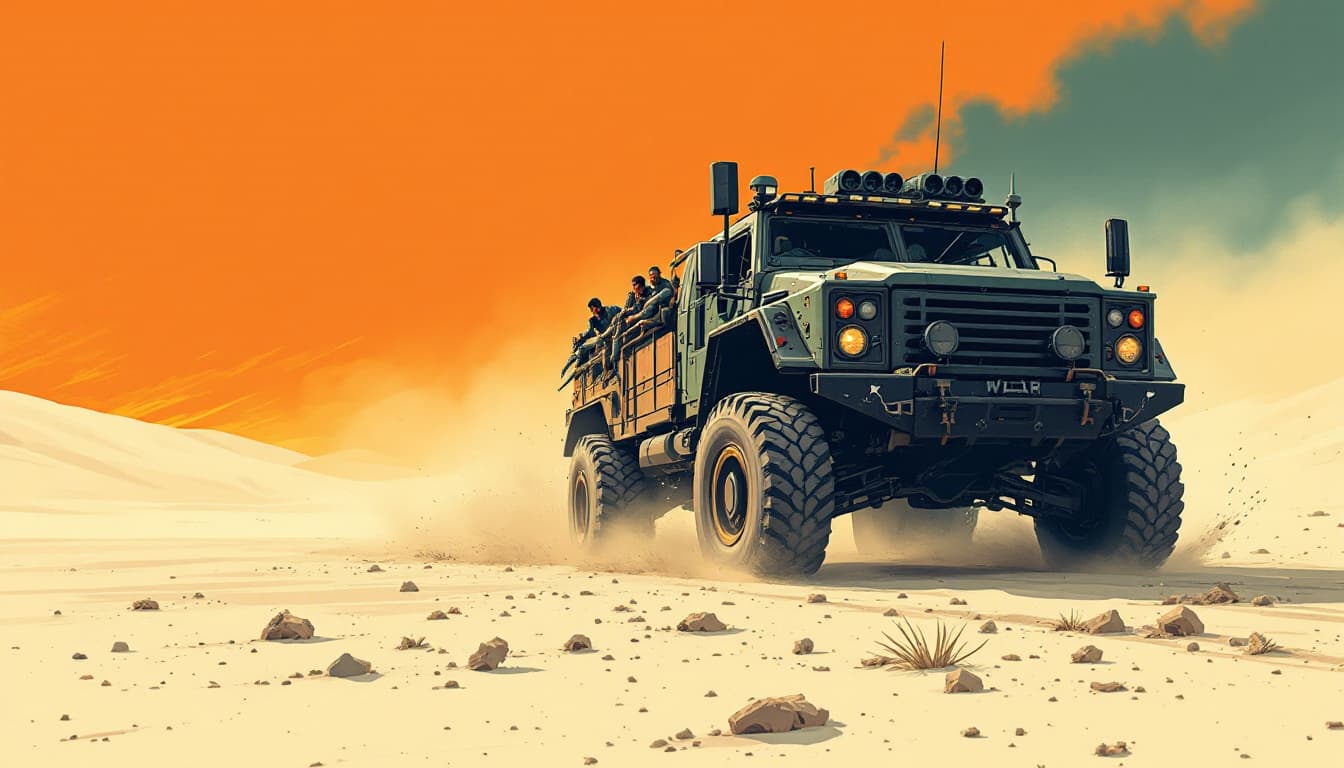
The film's production design is worth dwelling on, because it is doing real thematic work rather than just providing spectacle. Miller and his team built the vehicles. Built them. The war machines are elaborately functional nightmares, each one a physical expression of its owner's worldview and obsessions. The Citadel — the warlord's fortress — implies an entire ecology of power and exploitation in its visual architecture. And Junkie XL's score, all thundering percussion and distorted metal strings, completes the sensory argument. This is world-building achieved almost entirely through image and sound rather than exposition.
What works and what doesn't
The film is not without its limits. The antagonist, Immortan Joe, is deliberately operatic and symbolic rather than psychologically textured — which is a defensible choice for this kind of mythic action cinema, but it means the conflict at the center of the film has slightly less dramatic friction than it might. Characters beyond the central duo and a handful of others function more as archetypes than people. That's partly intentional — Miller is working in a heightened, almost fable-like register — but viewers accustomed to more conventional character development may occasionally feel the film is keeping them at arm's length.
There is also a case to be made that the film's final act, while exhilarating, resolves its central tensions somewhat schematically. The emotional payoff is real, but it arrives with a kind of blunt efficiency that borders on the abrupt. Miller earns most of it — but not quite all.
None of that substantially diminishes the achievement. Fury Road does what almost no blockbuster manages: it uses every dollar and every frame in service of a coherent vision. There is no filler here. Every shot is doing something. And underneath the roaring engines and the chrome and the fire, the film is making an argument — about bodies as property, about the mythology of scarcity as a tool of control, about solidarity as the only meaningful answer to tyranny — that is considerably more serious than the genre typically bothers with.
Who it's for
The obvious answer is anyone who loves action cinema. But Fury Road also rewards viewers who don't ordinarily seek out the genre — people who care about visual storytelling, about physical filmmaking, about what can be done when a director has both genuine craft and genuine conviction. It is rated R and earns that rating; the violence is not gratuitous but it is intense and unsparing. This is not a film for young children or for viewers with a low tolerance for sustained action. For everyone else, it is close to essential viewing.

