
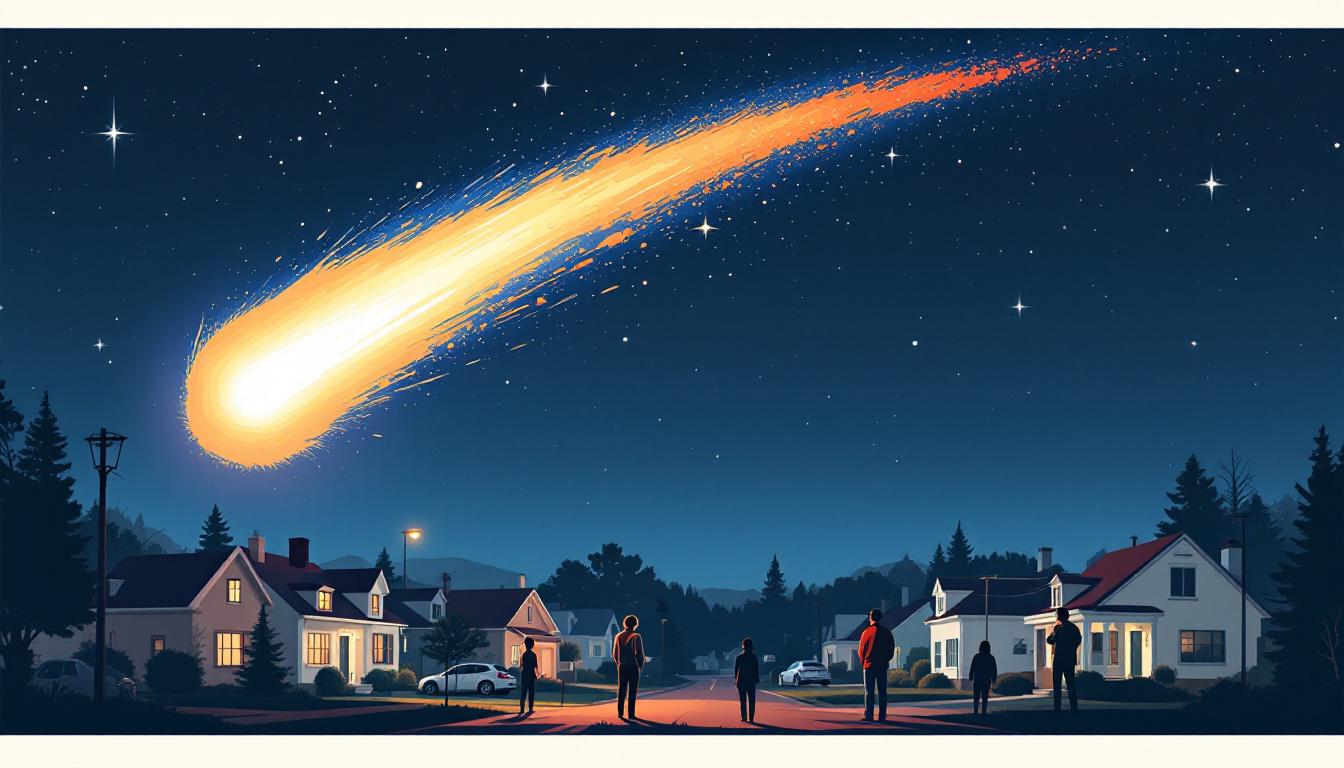
A comet, a cast of thousands, and a question worth asking
There is a specific kind of ambitious novel that only a certain decade could produce: thick, socially argumentative, sprawling with characters, convinced that science and civilization are both worth defending and worth interrogating. Lucifer's Hammer, published in 1977 by Larry Niven and Jerry Pournelle, is that kind of novel. It arrives with the confidence of authors who had already, separately and together, reshaped what hard science fiction could do — and it swings for something genuinely difficult: not just the destruction of civilization, but the question of whether civilization deserves to survive, and who gets to decide.
That question is what elevates the book above a disaster-porn doorstop. The comet impact at its center is spectacular, but the real subject is what comes after.
The premise, briefly
A newly discovered comet, initially a curiosity for amateur astronomers and a media event for celebrity-hungry television producers, turns out to be on a collision course with Earth. Niven and Pournelle spend roughly the first half of the novel in the before — sketching an enormous ensemble cast across Los Angeles, rural California, and beyond, letting readers grow attached to lives that are about to be obliterated or transformed beyond recognition. The impact itself, when it arrives, is rendered with the kind of physical specificity that reminds you these are authors who did their homework. And then the second half begins: survivors sorting themselves into factions, making brutal choices, and fighting over what the remnants of the world will look like.
The setup is patient. Some readers will find that patience rewarding. Others will find the first two hundred pages a slow burn before the fire.
Craft: what two smart writers doing their best looks like
Niven and Pournelle write with an engineer's respect for consequences. When the Hamner-Brown comet strikes, the physics matter — tsunamis, firestorms, the collapse of infrastructure in a sequence that feels earned rather than convenient. This is one of the novel's genuine strengths: cause and effect are taken seriously. Characters don't just survive because the plot needs them to; they survive because they made specific decisions, had specific resources, or were in specific places. That rigor gives the chaos a credible weight.
The prose itself is competent rather than beautiful. Niven and Pournelle are storytellers, not stylists, and there's no shame in that — the writing moves, it's clear, and it carries a large cast across a large canvas without losing the reader. What it rarely does is surprise you at the sentence level. You won't underline passages. But you will keep turning pages, which for a 600-page novel is the more important achievement.
Where the craft gets complicated is characterization. The ensemble is large by necessity — the authors want to represent a cross-section of American society pre- and post-impact — but several characters function more as archetypes or argument-carriers than as fully realized people. The survivalist with his stored supplies, the astronaut-celebrity, the scientist who becomes a reluctant leader: these are legible types, and they serve the novel's thematic purposes, but they can feel schematic. A handful of characters, particularly those caught in the most morally ambiguous situations in the second half, do achieve genuine depth. But the ratio of archetype to character is not always in the reader's favor.
What works, what doesn't
What works, emphatically, is the novel's moral seriousness. The factions that emerge after the impact each represent a coherent, if sometimes repugnant, logic. The authors don't pretend that civilization reassembles itself cleanly or that the right people always win. The debates that unfold — about who deserves resources, what knowledge is worth preserving, what compromises a community can survive making — are conducted at a level of genuine intellectual engagement that most disaster fiction never attempts. A sequence late in the book involving the preservation of technical knowledge is quietly one of the most affecting arguments for scientific literacy you'll find in the genre.
What doesn't always work is the novel's politics, which wear 1977 on their sleeve in ways that can be jarring. Niven and Pournelle are unapologetically conservative in their sympathies — prepared, self-reliant, skeptical of institutional authority — and while those sympathies often illuminate real tensions, they occasionally tip into didacticism. Some characters exist primarily to be wrong in ways that validate the authors' priors. The treatment of certain social groups, particularly in the chaos sequences, hasn't aged uniformly well, and readers approaching the book fresh should know that going in. It's not a dealbreaker, but it's a texture you'll need to negotiate.
The pacing in the first half is the other honest complaint. The pre-impact world is carefully constructed, and that construction pays dividends later, but Lucifer's Hammer asks you to invest in roughly twenty characters before it gives you much reason to believe the investment will pay off. Trust that it largely does — but the ask is real.
Who it's for
If you have read The Road or Station Eleven and wanted something less literary and more load-bearing — something that actually thinks through logistics, factions, and the hard arithmetic of post-collapse survival — this is your book. If you enjoy the texture of 1970s science fiction at its most ambitious, with all the ideological freight that implies, you will find Lucifer's Hammer a rewarding and occasionally maddening companion. It is not a comfortable read, and it is not a fast one. It is, however, a serious one.
Readers who prefer their fiction sleek, morally tidy, or politically neutral should look elsewhere. Everyone else should clear a week.

