
The hard second act
The original Greenland (2020) arrived almost without fanfare and turned out to be one of the better disaster films in years — restrained where the genre is usually bombastic, intimate where it usually goes wide. Ric Roman Waugh kept the camera on Gerard Butler's face, on a diabetic child, on one family fighting a very human bureaucracy while a comet tore the sky open. It worked because it was small. The sequel, Greenland: Migration, has no interest in staying small.
That is not automatically a failing. Sequels are supposed to expand. The question is whether the expansion serves the story or merely serves the budget. Migration answers that question somewhere in the ambivalent middle, which is more or less exactly where a three-star film lives.
Where we pick things up
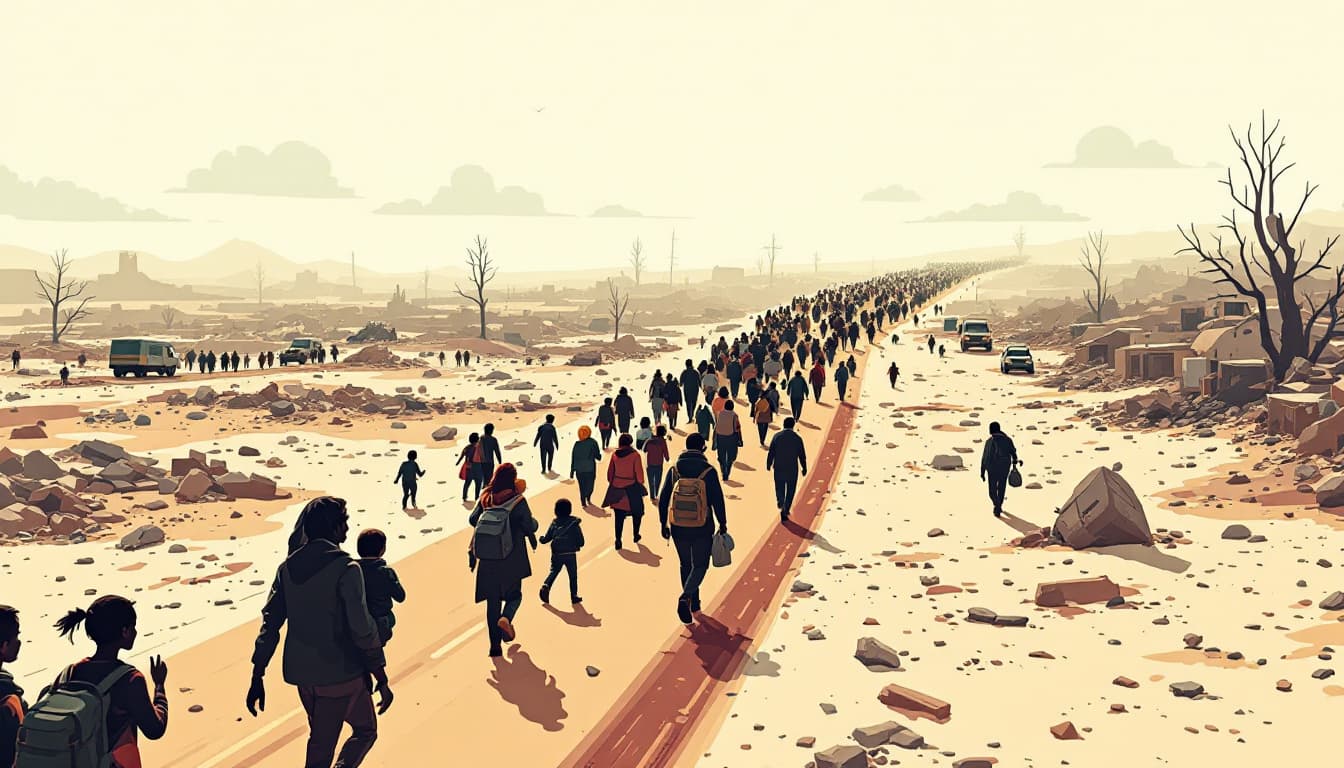
The Garrity family — John, Allison, and their son — survived the bunker. The comet's work is done, and the world left behind is the world the first film was quietly dreading: infrastructure gone, nations reorganizing, the old map of civilization replaced by something provisional and contested. The family's journey now takes them through a fractured Europe, where the business of survival has shifted from outrunning fire to navigating a landscape of displaced populations, collapsed institutions, and the power vacuums that follow both. The premise is essentially a refugee narrative grafted onto the chassis of a chase thriller, which is an interesting enough combination that you wish the script had trusted it more fully.
Craft: direction, performance, pacing
Waugh is a competent action director — his work on the first film and on Angel Has Fallen shows he knows how to put a sequence together without losing spatial logic. That skill is intact here. There are two or three extended set pieces in Migration that are genuinely well-constructed: one involving a road convoy and a bridge that demonstrates real filmmaking patience, and another, quieter sequence in an abandoned hospital that briefly recaptures the first film's claustrophobic dread. In those moments, Waugh earns his keep.
Butler is doing what Butler does: physical, reactive, more expressive in movement than in dialogue. He is not a subtle actor, but he has always been a credible one in this register — you believe his John Garrity is exhausted, and you believe he will keep moving anyway. The problem is that the screenplay gives him very little new to discover about the character. In the first film, Garrity's arc was essentially about what a man will dismantle in himself to protect his family. Here, that arc is mostly finished, and what replaces it is a series of external crises rather than internal ones. The film loses something in that trade.
Morena Baccarin as Allison is given marginally more to do this time — the script does attempt to distribute agency more evenly — but she is still working against a structure that fundamentally treats her role as reactive. Their son, now old enough to be a more conscious participant in the story, is one of the film's modest successes; a few scenes between father and child carry the kind of specific, unsentimental weight the first film had in abundance.
The new supporting cast, drawn largely from the European settings, is a mixed result. Some of these figures feel like real people caught in extraordinary circumstance; others feel assembled to represent geopolitical categories — the disillusioned soldier, the ruthless local strongman, the humanitarian worker with a secret — rather than to exist as individuals. When the film leans into type, it loses exactly the texture that distinguished the original.
What works and what doesn't
The film's greatest strength is also its greatest structural liability: its scope. The shift from American suburbs and bunkers to a cross-continental journey gives Migration visual variety and genuine grandeur in places. Europe rendered in various states of ruin is affecting. There is a long passage through what appears to be a repurposed refugee camp that has a documentary roughness — extras who look like they belong, production design that resists the usual disaster-movie glamorization of collapse. Waugh and his team have done real work here.
But the breadth comes at the expense of depth. The first film's confined geography created pressure. When the Garrity family moves across nations, the stakes paradoxically feel more diffuse. We are always waiting for the next threat rather than sitting inside the dread of a single, compounding one. The pacing in the second act in particular suffers from this: the film moves, but it doesn't build. Events accumulate rather than escalate.
The script also stumbles when it reaches for geopolitical commentary. There are gestures toward questions of who gets to define order after civilization breaks — legitimate, urgent questions — but they are raised and then largely abandoned in favor of the next action beat. That's a missed opportunity. A disaster sequel with real thematic ambition about how societies reconstitute themselves under pressure could have been something. Migration glimpses that film and then looks away.
Who it's for
Fans of the original will find enough here to justify the watch — the family dynamic has warmth, the action is clean, and the film respects its audience's intelligence more than most in the genre. If you came to Greenland cold expecting something like 2012 and found it too restrained, this sequel will probably suit you better. It's a more conventional disaster film. That's not a compliment, exactly, but it's not a condemnation either.
If you loved the first film precisely for its intimacy and restraint, manage your expectations. Migration is not a betrayal of that film; it is just a lesser version of what that film was doing.

