
The weight of a bottle-cap
Video game adaptations have a dismal track record on television, and the ones set in richly developed game worlds carry an extra burden: a fandom that has spent hundreds of hours inside that fiction, memorizing its logic and loving its corners. Geneva Robertson-Dworet and Graham Wagner, the showrunners behind Prime Video's Fallout, had to satisfy that crowd while making something a newcomer could actually follow — and more importantly, something worth watching on its own terms. Remarkably, they've largely pulled it off.
What you need to know going in
The Fallout games are set in an alternate-history America where the optimism of the 1950s never quite gave way to the cultural upheavals that followed — and where, in 2077, nuclear war finally ended the world as a consequence of corporate and governmental hubris operating on a scale that makes the present feel quaint. The television series works within that same mythology without being a direct adaptation of any single game. Its story follows three protagonists whose paths converge across the California wasteland: a Vault Dweller who has grown up in one of the underground bunkers that sheltered a lucky few, a Brotherhood of Steel soldier navigating loyalty and ideology, and a Ghoul — a desiccated, nearly immortal survivor of the original bombs — who operates as something between a bounty hunter and a walking embodiment of the show's darkest ironies. Their individual journeys are distinct enough to create genuine dramatic contrast, and the intercutting between them is one of the season's structural strengths.
Craft: design, performance, and the question of tone
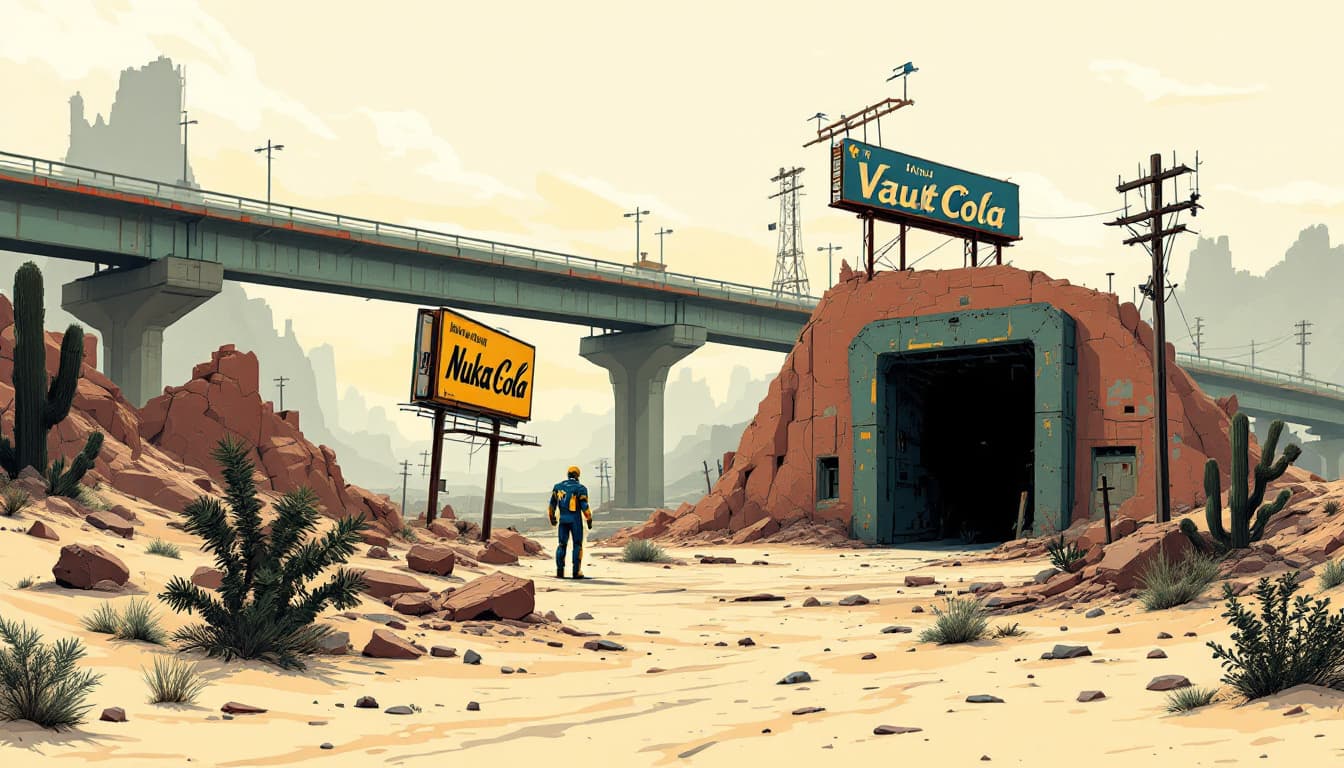
The first thing you notice is how good this looks. Production designer Howard Cummings and his team have built a world that feels both faithful to the games and liberated from the necessity of looking like a screenshot. The Vault interiors — all retrofuturist curves and institutional cheerfulness — are genuinely uncanny in a way that still photographs can't capture; they move and breathe with their inhabitants in ways that quietly communicate just how strange a life lived underground would become across generations. The wasteland exteriors, shot largely in the American southwest, have the sun-bleached desolation the premise demands without tipping into the gray sludge that mars so much post-apocalyptic visual design.
Ella Purnell anchors the Vault Dweller storyline with a performance that earns its emotional beats without overplaying them. Her character is naive in ways the show finds genuinely funny, but Purnell resists the temptation to play naivety as stupidity, and the result is a protagonist you actually want to follow. Walton Goggins as the Ghoul is something else entirely — a career-best performance, possibly, in which he manages to be simultaneously grotesque, hilarious, and heartbreaking. The show wisely uses flashbacks to give his character a pre-war life, and those sequences recontextualize everything we see from him in ways that build across the season with genuine care.
The tone is harder to calibrate than either of those two manages individually. Fallout as a game franchise is satirical at its core — the gap between the cheerful corporate propaganda of its pre-war world and the horrors it produced is the whole point — and the television series inherits that satirical DNA. When it works, the comedy and the violence and the pathos coexist in the same scene with a kind of controlled dissonance that's genuinely distinctive. When it doesn't, you feel the seams: a gag lands too hard, or a moment of real grief gets undercut by business that wasn't earned. The show is at its best when it trusts the audience to hold those registers simultaneously without being nudged.
What works and what doesn't
The opening episodes are close to extraordinary. The show establishes its world, its characters, and its thesis — something about how civilizations justify their own destruction to themselves — with real efficiency and visual invention. There's a sequence in the first episode that cuts between the pre-war world and its aftermath in a way that is startling even for viewers who know the games, and it sets a standard the series spends the rest of its run trying to match.
It doesn't always succeed. The middle episodes suffer from a familiar prestige-TV ailment: the sense that the plot is being managed rather than told, with characters circling each other across episodes that feel like they exist to delay a confrontation the writers aren't quite ready to stage. The Brotherhood of Steel storyline, in particular, loses momentum in these stretches, and its protagonist — the most conventional of the three — doesn't yet have the interiority to carry sequences that depend on his perspective. Aaron Moten brings genuine physicality and charm to the role, but the writing gives him less to work with than it gives his co-leads, and it shows.
The finale recovers strongly, delivering payoffs that feel earned for the characters even when they raise further questions about the world. And the world-building questions are genuinely interesting: the show's mythology around who actually pressed the button, and why, adds layers to the games' existing lore that feel like additions rather than contradictions.
Who should watch this
If you've played the games, this is an adaptation that respects what it's adapting while making real creative decisions rather than just recreating what you remember. If you haven't, the essential pleasures — the dark comedy, the excellent performances, the genuine emotional ambition — are available without homework. Those with little patience for violence, even stylized video-game-logic violence, should probably sit this one out. Everyone else has a strong season of television waiting.

