
The book that refuses to be forgotten
There is a telling irony at the heart of A Canticle for Leibowitz: a novel about the fragility of knowledge and the near-impossibility of transmitting it across catastrophe has itself survived sixty-seven years in print, never gone out of fashion, and continued to unsettle every new generation of readers. Walter M. Miller Jr. wrote it in pieces — three linked novellas published in The Magazine of Fantasy and Science Fiction in the mid-1950s — and assembled them into a single volume in 1959. The seams are barely visible. What you hold when you pick this book up is one of the most complete, deeply imagined works of American science fiction, full stop.
It is also a novel that a review can only partially describe. You have to meet it yourself.
Three epochs, one dark thread
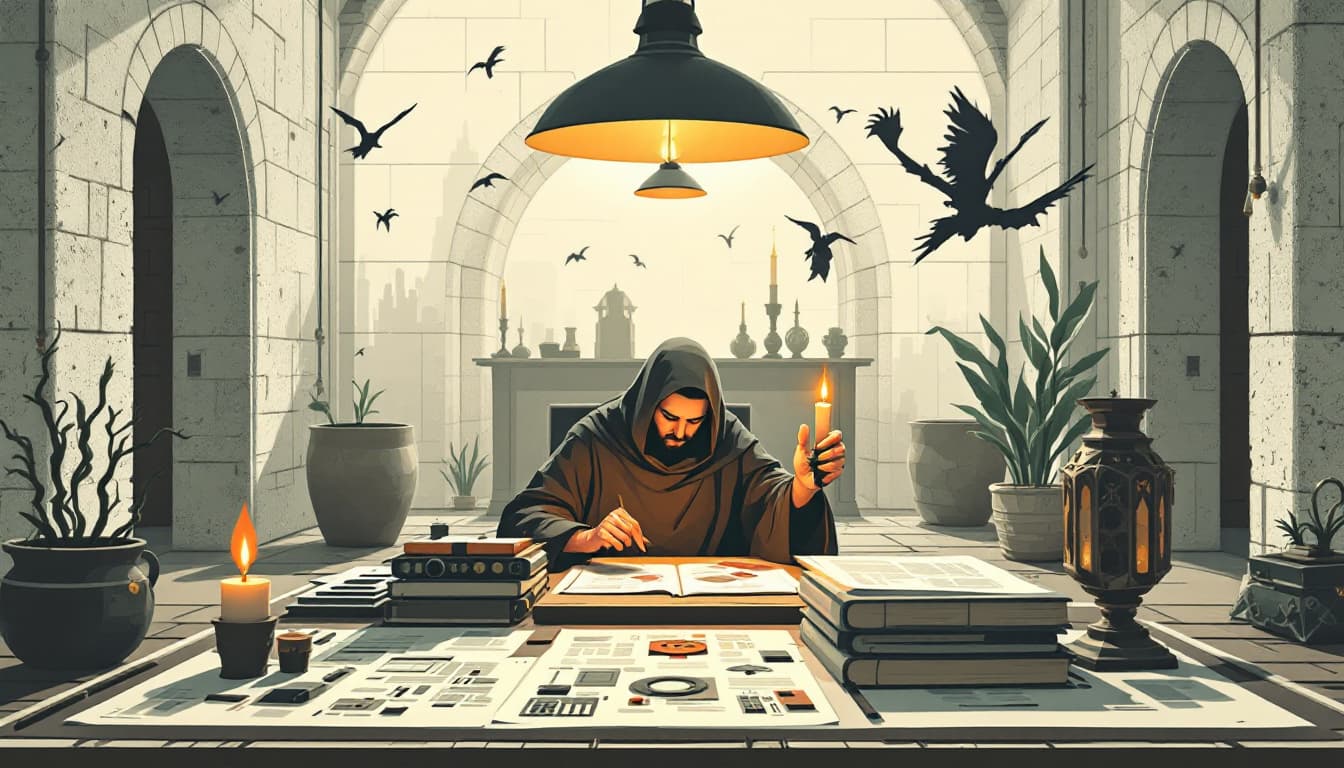
The structure is audacious: three sections separated by roughly six hundred years apiece, together spanning more than a millennium after a nuclear war has sent civilization back to a pre-literate dark age. What connects them is a Catholic monastic order in the American Southwest — the Albertian Order of Leibowitz — dedicated to the preservation of whatever fragments of pre-war learning its monks can find and copy. The founder, Leibowitz, was an engineer who survived the initial catastrophe and recognized that knowledge itself was the target of the survivors' rage. He built a library in the desert to keep a flame alive.
Miller never lets us forget that the flame might not be worth what it costs, or that the people tending it barely understand what they're tending. A illuminated blueprint for a circuit board becomes a sacred relic. A shopping list becomes scripture. The book's dark comedy is never cheap: Miller earns every rueful laugh by making the stakes genuinely enormous.
Craft: prose, structure, character
Miller's prose is deceptively plain. He works in a documentary register — clean, occasionally dry, sometimes almost archival — and then periodically breaks into passages of startling lyrical intensity. The effect is like walking through a monastery: long corridors of plain stone, then suddenly a chapel that takes your breath away. He is also, and this deserves emphasis, genuinely funny in ways that writers tackling nuclear annihilation rarely manage. His first section, set in what feels like an early medieval period, contains comic business involving a simpleton novice and a mysterious old wanderer that is both slapstick and quietly devastating. Miller sustains this tonal balancing act across all three sections without once losing control of it.
The structural choice to jump centuries between sections could feel cold or schematic, but it doesn't. Each section has its own fully realized cast of characters, its own political texture, its own crises. Yet the rhymes between them — the way certain arguments, certain human failures, certain moments of grace repeat with slight variations across the centuries — build into something more powerful than a linear narrative could achieve. Miller is not writing a plot. He is writing a cycle, the way history is a cycle, and he wants you to feel the terrible weight of that repetition.
The characters are not psychological studies in the modern sense; they are figures, the way medieval religious art uses figures — individuated enough to be vivid, but drawn to carry thematic weight rather than to feel like people you might have brunch with. This is a deliberate artistic choice and I think the right one. The abbots in each section are particularly well-drawn: fallible, intelligent men trying to act with integrity in situations that offer no clean options.
What works, what doesn't
Almost everything works. The novel's great strength is its refusal to take sides in the argument it stages between faith and reason, between preservation and progress, between the horror of forgetting and the horror of remembering too well. Miller spent years as a bombardier in World War II and participated in the bombing of the monastery at Monte Cassino — an act he apparently never recovered from. That biographical weight is present in every page without ever being sentimental about it. The book asks hard questions and does not offer false answers.
If there is a weakness, it is that the second section, set in a period that resembles the Renaissance, occasionally becomes somewhat more schematic than the other two. The debate between the scholar-statesman and the abbott, while intellectually vigorous, tips slightly toward the emblematic in a way the first and third sections mostly avoid. This is a minor complaint about a minor stretch in an otherwise major book. The third section — set in a future that looks alarmingly like our own era of nuclear deterrence — is the finest of the three, and its ending is among the most powerful final movements I've read in any genre.
Who should read this
Anyone who takes fiction seriously should read it. The novel is sometimes assigned in philosophy and theology courses, which is appropriate, but it shouldn't be quarantined there. Readers who like Cormac McCarthy's The Road and want something less nihilistic — more interested in the persistence of institutions as well as individuals — will find it deeply satisfying. Readers of literary fiction who are skeptical of science fiction as a category should be handed this book quietly and allowed to discover their prejudice dissolving.
It is not always a comfortable read. It is not supposed to be. But it is genuinely nourishing in the way only a few novels are: it makes you think differently after you've finished it than you did before.

