Walk into any preparedness forum, scroll for thirty seconds, and you will find someone explaining why the U.S. electrical grid is "one solar flare away" from a multi-year collapse that kills millions. The scenario has a name — sometimes EMP, sometimes CME, sometimes just "grid down" — and it has generated a genuine cottage industry: Faraday cages, whole-home generators, off-grid solar systems, and water storage scaled for a civilization that no longer exists. Serious people have spent serious money on it.
The fear is not irrational in origin. The grid is a genuinely complex system, large geomagnetic storms are real events, and a handful of credible government studies from the 2000s and early 2010s did flag vulnerabilities in the high-voltage transformer network. That kernel of legitimate concern then went through the preparedness-media amplifier and came out the other side as near-certainty.
The actual reliability data is considerably less dramatic.
What the record shows
The U.S. Energy Information Administration tracks outage duration and frequency across the country's grid regions. For most American households, the average total outage time in a given year runs somewhere between three and eight hours — scattered across multiple short events, not one catastrophic failure. That figure has been climbing modestly due to extreme weather, but the direction of travel is gradual, not precipitous.
The major outage events that actually affect large populations — Texas in February 2021, Puerto Rico after Maria, the Northeast ice storms — share a common profile: they last days to a few weeks in the worst-affected zones, not months or years; they are geographically bounded, not continental; and grid crews restore partial service within 72 hours in most affected areas, with full restoration measured in days to weeks, not seasons. These are genuinely serious events. They are not civilization-ending ones.
The high-consequence, low-probability scenarios the doomsday literature fixates on — a Carrington-scale geomagnetic event, coordinated physical attacks on transformer substations, a sophisticated nation-state cyberattack — remain exactly that: low probability. The grid's actual enemies are trees, ice, heat-warped equipment, and aging infrastructure. Boring enemies. Boring solutions.
Why the catastrophist framing persists
Two things drive the overestimation. First, the preparedness content ecosystem rewards extreme scenarios. A piece about "your area may lose power for four days during an ice storm" generates less engagement than "the grid could go dark for eighteen months." Alarm scales; nuance doesn't. This isn't a conspiracy; it's just incentive structure.
Second, the actual studies that identified transformer vulnerabilities were genuine, but they described a worst-case ceiling, not a likely scenario. When a congressional report says "this could cause widespread damage," the preparedness media reliably hears "this will cause widespread damage." The distinction between a vulnerability assessment and a probability estimate gets lost in translation every time.
There is also a subtler dynamic: once someone has spent several thousand dollars on a whole-home standby generator and a year's worth of diesel, they have a psychological stake in the scenario that justified that purchase. Sunk cost and identity reinforce each other.
What actually warrants your attention
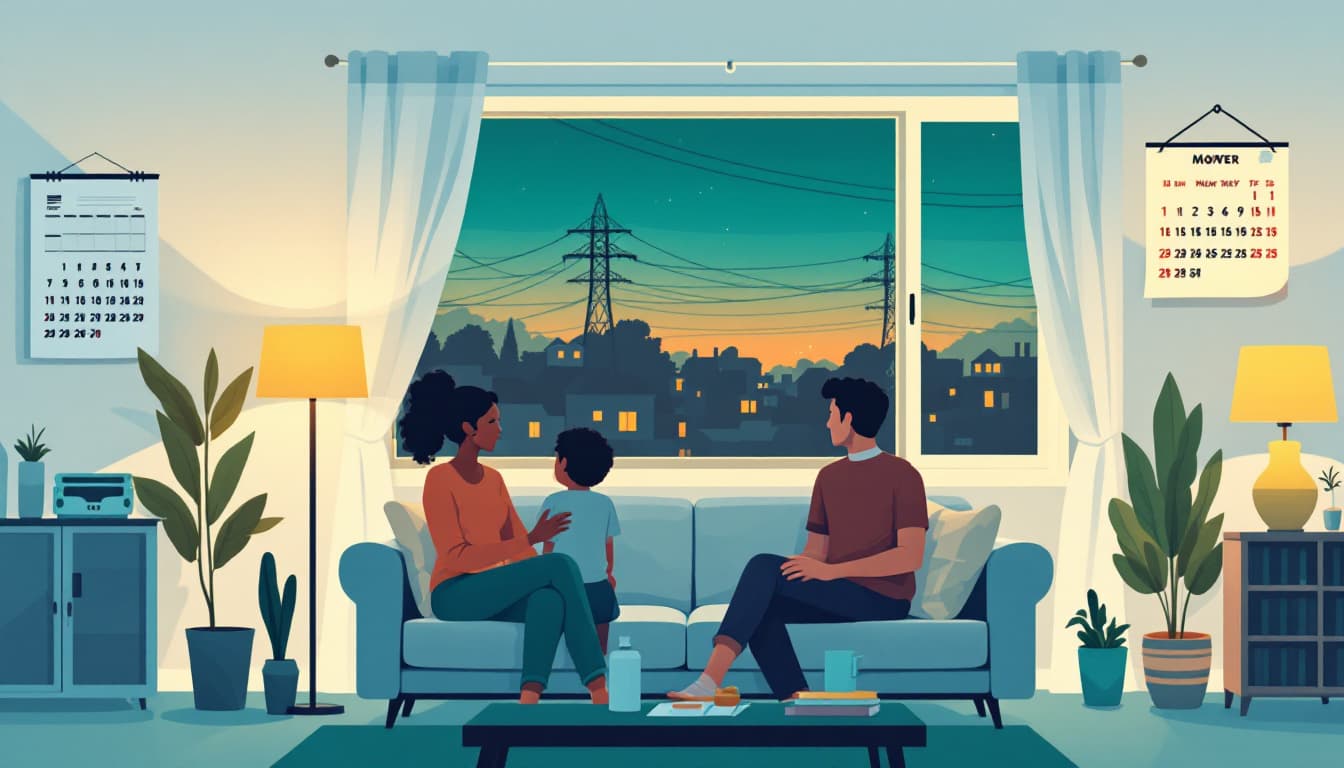
None of this means grid resilience is a non-issue. The boring version of grid risk — a four-day outage during a winter storm, a week without power after a derecho — is worth preparing for seriously. A household that can comfortably manage 72 hours without grid power, and somewhat uncomfortably manage a week, is well-positioned for the realistic threat distribution.
That means a different set of priorities than the doomsday scenario implies. It means a modest battery backup or generator sized for a refrigerator, a few lights, and phone charging — not a whole-home propane system. It means knowing where your circuit breakers are and having a manual can opener. It means a realistic food and water buffer, which our water and food calculator can help you size for your actual household without over-engineering it.
The difference between a 72-hour buffer and a 72-week bunker is not just cost. It's the difference between preparation calibrated to the actual risk landscape and preparation calibrated to content designed to frighten you into buying more.
The grid will fail your household again, almost certainly in a limited, recoverable way, during a storm or a heat wave or an equipment fault. The version that ends civilization is a thought experiment. Preparing for the former with the resources you'd spend on the latter is the clearer-eyed choice — and, in most cases, the cheaper one.