On the morning of July 4 this year, parts of the Texas Hill Country were still drying out from flash flooding while an Air Quality Index reading above 150 — "unhealthy" by EPA standards — hung over the Dallas–Fort Worth metroplex from Canadian wildfire smoke. The temperature that afternoon cracked 105°F in Austin. These were not three separate weather events. They were one week.
A report this week from The Cool Down framed this pattern as the United States settling into a "new abnormal," with Texas explicitly named as a place where multiple extreme-weather threads are converging. That framing is accurate and worth taking seriously — not because the sky is falling, but because most household emergency plans are structured around a single hazard.
What's actually changing
The problem isn't that Texas has floods, or that Texas has heat, or that smoke drifts south from Canadian fire seasons. The problem is the overlap.
Flood events in Central and South Texas are arriving faster than the state's drainage infrastructure was built to handle. The Hill Country's geology — thin soil over limestone karst — funnels rainfall into creeks at speeds that can go from dry to deadly in under an hour. This is not new, but the frequency of high-rainfall events is trending up, according to recent NOAA climate normals updates.
Canadian wildfire smoke reaching Texas is a newer wrinkle. It wasn't a regular feature of Texas summers a decade ago. It is now, typically arriving in May through July when upper-level wind patterns drive smoke plumes southeast. That smoke degrades outdoor air quality across the entire state — not just in fire-adjacent western Texas, but in Houston, San Antonio, and Lubbock.
Record heat compounds both. When an air quality event forces windows shut and people indoors, the cooling load on a grid already stressed by 105°F days becomes severe. When flooding hits during a heat wave, evacuation routes close at the exact moment staying home becomes medically dangerous for people without reliable AC.
The households most exposed aren't necessarily the ones in floodplains. They're the ones that have planned for one of these problems but not the intersection of all three.
What we'd actually do
Get a physical flood-risk number for your specific address, not your zip code. The FEMA Flood Map Service Center (msc.fema.gov) lets you pull a flood zone designation by address. Texas also maintains its own flood planning maps through the Texas Water Development Board. If your address sits in Zone AE or X with a shaded notation, that's a data point. If you rent, your landlord may not have shared it.
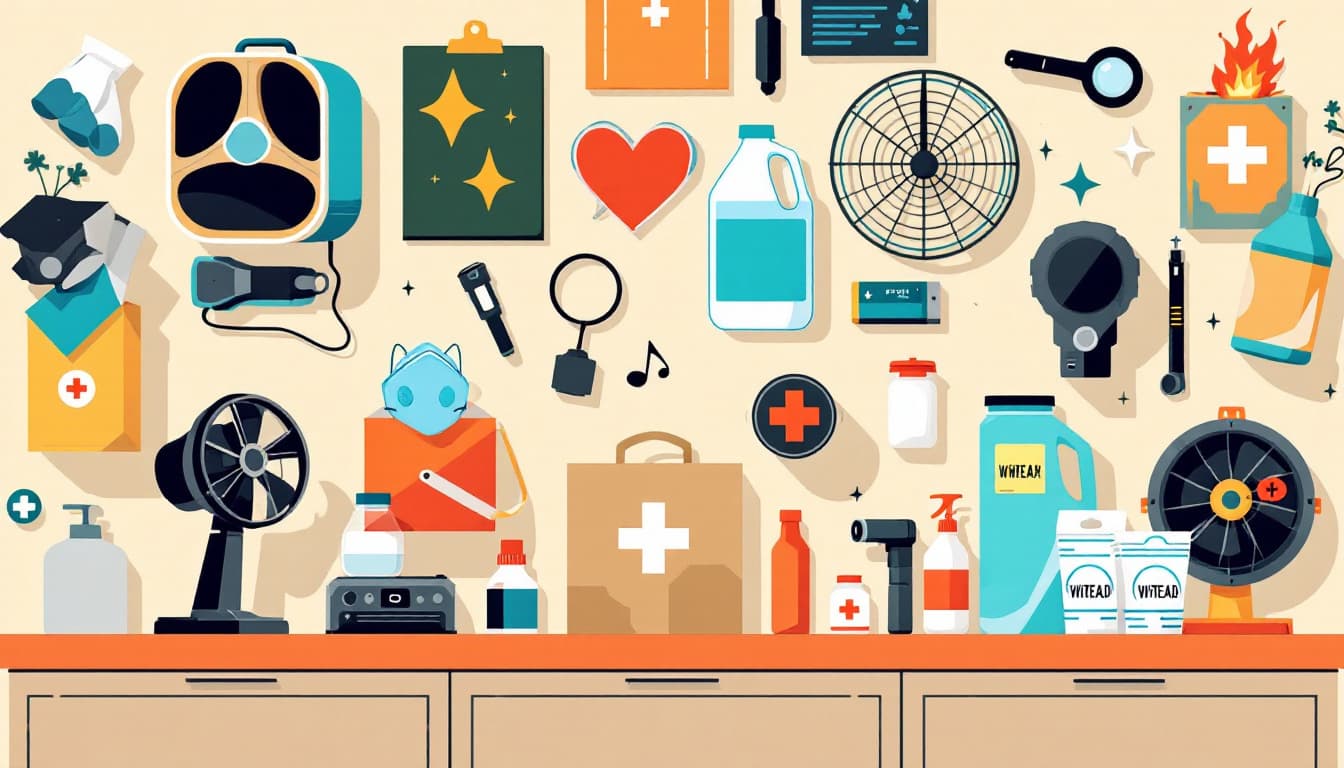
Stock a 72-hour indoor air kit before smoke season peaks. A single box of N95 respirators (not cloth masks), one or two box fans rated for filter attachment, and a supply of MERV-13 furnace filters cut to fit over fan intakes can hold indoor PM2.5 below harmful levels when outside AQI is 150+. The total cost is under $60. Keep it in one place. Texas smoke events can arrive with less than 24 hours of forecast warning.
Separate your "shelter in place" supplies from your "go bag." Most prepper checklists conflate these. A heat-plus-flood event in Texas may require you to go — quickly, in a car, with a route chosen before water rises. A smoke event requires you to stay, seal gaps, and run filtered air. These kits have almost no overlap. A go bag needs fuel, cash, medication, and documents. A shelter kit needs air filtration, extra water, and a battery backup for a window AC or fan.
Write down two evacuation routes from your home, including one that doesn't use an underpass. Low-water crossings and highway underpasses kill people in Texas floods every year because drivers misjudge depth. TxDOT's DriveTexas.org shows real-time road closures; the Texas Division of Emergency Management posts county-level alerts. Pre-selecting routes is a 20-minute exercise that costs nothing and works better under stress than improvising.
Put a battery-powered or hand-crank weather radio in your house. Smoke and flash flood events both develop faster than a phone notification pipeline can reliably capture. A NOAA weather radio with SAME county alerting wakes you up when your county specifically is under warning, not a general region.
The bigger picture
The goal here isn't to build a bunker or assume the worst. The goal is to stop treating each summer hazard as a one-off and start treating the overlapping version as the baseline. Texas has always had hard summers. The change is that hard things are arriving in combinations that older emergency frameworks didn't plan for.
A household that's done these five things hasn't transformed into a survivalist compound. It's become slightly more durable than it was. That's the entire project.