Walk the canned-goods aisle at any major chain this summer and you'll notice the store-brand section has quietly doubled in width. That's not a coincidence or a local quirk. A Reuters report this month documents what the data has been signaling for two years: U.S. private-label products have seized a historic share of grocery sales, driven by shoppers who absorbed three years of food inflation and simply stopped coming back to the name brands when prices eased.
What's actually changing
The private-label surge is real, but it's not uniform — and that distinction matters for household food planning.
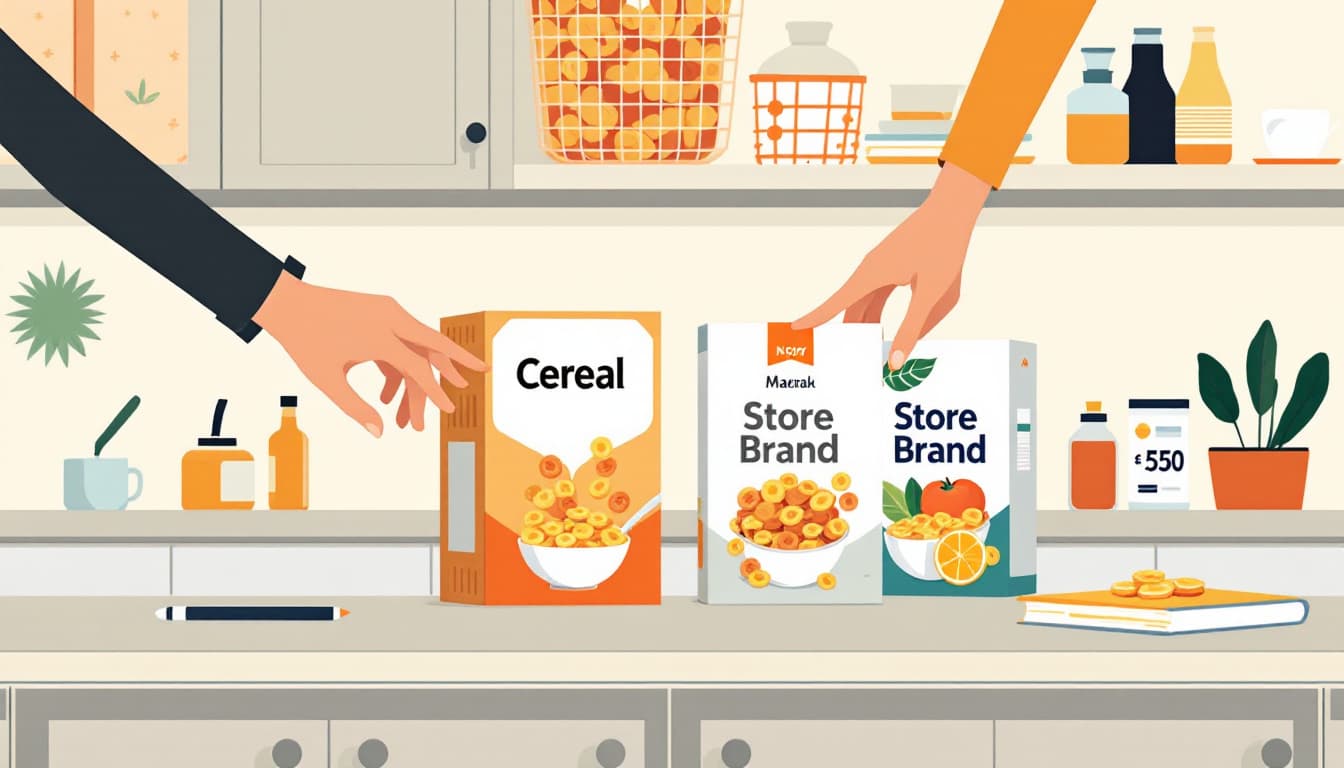
In shelf-stable staples (pasta, canned beans, cooking oil, canned tomatoes), store brands have been price-competitive for decades. What's new is the expansion into previously name-brand-dominant categories: infant formula analogs, over-the-counter medications, refrigerated proteins, and even premium olive oil. Retailers from Costco to regional grocery chains have invested in their own production contracts, and some are now manufacturing at the same co-packing facilities as the brands they sit beside.
That co-packing detail matters. For many categories, the only material difference between the national brand and the store label is the wrapper and a 25–40% price gap. For others — particularly products where formulation is proprietary or where a brand has held patents — there are genuine quality and consistency differences. The challenge is that grocery shelves don't tell you which category you're in.
There's a second pattern worth tracking. When retailers expand private-label aggressively, they also quietly narrow SKU variety. Smaller name-brand sizes, regional brands, and specialty items get discontinued to make room. For households that rely on specific formulations for dietary or medical reasons, that shelf consolidation is a real vulnerability.
What we'd actually do
Audit your current rotation for single-source dependencies. If your family relies on a specific store-brand item for nutrition or medical reasons — a particular infant formula, a gluten-free staple, a low-sodium canned product — identify whether that product has only one retailer source. One missed shipment at a regional distribution center can empty those shelves for two to three weeks. A second source (a different chain, a warehouse club, or an online fulfillment option) removes that fragility.
Use the private-label wave to build your pantry buffer cheaply. This is genuinely good news for household resilience. Store-brand canned beans, rice, pasta, cooking oil, and tomato products are now meaningfully cheaper than they were eighteen months ago, relative to income. If you've been putting off a 30-day pantry buffer because of cost, the math has shifted. Buy an extra four cans when you'd normally buy one. Rotate. Don't hoard — buffer.
Test before you stock. This sounds obvious, but the mistake is stocking 12 cans of a store-brand product your household hasn't actually eaten. Buy one. Cook with it. If it works, buy twelve. Taste, texture, and sodium levels vary significantly even within the same product category, and a pantry full of food your family won't eat in a stressful week is not a preparedness win.
Track price floors, not just current prices. When a store brand hits what feels like an all-time low on a staple you use, note the date and unit price. That floor becomes your restock signal. If you see it rise back toward brand-name pricing without a clear supply-cost reason, that's worth noticing — it often means the retailer is testing margin expansion, or a co-packer contract changed.
Don't let the savings evaporate into lifestyle drift. The documented pattern in behavioral economics is that when grocery costs fall, households reallocate the savings to dining out or convenience foods rather than building financial or supply buffers. If private-label switching saves your household $80 a month, decide in advance where that money goes. "Emergency fund" and "pantry buffer" both belong on that list.
The bigger picture
The Reuters report frames this as a consumer value story, which it is. It's also a structural signal about how the American grocery system is reorganizing — fewer brands, more retailer control over the supply chain, and production increasingly concentrated among a smaller number of co-packers. That concentration is more efficient in normal times and more brittle during disruptions.
The goal for a prepared household isn't to predict the next disruption. It's to be boring enough in your supply planning that no single product shortage or retailer decision materially damages your week. The private-label boom gives you a low-cost window to make that boring resilience real. Use it before the margins compress again.