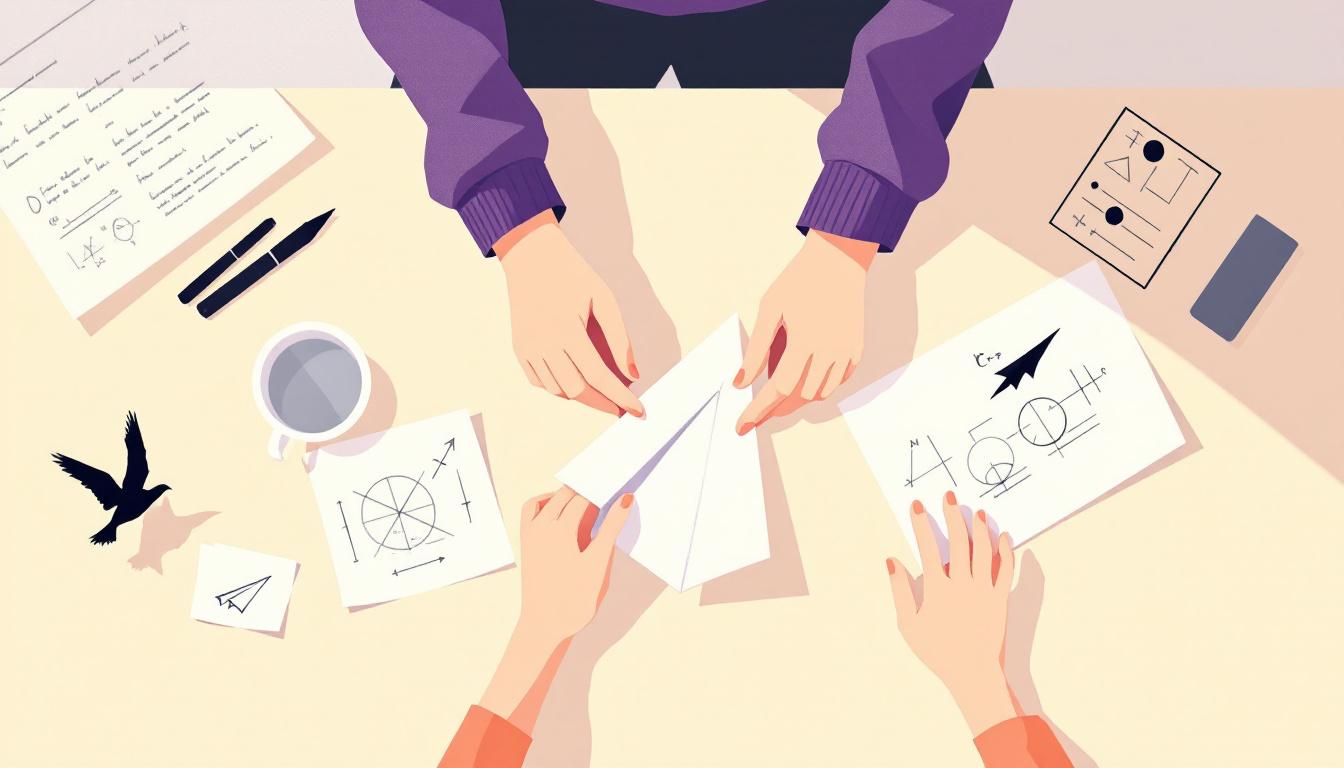
A feature spotlighted this week on Hacker News directs readers to Foldable Flight, a website dedicated to cataloguing and rating paper airplane designs across a range of performance categories — distance, hang time, aerobatic capability, and stability. The site, found at foldableflight.com, organizes dozens of distinct fold patterns with step-by-step instructions and notes on the aerodynamic principles governing each design, including wing loading, center of gravity placement, and dihedral angle effects on roll stability.
The Hacker News thread drew significant community engagement, with commenters noting that the site's explanations of lift-to-drag ratios and stall behavior are grounded in the same fundamental fluid dynamics that govern full-scale aircraft. Several respondents with aerospace backgrounds confirmed that paper models, because of their low Reynolds number flight regime, actually demonstrate certain aerodynamic behaviors — particularly boundary layer separation — in ways that are difficult to illustrate with powered models. The site does not appear to be affiliated with any commercial aviation entity and is maintained as an independent reference.
Paper airplane aerodynamics received formal academic treatment as far back as 1985, when aeronautical engineer Yasuaki Ninomiya published technical fold specifications that were later adapted into competitive distance-record attempts. The current world record for paper airplane distance, set in 2022 at 88.318 meters by Dillon Ruble and Garrett Jensen using a design by John Collins, is documented as a data point on sites like Foldable Flight to illustrate how optimized geometry translates to measurable performance differences.
For preparedness-minded readers, the less obvious relevance here is that paper folding as an aerodynamic teaching tool sits inside a broader category of skills that require no electricity, no connectivity, and no supply chain to practice or transmit. Understanding how physical geometry affects airflow — even at a hobbyist level — is the kind of durable, transferable knowledge that has historically moved well across communication disruptions; during the 1970s paper shortages and again during early COVID-era school closures, parents and educators noted that physical, instruction-free skill sets retained transmission rates that screen-dependent curricula did not. Our low-tech skills and tools coverage has tracked this pattern in other hands-on domains as well.