A piece circulating on Hacker News this week made a blunt argument: open-source AI must win. The framing was ideological, aimed at developers and policy people. But underneath the manifesto language is a structural question that hits every household already using AI tools — who controls the thing you're starting to depend on, and what happens when their business model shifts?
What's actually changing
For most of the past two years, the practical AI tools available to families — writing assistants, medical query tools, budget analyzers, homework helpers — have run on a handful of closed, proprietary models. You interact through an app or website. The company controls the model, the data pipeline, the pricing, and the terms of service. That's not inherently sinister. It's just how software has worked for decades.
What's different now is the speed at which households are building real workflows on top of these tools. Families are using AI to draft insurance dispute letters, summarize school IEP documents, cross-reference medication interactions, and plan evacuation routes. When that capability sits entirely inside a closed commercial product, you have a new kind of dependency — one that can be switched off, paywalled, or quietly degraded overnight.
Open-source models change that calculus. A model you can run locally, or that a community maintains outside a single company's control, behaves more like a utility you own than a subscription you rent. The Hacker News piece is right that the gap between open and closed model capabilities has been narrowing — recent open-weight releases have reached performance levels that were closed-only territory eighteen months ago.
The catch is that "open-source AI" is not a single thing. There's a spectrum from fully open (weights, training data, architecture) to "open-weight" (you can run the model but the training data is proprietary) to "open-ish" (source code released with commercial restrictions). Most households won't care about those distinctions until they do — until a service disappears, a price doubles, or a terms-of-service update removes a feature they relied on.
That's the resilience problem worth thinking about now, before it's urgent.
What we'd actually do
Audit which AI tools your household actually depends on. Spend 20 minutes listing every AI-assisted tool your family uses weekly — not aspirationally, but actually. A short list is more useful than a long one. Note which ones are closed commercial products with no local or open alternative, and which ones could be replaced.
Understanding your real dependency map is the first step. Most families will find two or three tools that matter and a dozen they barely use. The two or three are worth protecting. If your household uses an AI tool to manage a chronic health condition, to support a kid with learning differences, or to maintain a small business, that tool deserves the same contingency thinking you'd apply to any other critical utility.
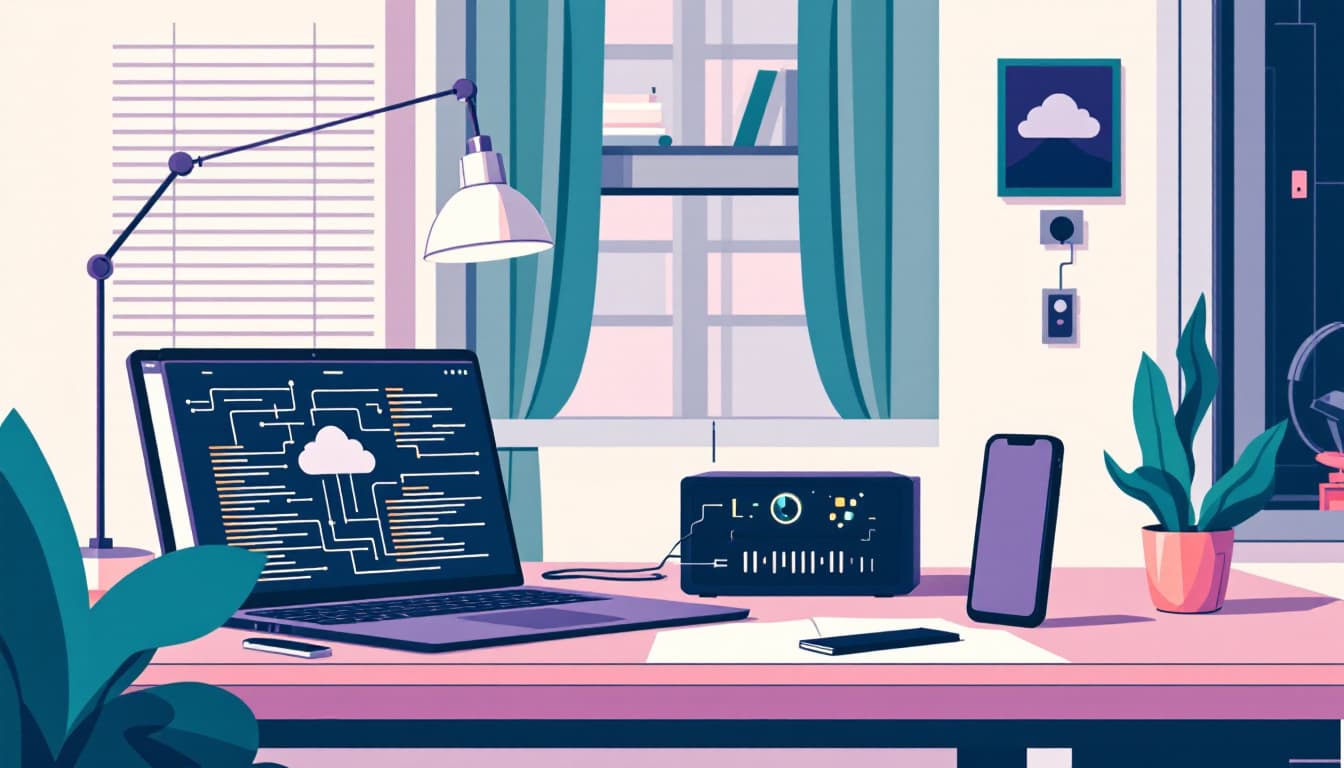
Learn one open-weight model well enough to use it offline. Tools like Ollama have made running a capable local language model on a mid-range laptop genuinely feasible — not for every task, but for text-heavy work like drafting, summarizing, and Q&A. The setup takes an afternoon. The value is a fallback that works without a subscription or an internet connection.
This is not about paranoia. It's about not being helpless if a commercial service has an outage, raises prices sharply, or changes its terms in a way that affects your use case. A local model is slow and less capable than the frontier tools. It is also always available.
Keep non-AI versions of your critical workflows documented. Before you had an AI that could draft your property insurance dispute letter, you wrote it yourself. You still can. For each AI-assisted task your household depends on, write one sentence describing how you'd do it manually. This takes fifteen minutes and makes you dramatically less fragile.
The goal isn't to reject useful tools. It's to make sure you're augmenting your capability rather than outsourcing it entirely.
Follow the open-source model landscape through one reliable technical source. Hacker News, despite its developer-heavy audience, surfaces model release news faster than mainstream tech journalism. You don't need to read it daily. A weekly scan of the top stories takes five minutes and keeps you aware when a new open-weight model shifts what's possible without a subscription.
The bigger picture
The open-source versus closed-AI debate will play out at the policy and industry level over years. Households don't need to pick a side. What they need is not to sleepwalk into a posture where a single commercial decision — a price change, a shutdown, a terms update — suddenly breaks something important.
Durable households have always kept capabilities in-house that the market might otherwise make inconvenient. A garden doesn't mean you distrust grocery stores. A paper copy of your insurance policy doesn't mean you distrust your agent's portal. A local AI model and a documented manual fallback don't mean you distrust the cloud.
They mean you've thought about what you'd do if the cloud had a bad day.