The Piedmont hit triple digits last July. Asheville, which visitors still mentally file under "mountain cool," recorded back-to-back days above 95°F. The Coastal Plain routinely adds ten degrees of heat index on top of whatever the thermometer says. North Carolina is not a mild-summer state, and the gap between "hot day" and "medical emergency" is shorter than most households have planned for.
A report this week from Enlace Latino NC covers heat protection for outdoor and indoor workers — a useful baseline, but it stops at the individual level. For households, the risks stack differently: you're managing kids, elderly relatives, pets, unreliable rental HVAC, and power that may or may not hold when the grid is under peak load. That's the gap worth filling.
What's actually changing
North Carolina's heat season has been lengthening. The NC State Climate Office tracks this; their data shows more consecutive days above 90°F across the Piedmont and Coastal Plain compared to 30-year baselines. That's not alarmism — it's calibration. Longer heat seasons mean more exposure windows, more cumulative physical stress, and more strain on household cooling infrastructure that was sized for shorter summers.
The second shift is economic. Electricity rates in North Carolina have risen, and Duke Energy's tiered pricing means peak-hour AC use in June through September is materially more expensive than it was three years ago. Households that kept their thermostat at 72°F in 2022 and haven't revisited that setting are paying more and may be masking HVAC inefficiency they haven't noticed yet.
Third: indoor heat is underestimated. A house with windows closed and no AC running can reach 90°F indoors within two hours on a 95°F day. Manufactured housing — disproportionately common in rural eastern NC and parts of the foothills — heats faster and holds heat longer than site-built homes. Renters and older homeowners in these situations face the same risks as outdoor workers, just more invisibly.
What we'd actually do
Get a $15 indoor thermometer and put it in your worst room. Most households have no idea what their hottest interior space actually reaches during the day. A basic hygrometer/thermometer from any hardware store will tell you within minutes whether your second floor or back bedroom is hitting dangerous levels. You cannot manage what you don't measure.
Map your household's "cooling floor." Identify right now — not during an emergency — who in your household is most heat-vulnerable and where they'd go if your AC failed for 12 hours. For many NC families this means a specific family member's house, a library branch, or a cooling center. The NC Division of Public Health maintains a list of cooling centers that activates during heat advisories; find your county's location before you need it. This takes fifteen minutes.
Run your HVAC filter check this week, not in August. A clogged filter makes your system work harder, raises your electric bill, and can cause the unit to ice up and fail on the hottest day of the year. A standard 1-inch filter costs under $10 at any Lowe's or Home Depot. If you haven't changed it since spring, change it now.
Pre-cool one room and commit to it. Trying to cool an entire house during a grid-stress event is expensive and often ineffective. Pick the room where the most vulnerable household member sleeps, seal it as well as you can with a towel under the door and curtains drawn, and treat it as your primary cooling space during a heat event. A window unit running in one room is far more reliable than a central system struggling against the whole structure.
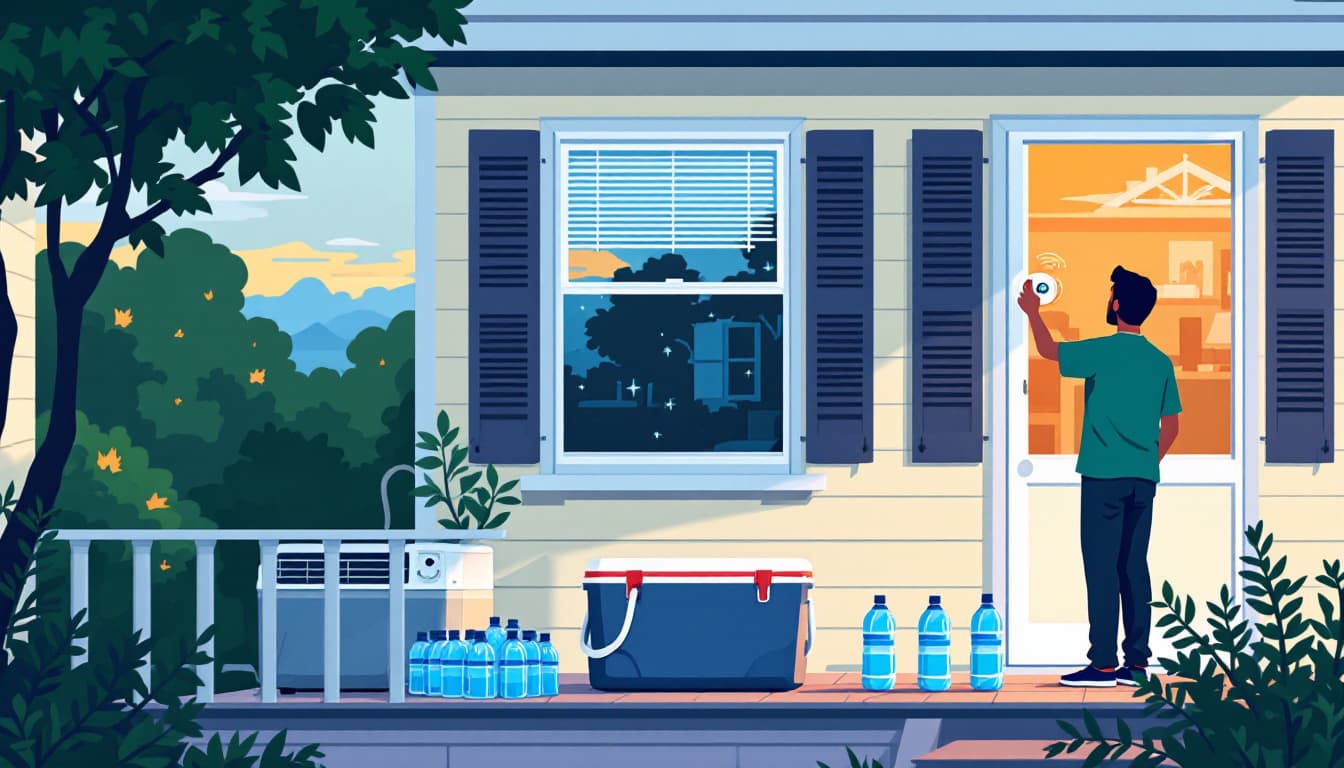
Keep 72 hours of room-temperature water staged, not refrigerated. Water stored in your garage or closet at ambient temperature is immediately drinkable during a power outage — chilled water from a dead fridge is fine for a few hours, then uncertain. One gallon per person per day is the standard guidance. For a family of four, that's twelve gallons. It fits in a single storage bin and costs around $12 at a warehouse store.
The bigger picture
Heat is the deadliest weather hazard in the United States by annual mortality, consistently outpacing hurricanes, tornadoes, and floods. In North Carolina, where hurricanes get the headlines and the preparedness budgets, heat tends to be under-planned at the household level. That's not a reason to panic. It's a reason to spend one afternoon this week closing three or four specific gaps — a thermometer, a filter, a plan for your most vulnerable person — before the first advisory lands.
Durable households aren't the ones with the most gear. They're the ones that already know what they'd do.