A KOLD First Alert Weather Day designation means the station's meteorologists have flagged conditions severe enough to warrant elevated public attention. For southern Arizona this week, that means sustained extreme heat across the Tucson metro, the Santa Cruz Valley, and the lower desert communities stretching toward the border. These aren't anomalies anymore — they're the operating environment.
The question for households isn't whether it's hot. It's whether your home, your systems, and your people can absorb several consecutive days above 110°F without something breaking.
What's actually at stake
Air conditioning failure during a heat event is not a discomfort problem. It becomes a medical emergency within hours for elderly residents, young children, and anyone on medications that affect thermoregulation — a list that includes many common blood pressure and psychiatric drugs.
The grid risk is real but often misframed. Arizona's major utilities have invested heavily in demand-response infrastructure, and large-scale outages during heat events are less common than the panic coverage suggests. The more frequent failure mode is localized: a transformer in your neighborhood, a breaker in your panel, or your own AC unit running past its design limits. Recent APS and TEP service data both show that most heat-season outages affect fewer than a few thousand customers at a time, resolve within hours, and are concentrated in older residential infrastructure.
Your AC unit is the one system that matters most. Units running at full capacity for 72-plus hours will reveal any deferred maintenance. Refrigerant levels drop, capacitors fail, and air filters that were "fine" in March become a real restriction on airflow. An HVAC technician costs money in June. A unit that seizes at 4 p.m. on a Saturday costs more — in dollars and in risk.
The second underappreciated risk is water. Municipal water pressure in Arizona communities can drop during peak demand days as irrigation, cooling towers, and residential use spike simultaneously. If your emergency water supply is "the tap," that assumption deserves a second look.
What we'd actually do
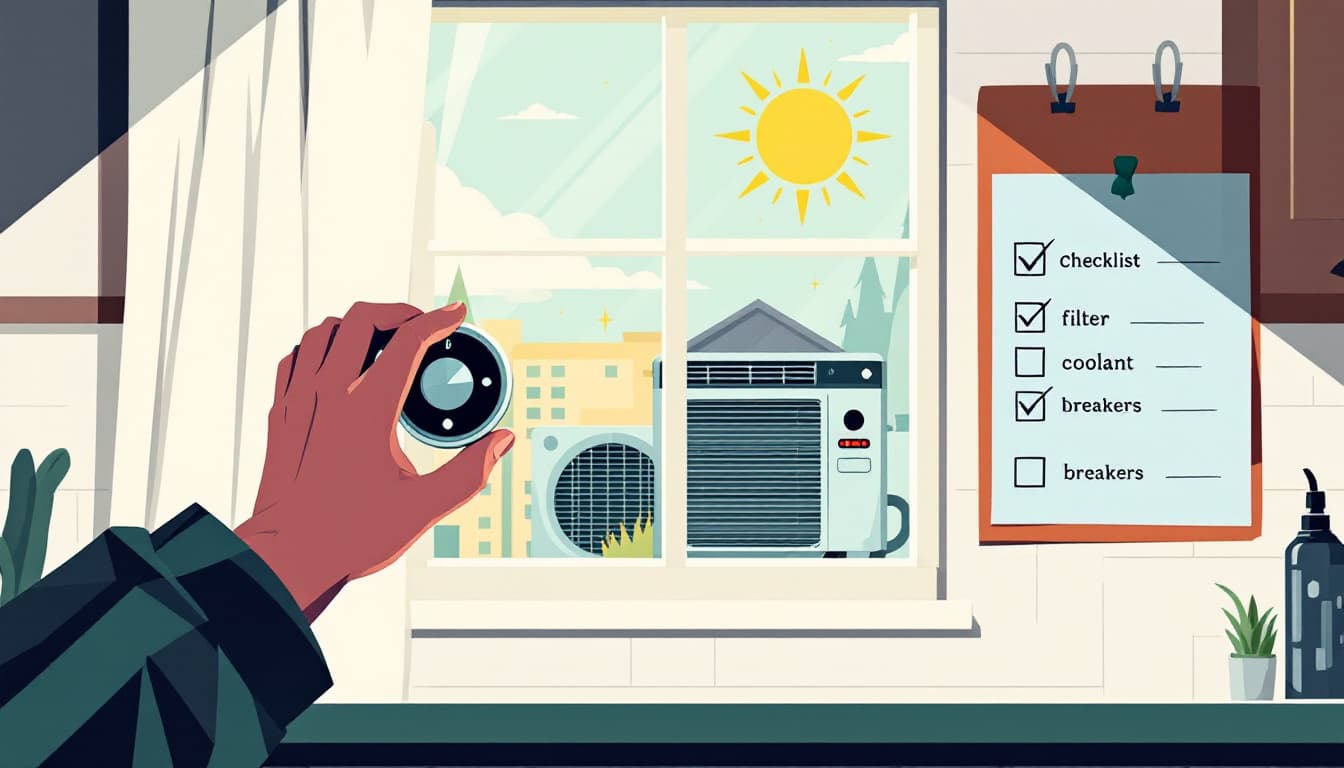
Get your AC serviced if you haven't this season — or at minimum, replace the filter and clean the exterior condenser coils yourself today. A clogged filter forces the blower motor to work harder, reduces cooling capacity, and can cause the evaporator coil to ice over and shut the system down. A clean condenser coil (a gentle hose-down, power off first) allows the refrigerant to release heat efficiently. Neither task requires a technician. If your unit is more than 12 years old and hasn't been inspected this year, call now — not when it fails.
Identify your nearest publicly operated cooling center before you need one. Pima County and Maricopa County both operate cooling center networks that expand during declared heat emergencies. The Arizona Department of Emergency and Military Affairs (DEMA) maintains a state-level resource directory. Write down two locations. This matters most if you have household members who can't self-regulate well in heat or if your AC fails during a weekend when HVAC companies are booking days out.
Store a minimum of one gallon of water per person per day for three days — and actually check it. The three-day figure is the floor, not the goal. For an Arizona summer, where physical activity and heat exposure drive consumption well above normal, 1.5 to 2 gallons per person per day is more realistic. Stored water in plastic containers degrades in quality over time; rotate it every six months. If your stored water is in a hot garage in an unlabeled two-liter bottle from two years ago, it's time to restart.
Audit your medication storage. Many common prescriptions have narrow temperature ranges — typically below 77°F or 86°F — and a home that reaches 90°F inside during a power outage will compromise them within hours. Know which of your household's medications are heat-sensitive. Keep a small cooler and ice packs accessible, and have a plan: a neighbor with power, a pharmacy, a hotel for one night.
Install a battery-powered or USB-rechargeable box fan and know where it is. Evaporative cooling works in Arizona's pre-monsoon dry heat in a way it won't once July humidity arrives. A box fan drawing air through a wet towel hung in a window can drop a room's effective temperature meaningfully for a few hours — enough to protect vulnerable household members while you arrange alternatives. This is a $30 solution that belongs in every Arizona home.
The bigger picture
Heat preparation is the least glamorous corner of emergency readiness. There's no dramatic gear to buy, no scenario to tactically plan around. It's maintenance schedules, stored water, and knowing your neighbors. But in southern Arizona, where the Sonoran Desert sets the terms and summer arrives without negotiation, heat is the most statistically likely emergency your household will face. Durability here means boring competence: systems that work, supplies that exist, and plans that don't require a perfect outcome.
The goal isn't to survive the apocalypse. It's to get through a bad week without it becoming a crisis.