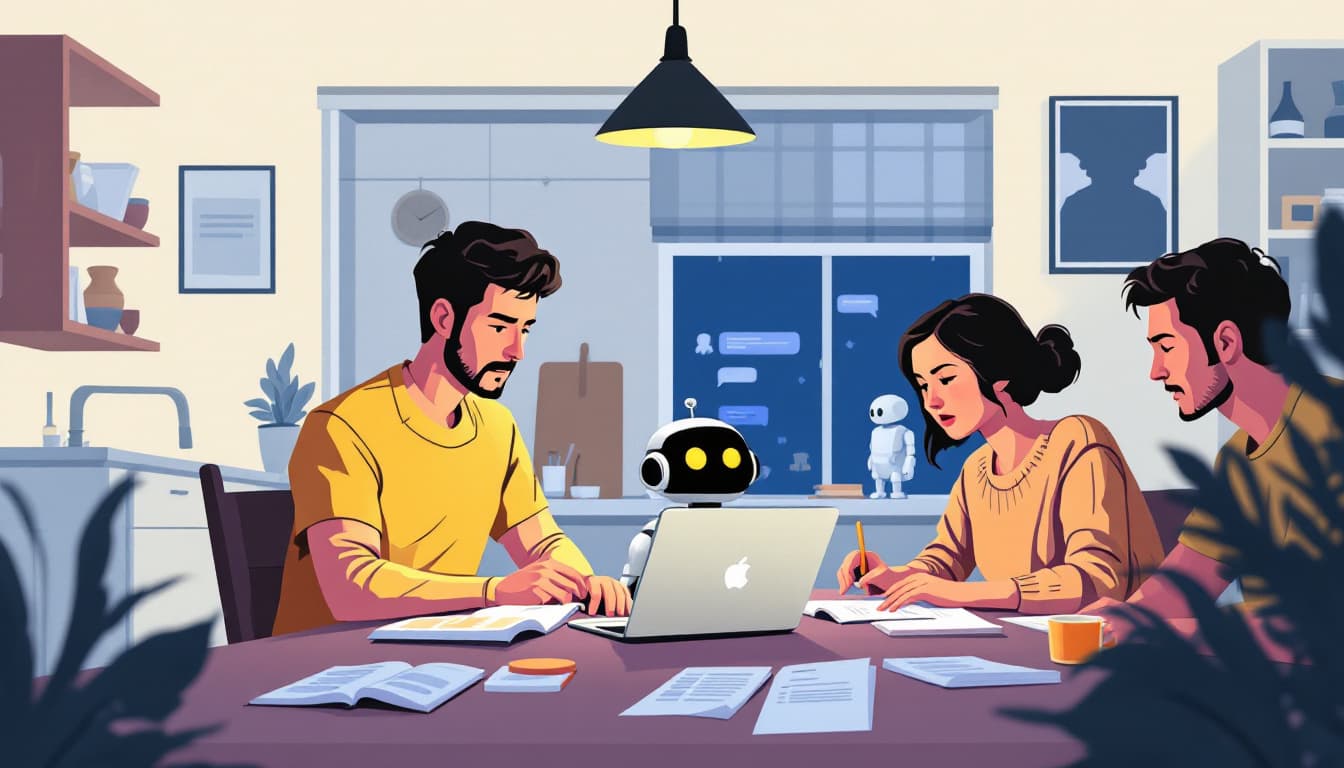
A lawsuit filed this week between two of the largest AI companies in the world is being covered as a corporate drama. It's worth treating it as a systems check instead.
9to5Mac reported this week that Apple sued OpenAI, alleging that former Apple employees took proprietary trade secrets with them when they moved to the competing AI company. The legal details will unfold over months or years. But the shape of the event — a sudden, high-stakes rupture between a hardware ecosystem and an AI model provider — is the thing households should be paying attention to.
What's actually shifting
The Apple-OpenAI partnership has been one of the most visible AI integrations in consumer technology. Apple Intelligence features are baked into the operating systems running on devices a large share of families use for banking, communication, medical records, and school. When the companies behind those integrations are in active litigation, the continuity of those features becomes genuinely uncertain.
This isn't speculation about catastrophe. It's an observation about dependency. Litigation can freeze integration agreements, trigger renegotiation, or accelerate the removal of features that users have come to treat as infrastructure. We've seen this before: when business relationships between platform companies collapse, users absorb the disruption without warning.
The deeper pattern is that AI capabilities are now embedded inside everyday tools faster than most households have time to audit. A family using AI-assisted writing in a shared document tool, AI summarization in a note-taking app, or AI-powered features in a health tracker may not know which underlying model is powering those features, who trained it on what data, or what happens to those features if the licensing relationship between companies breaks down.
Trade secret cases also tend to surface uncomfortable questions about data handling during model training. That's not a settled area legally or technically, and the Apple suit adds to a growing body of litigation that will eventually clarify — or at least constrain — how AI companies acquire and use the information that trains their models.
What we'd actually do
Audit which of your family's core tools have AI features switched on by default. Go through the apps your household uses for finances, health, communication, and children's schoolwork. Most have added AI capabilities in the last 18 months with minimal announcement. For each one, note what data it accesses and whether AI processing can be turned off. This is a 30-minute exercise, not a weekend project.
Identify one offline or non-AI-dependent alternative for each critical function. If your household uses an AI-assisted budgeting app as its primary financial tool, know which spreadsheet or paper ledger you'd fall back to if the app changed materially. The goal isn't to abandon useful tools — it's to avoid single-point-of-failure dependency on any one platform's continued operation.
Review your device's AI data-sharing settings at the OS level. Both major mobile operating systems now have settings that control whether on-device AI features send data to cloud servers for processing or model improvement. On iOS, this sits under Settings → Privacy & Security → Apple Intelligence. On Android, it varies by manufacturer. Tightening these settings doesn't break functionality — it reduces the surface area of what gets shared during exactly the kind of corporate disputes that produce trade secret litigation.
Don't assume that a feature present today will be present in six months. AI integrations between companies are governed by contracts, not permanence. When you build a household workflow around a specific AI feature, document what that workflow is and what manual steps it replaces. That documentation becomes your recovery plan if the feature disappears.
The bigger picture
Corporate AI litigation isn't background noise. It's the legal infrastructure of a technology transition that is moving faster than households, regulators, or courts can track. The Apple-OpenAI dispute is one data point in a pattern that includes model copyright cases, data provenance disputes, and employee mobility conflicts across the industry.
A durable household doesn't need to follow each case. It needs to maintain enough distance from deep dependency on any single AI-powered system that a feature change, a lawsuit, or a partnership collapse doesn't disrupt how the family manages money, health, or communication.
That's the same principle that applies to any supply chain: the risk isn't in the disruption itself, it's in having no path around it.