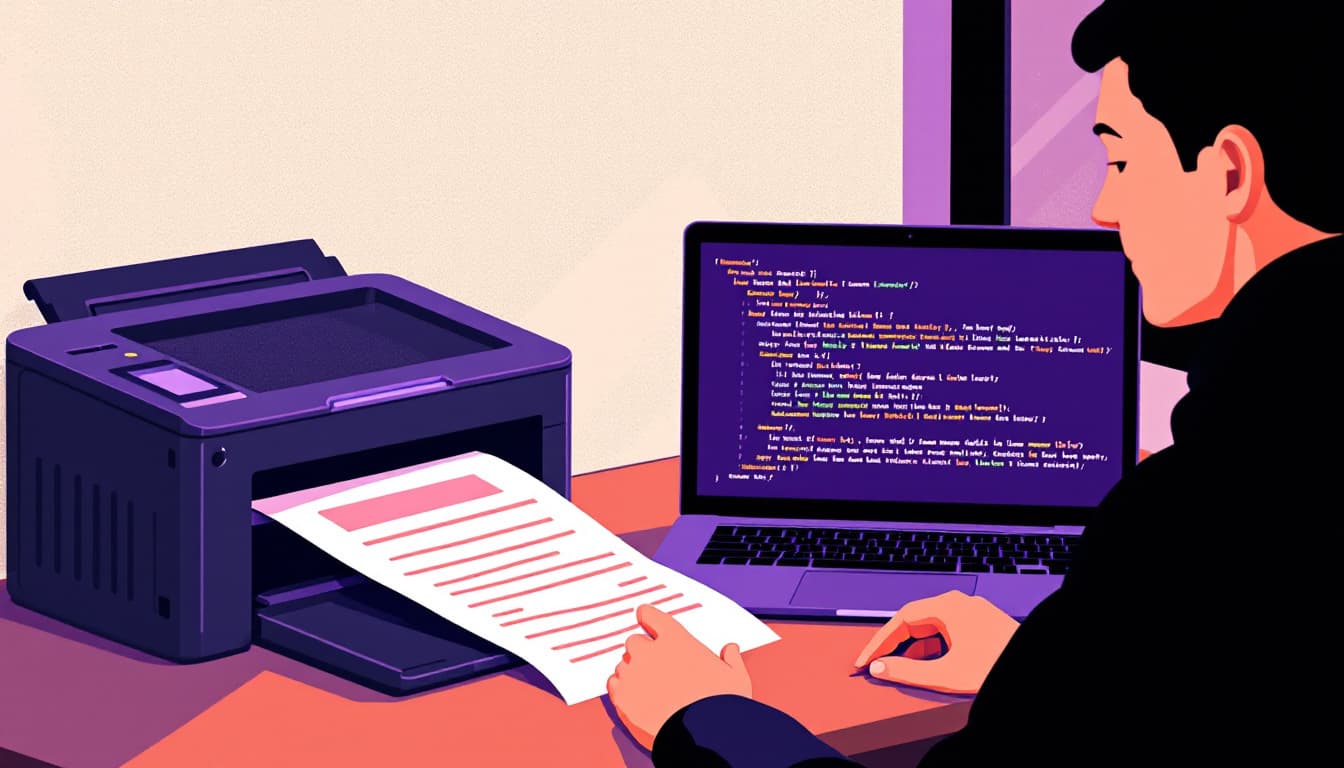
A post circulating on Hacker News this week documented a developer — operating under the handle @kuberwastaken on Twitter/X — successfully using Anthropic's Claude to write a working macOS printer driver from scratch for an HP model that shipped with Windows-only support. The printer in question had no official macOS driver, no community-maintained open-source alternative, and was effectively a paperweight on any Apple hardware. After feeding Claude the available Windows driver documentation and hardware specifications, the developer received functional driver code that allowed the printer to communicate correctly with macOS and produce actual printed output.
The significance here isn't novelty — people have experimented with AI-generated code for years — but specificity. Printer drivers are notoriously low-level, requiring correct handling of proprietary communication protocols, print queuing systems, and operating system kernel interfaces. They are exactly the kind of narrow, unglamorous software that manufacturers quietly abandon when a product line ages out or a platform isn't worth the engineering hours. The fact that a general-purpose language model produced something operational, rather than plausible-looking but broken code, marks a meaningful capability threshold.
For readers who maintain older equipment as part of a preparedness posture, this result carries a dimension that general tech coverage won't flag. A substantial portion of the hardware stockpiled in preparedness contexts — label printers, older laser printers purchased for reliability, specialized scanners, legacy networking gear — exists in exactly this driver dead zone: functional hardware with no path to modern operating systems because the manufacturer stopped caring. The traditional remedies have been keeping an aging Windows XP or Windows 7 machine running solely to operate that one device, or accepting that the equipment is stranded. The emerging picture from experiments like this one is that AI systems may now be capable enough to resurrect that stranded hardware on demand, provided someone can supply the technical documentation. That changes the calculus on what "durable" means for a piece of equipment — a printer without a macOS driver today is not necessarily a printer without a macOS driver next year.
No formal benchmark or independent replication of the specific driver was published alongside the original post, and one developer's successful result with one printer model is not a guarantee the approach generalizes cleanly to every orphaned device. The Hacker News discussion thread noted both skepticism about edge-case print fidelity and genuine interest from others who have similar stranded-hardware problems. Anthropic has not commented on the result.